Friday, May 11, 2018

Spring Garden Tours


These past few weeks Tim and I have had the good fortune to be in the right place at the right time to see spring burst on the scene.  


From the Italian and Japanese gardens at Maymount in Richmond to the District of Columbia's Arboretum and Hillwood Mansion, we've had a front row seat for viewing the showy blossoms of azaleas, tulips and daffodils that herald the arrival of warmer weather.


Yet, those were only the opening acts before nature's star performance at Longwood Gardens near Philadelphia, Pennsylvania.

Last Thursday we set up housekeeping at a KOA campground 20 miles south of Philadelphia, the closest campground we could find to the city.  Our daughter Jillian lives and works in the City Center of Philly so while she's busy at work, I thumbed through my well-worn copy of 1,000 Places To See in the United States and Canada Before You Die to see what attractions might be near us.  There I read about Longwood Gardens and determined to pay a visit.


Tim wasn't so sure he wanted to go on a garden tour.  That sounded a little too old lady-ish for him, but I appealed to his better nature, pointing out that this would be an opportunity for him to log some miles on the Fitbit he received as a Christmas gift from our children.


Even as we drove into the parking lot, I was holding my breath that he wouldn't just drop me at the entrance and do a disappearing act.  But even he was impressed by Longwood's grand performance.  And so he should be!

Longwood's Greenhouses

To quote my guidebook, "Longwood is one of the world's finest horticultural displays, with 20 outdoor gardens, 20 greenhouse gardens, four lakes, many acres of forest, and 11,000 different types of plants spread out over 1,050 acres."


Let me just add that the 245,000 flowering spring bulbs we saw in full bloom gave a stellar performance as they painted the landscape with their glorious colors.

The Pierce-Du Pont House

Of course, this garden did not happen overnight.  Its history stretches back 300 years to 1700 when Quaker farmer George Pierce purchased 402 acres from William Penn's landholdings.  A hundred years later, his great-grandsons had the grand idea of turning the farm into a pleasure garden that they could open to the public.  To that end, they purchased exotic plants and trees that with their care took hold and flourished.  But even they could not have imagined the garden as it is today.


By the time the 20th century arrived, Pierce heirs had lost interest in the farm and put it up for sale.  The buyer intended to cut down the trees and clear the land for development.


That's when Pierre S. du Pont of the DuPont chemicals empire stepped onto the stage.  An avocational landscaper, he bought up the land and added more acreage all the while envisioning a garden that would rival those he'd seen in his travels abroad.


To further gild the lily, Du Pont added more than 1,700 fountain jets and streams to the gardens, fountains that spin and dance to music as well as soar as high as 175 feet.  Du Pont credited a childhood trip to 1876 Centennial Exposition in Philadelphia with his lifelong fascination with fountains.  It was there that he was mesmerized by the huge display of water pumps he saw.


Tim and I were certainly impressed.  We arrived in time to witness the water spouts of the Open Air Theatre shooting water into the air in a choreographed show that rivaled that of the Bellagio Hotel in Las Vegas.

With the death of his wife Alice in 1944 and having no children of his own, Du Pont opened Longwood to the public.  Today the garden welcomes not only visitors from around the world but schoolchildren in its education programs and graduate students pursuing master's degrees in public garden management.


Truly the gardens put on a spectacular show, the most sublime I've ever seen and Tim can back me up on that.


Wednesday, May 9, 2018

An Abundance of Riches


When my friend Julie emailed me to say she would be in Washington, D.C. the same week as Tim and I, we made plans for a girls' day out.


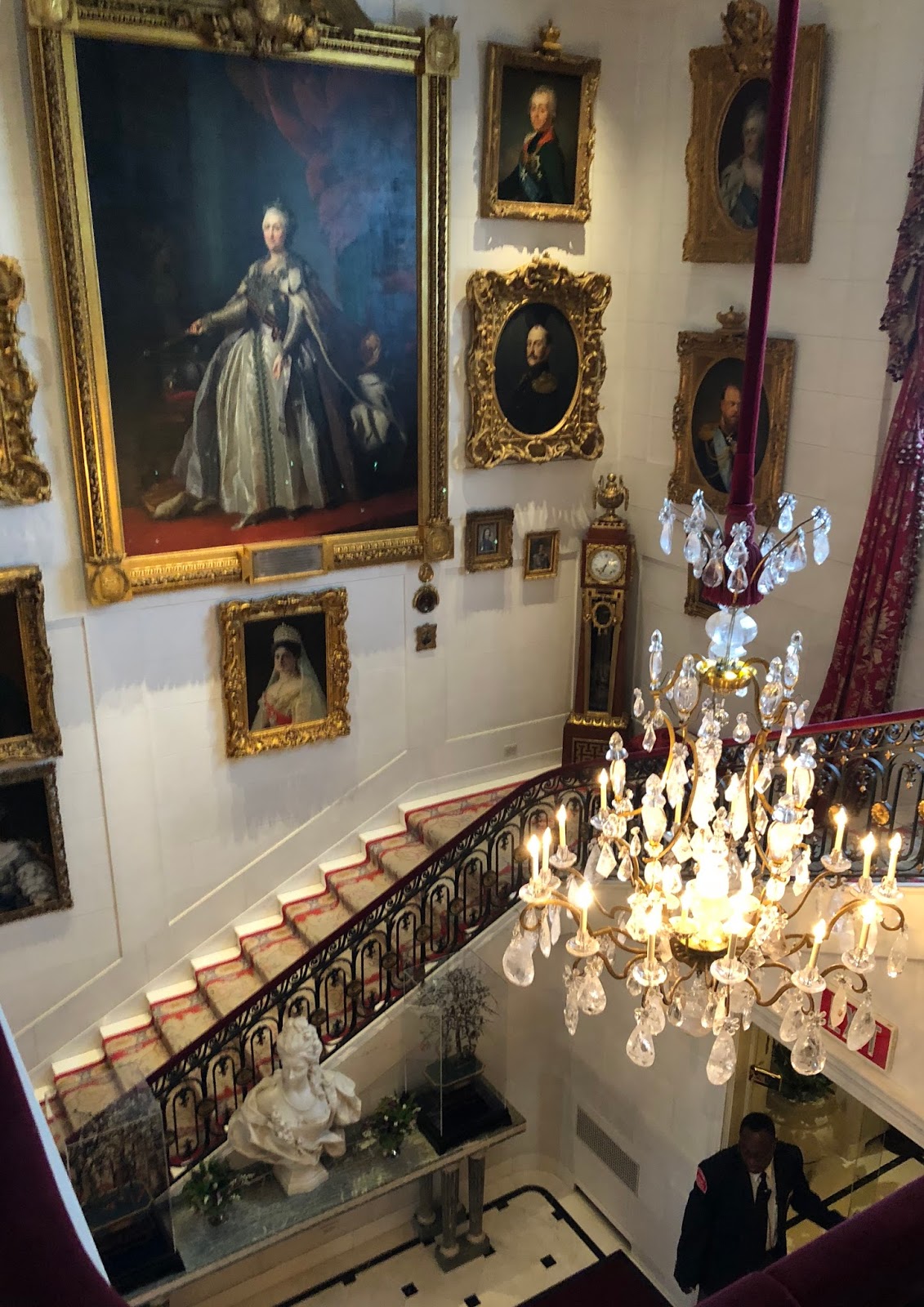
Foregoing the sights most tourists see down on the Mall, we paid a call at Hillwood Museum and Gardens, one of the homes of Washington socialite Marjorie Merriweather Post.  Too bad we could not also plan a stay at her winter residence in Florida, Mar-a-Lago, which is now owned by President Trump.  Maybe next time, Julie!


Marjorie Merriweather Post was the only child and daughter of C.W. and Ella Post.  In 1914, when her father died, she at age 27 inherited Postum Cereal Company and through her business acumen, spun the company into the General Foods empire.


She became the richest woman in the United States with a fortune worth $250 million.

Married and divorced four times, notably to financier E. F. Hutton with whom she had one daughter, the actress Dina Merrill; and later to Joseph E. Davies, a Washington D.C. lawyer picked by President Franklin Roosevelt to be the U. S. Ambassador to the Soviet Union, Marjorie developed a discerning eye for art.

Marie Antoinette's swivel hairdressing chair, diamond-encrusted Fabrege eggs and jewelry, a chalice once owned by Catherine the Great, silver tea set and French porcelain. 

She accompanied Davies to the Soviet Union in 1937 and for the 18 months they were there, she rescued treasures by purchasing jewels and art that the Soviet government had seized from the church, the imperial family and the aristocracy.


These, along with her collections of French porcelain and furniture, she showcased in Hillwood, the home where she entertained the power brokers of Washington, D.C. and later turned into a museum.


"When I began [collecting] I did it for the joy of it, and it was only as the collection grew and such interest was evidenced by others that I came to the realization that the collection should belong to the country." ~ Marjorie Merriweather Post


Julie and I took the house tour and then wandered through the gardens riotous with spring blossoms.


Tulips, azeleas and redbud trees painted the grounds with vibrant colors.


The orchids that Marjorie loved dazzled us in the greenhouse.


Riches were everywhere the eye looked inside the house and out.  I might not be as wealthy as Marjorie Post, but I, too, am rich--rich in friendships I've made in every season of life.

Julie and I have been friends for more than 30 years, beginning when we played on an intramural soccer team sponsored by First Presbyterian Church in Colorado Springs.  I think our friendship began the way C. S. Lewis describes it:  "Friendship is born at that moment when one person says to another, "What!  You too?  I thought I was the only one."  We've had lots of those moments over the years.


Although we've texted and emailed each other, that pales in comparison with the chance to spend time face-to-face.  She inspires me with her deep faith and challenges me to live my life in greater devotion to God.  Looking at the worldly riches of Marjorie Merriweather Post, we were reminded of Christ's words in Luke 12:15, "Be on your guard against all kinds of greed for one's life does not consist in the abundance of his possessions."


True happiness is not found in possessions but in pursuit of the abundant life promised to us by God.  Having a friend who encourages me in that direction makes me rich indeed.


Monday, May 7, 2018

Our Nearest and Dearest In D.C.

Tim and I finally made it to Washington, D.C. just in time for our annual physicals.  So far this visit, we've been peered at, poked, prodded and palpated by our internists, dentist, dermatologist, optician and for me, my audiologist, ophthalmologist, gynecologist and the dreaded mammogram technician.  We've logged 12 doctors' appointments in ten days.  I'm sure our health insurance benefits representative is going crazy trying to keep up with our claims.  But it's been worth it!  We got to spend precious time this weekend with our son and daughter.

Richard lives in D.C. just a few blocks east of the Capitol.  Because he teaches school and coaches extracurricular sports, his free time is practically non-existent so I made sure we claimed a spot on his calendar well in advance for this past weekend when his sister Jillian could join us.


Jillian was transferred to Philadelphia earlier this year.  Like so many other urban dwellers in the northeast, she's selling her car and plans to use public transportation to get around.  Tim and I met her when her bus rolled into D.C.'s Union Station right on time Friday afternoon.


We dropped her bag at her brother's rowhouse and walked over to the National Gallery of Art, stopping to take the requisite snapshot of the Capitol along the way.

Paul Cézanne.  Self Portrait On Rose Background, 1875-1877
Private Collection

There was an exhibition of Paul Cezanne's portraits that we wanted to see, the same exhibition that Melania Trump brought French First Lady Brigette Macron to view just a few days prior to our visit.  The First Ladies had a private tour with the curators of the exhibit.  Our visit found the gallery much more crowded, but still there was room to stop before paintings that captured our attention.

Paul Cézanne.  Boy in a Red Waistcoat, 1888-1890Collection of Mr. and Mrs. Paul Mellon

One of Cezanne's greatest masterpieces is Boy in a Red Waistcoat.  Unlike many artists commissioned to paint portraits of wealthy patrons, Cezanne painted his family, his friends or working class people of his native in Aix-en-Provance.  I'm not certain who this boy was but both Jillian and I agreed that Cezanne captured the angst of an adolescent boy.

Paul Cézanne.  The Artist's Father, Reading "L'Événement", 1866
Collection of Mr. and Mrs. Paul Mellon

One portrait we all liked was the one Cezanne painted of his father.  The painting pokes fun at his father's aspirations for his son whom he'd hoped would become a lawyer--not a painter.  Despite that disappointment, Louis-Auguste Cezanne supported his son financially for years while he experimented with art that found few buyers.  In this portrait of his father, Cezanne shows him reading a journal that was known for its defense of avant-garde art.  Undoubtedly, that was the opposite view of his father who wanted his son to make a decent living painting conventional images popular with the masses.  I could just hear his father saying, "All this is fine, Paul, but it won't pay the bills!"


Saturday after a delicious brunch at a restaurant Richard wanted to try, we wandered through the National Arboretum for a couple hours.  The Arboretum's annual Spring Plant sale was in full swing.  Richard picked up a few pots to set out on his patio.


Then on to the Kennedy Center where we had tickets to the improv production of Shear Madness, a whodunit comedy that's been running there for more than 13,200 performances.  In fact, Tim and I first saw the show back in 1987 when we initially came to D.C.  The insider jokes about D.C.'s politics have changed but the laughs are still plentiful.

Sunday morning church, a leisurely brunch and then it was time to take Jillian back to the station.  I can hardly wait to see her again next weekend in Philadelphia.

Thursday, May 3, 2018

On To Richmond!


St. Paul's Episcopal Church

"On to Richmond" was the battlecry of the Union troops once Petersburg fell.  After our time at Petersburg National Battlefield, Tim and I, too, headed to Richmond, the erstwhile capitol of the Confederacy.

Instead of touring the Civil War battlefields spread around the city, a project that would take several days, we joined a walking tour of the city, but that experience was not one that I'd recommend.  Yet I guess you get what you pay for and since the tour was free with a donation, I have no reason to complain.  At least it was an orientation to Richmond's downtown--


most notably the Capitol of Virginia,


the Confederate White House,


and the home of John Marshall, the 4th Chief Justice of the Supreme Court--even if the tour guide's spiel was less than compelling.

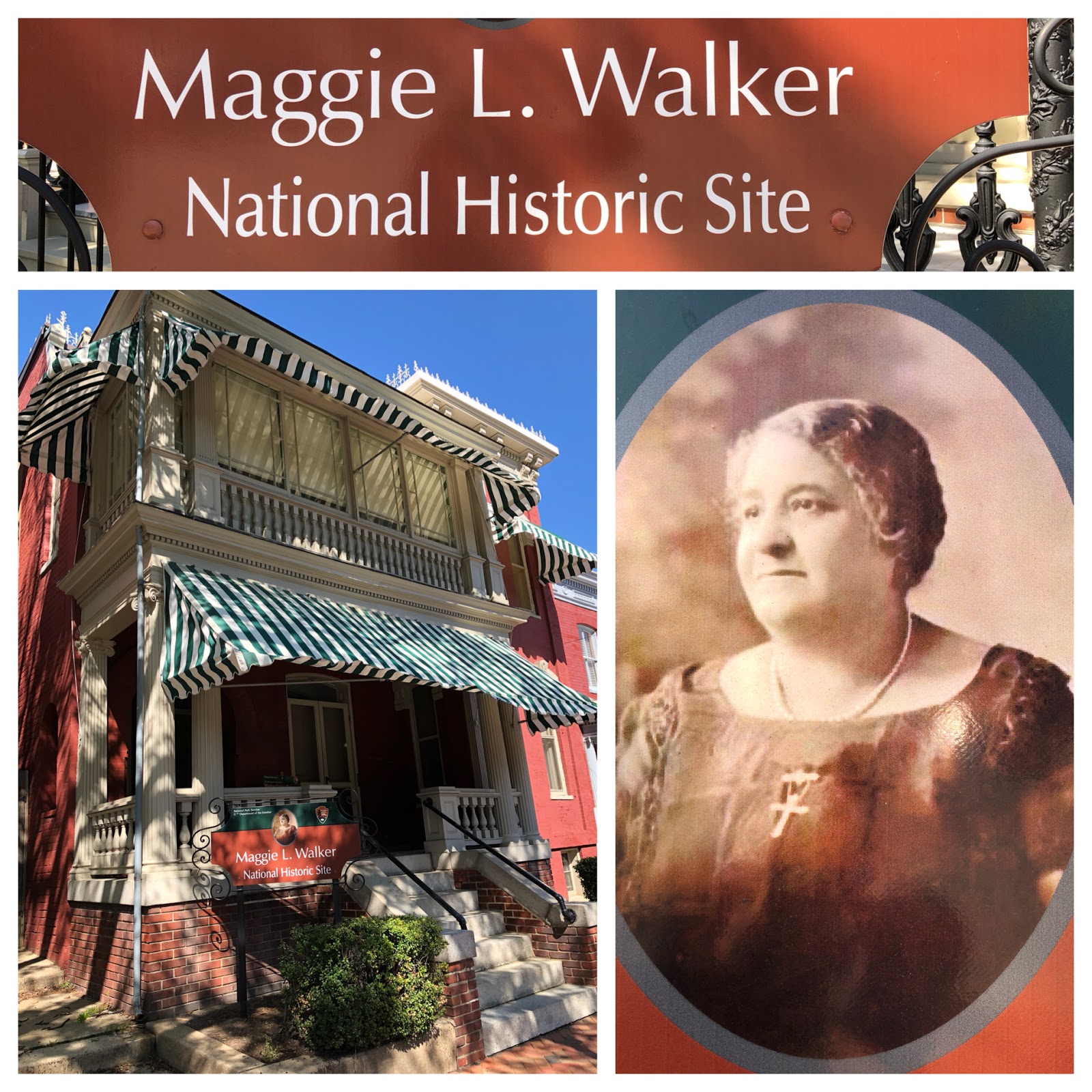
What was spellbinding were our visits to two National Park Service properties, first to Tredegar Iron Works and later to the home of Maggie L. Walker.


At Tredegar Iron Works, we learned why Richmond was worth fighting for.  Tredegar Iron Works on the banks of the James River was the Confederacy's most important foundry, churning out more than half the munitions that fueled the Confederate States Army.  In addition, it made the iron plating for the CSS Virginia, the South's first steam-powered ironclad warship.  Today the Tredegar houses two museums, one supported by the National Park Service and the other the American Civil War Museum.  Due to time constraints, Tim and I chose to visit the one maintained by National Park Service.  After all, I had to get the stamp in my NPS Passport.  We found the visitors center a fascinating look at why Richmond with its manufacturing and transportation infrastructure was such a prize in the Civil War.


Later the same day, we stopped at a very different National Park property, the home of Maggie L. Walker.  Neither Tim nor I had ever heard of Mrs. Walker before and we were astonished by the incredible impact she had on the black neighborhood in Richmond's historic Jackson Ward.  In 1901 she boldly presented her community with an idea for economic empowerment:  "We need a savings bank, chartered, officered, and run by the men and women of the Order...Let us have a bank that will take the nickels and turn them into dollars."  In 1903 St. Luke Penny Savings Bank opened its doors--the first chartered bank in the United States founded by a black woman.

Of course, what caught Tim attention, former law enforcement officer that he is, was the suspicious death of Mrs. Walker's husband who was shot and killed by her son.  Allegedly, the son thought an intruder--not his father--was trying to break into the house.  But that's a little difficult to believe, given that the incident occurred in broad daylight and the fact that Mr. Walker's philandering ways were an embarrassment to the family.  The true story is buried by now but it does make one wonder what really happened.

Left: the hotel lobby
Right: the dome skylight

Friends told us that we ought to partake in a true Southern afternoon tea at the historic Jefferson Hotel.  Regretfully, when we arrived there, we discovered that the tea is only offered Fridays through Sundays--not on a Thursday, the day we were there.  So that's another reason, along with Richmond's battlefields, for us to return to this beautiful city at some future date.


With thoughts of what we'd missed at the hotel's Palm Court, we decided to pay a visit to Maymount, the grand Gilded Age estate that the wealthy owners James and Sallie Dooley willed to the city of Richmond.


There I could imagine Sallie Dooley presiding over her own afternoon tea with her invited guests of Richmond's elite.


I also found it interesting that the childless Dooleys never had to discourage children from crawling into their fanciful Swan bed with them.  Nor did they wrestle with the question of how parents with differing faiths should raise their progeny.


As it was, every Sunday James would have the carriage brought around to deliver Mrs. Dooley to the Episcopal worship service before he continued on to mass at the Catholic church.


Finally, and perhaps fittingly since it was our final stop on our Richmond itinerary, we made a pilgrimage to Hollywood Cemetery.  The cemetery situated on a bluff that overlooks the James River is the final resting place of two U. S. Presidents, James Madison and John Tyler, as well as the Confederate President Jefferson Davis.  Twenty-two Confederate generals including George Pickett and J.E.B. Stuart are also buried there.  We didn't visit them all, preferring to focus on the three presidents.


I thought the gravesite of Jefferson Davis would be the most impressive but on the day we visited, it was surrounded by construction tape as workers repaired the circular drive around it.


Instead, we found Madison's grave nicknamed "The Birdcage" the most impressive with its ornate Gothic Revival style.  It makes my plans to be cremated upon my death with my ashes spread as fertilizer over the east 80-acres of my family's farm seem very stark.  Ah, well!  Hopefully my day is far away!  On to Washington and Philadelphia where we have plans to spend the coming weeks visiting our children.


Tuesday, May 1, 2018

Petersburg Is the Key


"The key to taking Richmond is Petersburg" believed Civil War Union General Ulysses S. Grant.  Consequently, when his more direct forays against the capitol of the Confederacy failed, Grant swung his soldiers east and then south to lightly-defended Petersburg in a masterful move meant to sever the supply line of the rebel army.  It was arguably the one time Grant outmaneuvered the canny Confederate General Robert E. Lee.

The Eppes Plantation at City Point

On our way to Washington, Tim and I devoted a day to seeing how Grant did this.  Having lived in Virginia for more than fifteen years, we've become Civil War buffs.  Something about seeing the sites where major battles played out has given the war an immediacy that has captured our interests.  However, in all the time we lived here, we never made it to Petersburg, that is until now.  So beware!  The rest of this post is a history lesson of what impressed us the most about the siege.


With its proximity to the confluence of the James and the Appomattox rivers, Petersburg was a transportation hub that funneled what war materiels the South still possessed to Lee's ill-equipped rebel soldiers dug in at Richmond.  By the time of the Siege of Petersburg from June 1864 to April 1865, the freight of all but one railroad from the Deep South bound for the Confederate capitol passed through Petersburg.


When I was a child, one of our family vacations was a trip to Durango, Colorado, where my railroad-mad dad made reservations for us to ride the Durango & Silverton Narrow Gauge Railroad.  That ride  sparked my own interest in railroads and made me pay attention to the importance of the railroads at Petersburg.

To sever those rail lines, Grant laid siege to the city and made use of the dormant City Point section of the South Side rail line to build his own railroad to supply his troops.  This ability to build railroads as needed was another way more industrialized North surpassed the South. The railroads of the Confederacy, in keeping with its strict stance on states' rights, were not centrally controlled like those in the North.  To prevent their purchase by rivals, Southern railroad companies would lay track using different gauges, a business practice that proved detrimental to the Confederate war effort.

Plantation of Dr. Richard Eppes where Gen. Grant established his headquarters.

I found it interesting in our visit to Grant's headquarters at City Point that he chose to live in what looked like a shack instead of appropriating the plantation home of Dr. Richard Eppes for his personal quarters after the Eppes family fled to what they supposed was the safety of Petersburg.

Grant's Headquarters on the grounds of the Eppes' Plantation

So Grant built a short line from the wharfs he quickly constructed at City Point, the base for one of the greatest logistical operations of the Civil War.  There more than 100 ships a day dropped supplies of food, ammunition and supplies which were then ferried by rail to the Union Army entrenched on the east side of Petersburg.


Had the Union commanders pressed their advantage upon their arrival at Petersburg, the siege might not have been necessary, but alas they did not.  At 7 p.m. on June 15, 1864, the boom of Union cannons to the east foreshadowed an attack on the Dimmock Line.  Minutes later, the soldiers of the Union 18th Corps broke through the undermanned Confederates and swarmed over Battery 5, a fortified earthworks emplacement for heavy guns.


In the two hours that followed, the Federals captured 1.5 miles of Petersburg's defenses.  Though few Confederates stood between the Federals and the streets of Petersburg, Union Maj. Get. William F. Smith stopped his advance to await reinforcements.  Had he continued his momentum, nine months of tedious, deadly siege could have been avoided.


"We could blow that damn fort out of existence if we could run a mine shaft under it." ~ A private of the 48th Pennsylvania, June 23, 1864.


Spurred by the offhand suggestion of a former coal miner, Lt. Col. Henry Pleasants put his 48th Pennsylvania to digging.  Their objective was to tunnel under the Confederate line and blow up the battery at Elliott's Salient.

Such a plan stirred Tim's memory of his stint in the Army when he was assigned to the Corps of Engineers, the division that performs a variety of construction or demolition tasks under combat conditions.  Naturally, Tim was fascinated to learn that Pleasants' troops secretly proceeded with their plan literally right underneath the noses of the Confederates.


Beginning on June 25, 1864, and continuing for the next month, these Pennsylvania coal miners burrowed a shaft 511 feet into the hillside.  Then they packed four tons of powder into the magazines under the Confederate battery.  At 3:16 a.m. on July 30, Lt. Col. Pleasants lit the fuse and scrambled out of the tunnel.  After a 30 minute wait for the explosion to detonate, Pleasants concluded that the fuse had gone out.  With dawn approaching and at risk of losing the surprise attack, two volunteers, Lt. Jacob Douty and Sgt. Harry Reese, crawled into the tunnel to try lighting the fuse again.  This time it worked.  Two hundred and seventy-eight Confederates died in the explosion that created a crater measuring 170 feet long, 60 feet wide and 30 feet deep.  Two 1,700-pound cannons were hurled completely out of the works.


But instead of pushing through, the first waves of Union attackers simply stood at the Crater, gawking at the incredible scene they'd created and thus allowed the Confederates to regroup.

And so it went, first one side and then the other surged back and forth, but it was just a question of time.  With the arrival of spring, the beleaguered Confederates and the city fell.  Seventy thousand Americans were casualties at Petersburg.  Infection and disease accounted for the greatest number of deaths.

A window at the Eppes Plantation at City Point
By preserving the Petersburg National Battlefield, the National Park Service gave us a window to look back at this important event.  Two weeks later General Robert E. Lee surrendered at Appomattox Court House and the war ended.