Wednesday, July 26, 2017

Olympia National Park


"From the mountains to the prairies to the oceans white with foam, God bless America, my home, sweet home."  Irving Berlin

I doubt that Mr. Berlin would have considered substituting the word rainforests in place of prairies.  That would have messed up his iambic pentameter, not to mention spurned the middle of the country.  But if he had wrote the lyrics that way, he would captured the diversity of Olympic National Park.

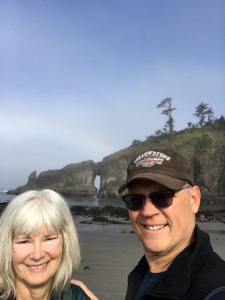
Within its boundaries are rocky coastlines, old-growth rainforests and alpine mountains.  Tim and I observed them all and I have the photos--too many photos, in Tim's opinion--to prove it.  So the following needs editing, but I am reluctant to cut any.  I'll leave it to you to skim through this.

As a postscript, let me say that having two base camps from which to explore the park was key for us.  We camped near Forks, Washington giving us great access to the coast and the rainforest on the west side of the park.  Then, after three days, we moved the Dawntreader to Port Angeles, gateway to the Olympic Mountains.  Otherwise, the distances within the park might have prohibited us from enjoying all three ecosystems.

Now, ready, set...skim!


The Beach


The Rainforest


The Mountains


"God bless America, land that I love."

Sunday, July 23, 2017

Fort Vancouver and Fort Clatsop

This weekend Tim and I added two more stamp cancellations to our National Park Service passport, logging our visits to two historic sites, Fort Vancouver and Fort Clatsop.  They could not be more different.

Fort Vancouver

Fort Vancouver, situated just across the Columbia River from Portland, has a surprisingly--at least to me--long history.  It's a place that has gone through several transformations over time.


First as the Northwest headquarters of the London-based Hudson Bay Company, its mission was to keep peace with the Indians, squeeze Americans out of the fur trade, and firmly establish the British claim to all of Oregon.

John McLoughlin

Therefore, the company was not at all pleased with John McLoughlin, the British chief factor of the fort, who tried to help the trail-weary, needy Oregon settlers with food and supplies.  When in 1846 the influx of Americans resulted in a division of Oregon Territory along the 49th Parallel, McLoughlin retired, moved to Oregon City, Oregon and became an American citizen.  He has since gained the accolade, "Father of Oregon."

Officers Row

Now under American ownership, Fort Vancouver served as a major headquarters west of the Mississippi with an illustrious roster of famous soldiers who spent time there, personages such as Ulysses S. Grant, George B. McClellan, Philip H. Sheridan to name a few.

The Barracks

In World War I when lumber was needed to build airplanes, the fort, now called Vancouver Barracks, became the site of the largest sawmill in the country, utilizing Army soldiers as lumberjacks and millworkers to replace the men lost to the draft.  

Pearson Airfield

The Army established Pearson Airfield there in 1925 making it a leader in military aviation.  

The Marshall House

General George C. Marshall, architect of the Marshall Plan to restore war-torn Berlin and subsequently Nobel Peace Prize winner, served as the post commander here in the years leading up to the World War II.  Next, the Barracks became an aviation training center, and due to its deep-water harbor, a port of embarkation for troops and supplies to fight the Axis.  Finally from 1946 to 2011, the Vancouver Barracks trained U. S. Army Reserves and National Guard soldiers for missions ranging from Korea to Vietnam to Iraq and Afghanistan.  A very illustrious history, indeed.

Fort Clatsop

Fort Clatsop, on the other hand, was much more fleeting.  Built at the mouth of the Columbia River where it empties into the Pacific, it was the winter quarters of the exploratory party of Lewis and Clark.

Meriwether Lewis, left; William Clark, right

There I wondered what Meriwether and Captain William would say if they could see our RV, the Dawntreader, parked in the lot near what was once their Fort Clatsop, named for the local Indian tribe.  Would they be impressed by the Dawntreader's mobile, modern conveniences?  Or would they think of all the wondrous details we likely missed as we hurtled along the highway, details they so meticulously noted in their journals about the plants and the animals and the landscapes they saw as they tried to find a passage to the Pacific.


I doubt that I could dwell in their meager outpost for a winter without loudly lamenting its lack of comforts.  


The crude cabins they hastily assembled probably seemed like a little bit of home to this company of 31 men who had traveled rough over 4,000 miles across the continent, but I could not fathom living there.  

Sacagwea

And what of Sacagwea who likely helped cook their meals?  Would she have been awed by my microwave?  Or would she claim she missed the smoky flavor a campfire imparts to a roasted meal.

I wonder!


Thursday, July 20, 2017

Bike City, U.S.A.


The American city with the highest percentage of bike commuters for a major metropolis is Portland, according to the Portland Board of Transportation.  Seven point two percent of the city's commuters peddle a bike to get to work.  No wonder Portland is called Bike City, U.S.A.


Tim and I are no longer in the workforce; we don't qualify as commuters. Still, we couldn't leave Portland without taking a spin on our bikes.  So we headed downtown to follow the Sellwood Bridge Loop.  We rode along the Willamette River, circling from the Waterfront Park over Steel Bridge to the Eastbank Esplanade and across the Tilikum Crossing Bridge to return to where we began.


With killer views of the Portland cityscape, the route enticed us to repeat the loop until our legs gave out.  Fortunately for us, we didn't have to dodge very many people.  The gray moody day kept most pedestrians away from this shared public space.


Beginning at the neon Portland Rose, repurposed from a former restaurant to adorn the headquarters of Portland's Rose Festival Foundation,


We passed the historic steam-powered tug moored on the Willamette River that is home to Oregon Maritime Museum,


Thumped and clunked our way through that model of multi-modal transportation, the Steel Bridge, the bike lane being on the lower strand,


Blew kisses at the Love Locks, those padlocks marked with hearts, dates and names that lovers have affixed to the Esplanade's grated crossing,


Sipped at a Benson Bubbler water fountain,


Traversed Tilikum Crossing, the "Bridge of the People," which only pedestrians, bikers and public transit may use,


And ended our ride at the Salmon Street Springs where children splashed and frolicked despite the upper sixty degree temperature of the day.

It was a great way to spend a day!

Wednesday, July 19, 2017

Cascades in the Cascades

Multnomah Falls

Tim and I were headed in the wrong direction as we traveled west through The Dalles and down the Columbia River Gorge.  Friends told us to watch for the two-tiered cascade of Multnomah Falls on the south side of Interstate 84, but they neglected to say that these falls, which plummet 620-feet, are best seen as you travel from west to east.

Still, it would be hard to miss it.  After all, there is a rest stop between the two lanes of travel which affords a view of the falls.  But we lumbered by before we realized that we needed to maneuver the Dawntreader into the left lane to exit, if we wanted to stop.  By then, the falls were beyond our sight.

Not wishing to miss what more than two million people stop each year to view, Multnomah Falls, the most visited natural recreation site in the Pacific Northwest, we decided to return to this spot, devoting one of our days in Portland to do so.

Benson Bridge

Just a quarter mile up from the rest stop's historic Multnomah Falls Lodge is Benson Bridge, a graceful arching bridge, perfect for photo ops.  The bridge was built in 1914 by Simon Benson, the same lumber baron who donated his Benson Bubbler water fountains to Portland.


Where it rains, it pours--waterfalls, that is!  The wet winter weather of the Pacific Northwest empties over 200 inches of rainfall on the Cascade Mountains.  That water-drenched air cannot make it over the chain of mountains so it jettisons the rain on the west side of the range.  The result is more than 90 major waterfalls in the Columbia River Gorge.

Dutchman Falls

We saw five falls within five miles as we hiked to the top of Multnomah Falls; then, followed the Larch Mountain Trail in a loop to return to the historic Multnomah Falls Lodge at the base.

Weisendanger Falls

Ecola Falls

Fairy Falls

Wahkeena Falls

Five major waterfalls--six, if you include Multnomah--not to mention all the smaller cascades I failed to count.


But our hike wasn't easy!


The trail to the top of Multnomah Falls has 11 steep switchbacks and no guard rails to keep you on the narrow path.  


Tim noted we gained 1700 feet in elevation before we returned to the base. 

Multnomah Falls Overlook

No wonder the majority of those two million visitors are satisfied to simply take a snapshot from the base of this place.


Tuesday, July 18, 2017

Keep Portland Weird


New York has the Statue of Liberty, St. Louis the Gateway Arch and San Francisco the Golden Gate Bridge.  So what is the icon for Portland?  The Portlandia sculpture, if you could see it for the trees!  It's perched above the entrance to The Portland Building, but the canopy of the trees lining the sidewalk hide this piece of public art from--well, from its public.

Her muse is also on the Portland city seal.  Thus, you might think there would be postcards, T-shirts and coffee cups emblazoned with her likeness, but you would be wrong!  Raymond Kaskey, the artist who created the statue, the second-largest bronze sculpture in the world after the Statue of Liberty, holds the copyright and he has said that he has no interest in ever selling the rights to the city.  What a missed opportunity for Portland's tourism industry!

Still, after lengthy negotiations, Kaskey did allow the producers of the television comedy, Portlandia, to show it briefly in the program's opening scenes.  And if you are still alive 70 years after he dies, you could use it freely since by then it will be within the public domain.  


That's just one of the quirky stories our tour guide Eric told us to prove the weirdness Portland claims as its own.


Joining his crocodile of followers as he led us in a walk around downtown, Tim and I felt as if we'd been dropped into one of the comedy sketches from the TV show Portlandia.  That's because Eric not only knows his city of Portland, he shares it in a series of silly stories and little known trivia that kept us laughing as we got introductory look at the city through his eyes.

The tour began at Pioneer Square, affectionately called the living room of Portland, according to Eric.   Once the site of a school for 250 students taught by three teachers--now that's my notion of crazy--in the early days of the town's existence, this public space in 1969 was on track to become an 800-car parking garage before the Portland Planning Commission rejected the proposal, calling for a public plaza instead.  The community rallied to the idea, buying bricks personalized with their names for $100 each to pave the plaza and purchase this parcel of land.  Of course, there are some facetious engravings, including one for Elvis but that's just one more manifestation of the weirdness of Portland's hipster culture.  Nowadays, a Starbucks, incidentally the first one to open in Oregon, anchors one corner and serves coffee to weather-weary Portlanders. 


I can't recall all of Eric's stories, but a few did stick with me.  Benson Bubblers, the iconic, four-faucet drinking fountains which continually spurt water, were gifted to the city by lumber baron Simon Benson.  These were his attempt to wean the thirsty lumbermen in his employ from consuming alcoholic beverages during their breaks by offering clean drinking water as an alternative.  


You can tell which of the now ninety fountains found in the downtown is one of his original 20 by the engraving around the rim.


Mill End Park, dedicated in 1948 as the only colony for leprechauns west of Ireland, is the smallest public park in the world according to the Guinness World Book of Records.  Planted squarely in the center of the median strip of SW Naito Parkway next to Portland's city's waterfront, the garden, complete with a miniature park bench, thrives in a former streetlight's foundation, the light being removed after it was involved in numerous traffic accidents.


Then, there's the Voo Doo Doughnuts craze.  Customers wait in line as much as an hour to sample a creation fashioned not by bakers but by doughnut artists.  


These doughnuts--do not insult them with the spelling "donuts"--offer distinctly weird combinations such as Bacon Maple bar, a maple glazed topped with a strip of bacon or the chocolate-frosted doughnut filled with raspberry jam "blood" that oozes from the pretzel-staked heart, the Voo Doo Doll.  Of special interest to beer drinkers here in Brewtown--but sadly, thanks to the FDA, no longer available--was the Hangover Doughnut with its topping of aspirin sprinkles.

Weird, huh?  Yes, we thought so!