Saturday, August 12, 2017

The Rocky Coast of Oregon


"The Lord is my rock, my fortress and my deliverer; my God is my rock in whom I take refuge."  Psalm 18:2

That verse came to mind as I gazed at the rocky coast of Oregon.  The bluffs and sea stacks and boulders that rise from the Pacific Ocean here create a beautiful landscape that supports an abundant marine ecosystem.

Similarly, I thought about how God has upheld me over the course of my life.

Spouting Horn near Yachats, OR

There have been blow ups in marriage, 


twisted turns at work, 

Raucous sea lions on the dock in Newport, OR

mouthy children,

A solitary seal near Yaquina Head

loneliness and

Thor's Well near Yachats, OR

empty periods of depression 

Thor's Well

as well as times of fulfillment.


But through it all, God has given me refuge during times of struggle.  Psalm 46:1 reaffirms that "God is our refuge and strength, an ever-present help in times of trouble."
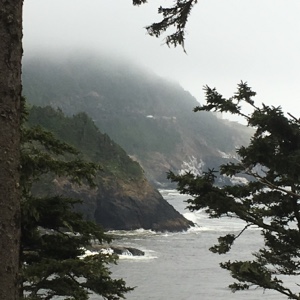

So to look back at my sometimes rocky journey clears away the fog.

A bridge built by the CCC in Florence, OR

It reminds me how God has built bridges for me to carry me through those times, 


even when I couldn't see the forest for the trees

Hobbit's Trail near Florence, OR

or the way through the brambles.

Hecata Head Lighthouse

Hecata Head Light

Yaquina Head Lighthouse

Looking at these lighthouses, I was reminded that "His Word is a lamp to my feet, a light on my path." (Psalm 119:105)


Like the tide that continuously breaks upon the rocky shore, He has reassured me repeatedly in the Bible, "Do not fear for I am with you!"


God knows my fears, even before I voice them.  He wants me to trust Him when life's storms assail me.  There's a sense of security when I pray and turn these cares over to Him.  Prayer drives away my fear, shifts my focus from the world's turmoil to God's character, and creates a quiet confidence that the Lord is in control.  I come away with a peace that only God, my rock, can provide.

"My hope is built on nothing less
Than Jesus' blood and righteousness;
I dare not trust the sweetest frame,
But wholly lean on Jesus name.
On Christ the solid rock I stand;
All other ground is shifting sand.
All other ground is shifting sand."
~ a hymn by Edward Mote, 1797-1874

Sunday, August 6, 2017

The Meadows of Mount Rainier


"Discover Wildflowers" the National Park Service web site for Mount Rainier commanded and so we did.  On a day when we wondered if the smoke from wildfires in British Columbia would obscure our view of the mountain itself, we looked down at our feet as we hiked through subalpine meadows


There was a profusion of wildflowers to see.

Purple Phlox
Penstemon
Alpine Yellow Fleabane
Alpine Asters
Shrubby Penstemon and Indian Paintbrush
Penstemon and Yellow Wall Lettuce

I couldn't identify the wildflowers in the next two photos, but they were beautiful, too.


Almost everywhere you looked, there was a picture-perfect display.


And presiding over it all at 14,400 feet was glaciated Mount Rainier just as John Muir had promised, "wholly unveiled, awful in bulk and majesty."


  Not even the wildfires' smoke could shroud it.


Saturday, August 5, 2017

Sightseeing in Seattle, Continued

Chihuly Garden and Glass

As I mentioned in yesterday's post, it was million tiny little things that caused Tim and I to fall in love with Seattle.  First, the Pike Place Market appealed to our tastebuds, but that was only the beginning of our love affair.  We also became enamored with its art, its history and its public spaces.


On the grounds of the 1962 World's Fair is the landmark Space Needle, the observation tower that inspired William Hanna and Joseph Barbera to create the cartoon, The Jetsons.  We didn't take the time to wait in the long lines to ascend to its apex, but I did to take photos of it from different vantage points around the city:


From the waterfront, 

Smoke from British Columbia wildfires blanketed the city while we were there.

from Kerry Park,


and from within the Chihuly Garden Glasshouse.


The Chihuly Garden and Glass museum displays the wildly colorful blown glass sculptures created by Seattle artist Dale Chihuly.   


He once said, "I want people to be overwhelmed with light and color in a way they have never experienced."  That's definitely the reaction I had to his works and Tim agreed.  


The exhibition could not be contained within museum walls but spilled into the adjacent glasshouse and gardens.  Truly stunning!

The Hammering Man
The Hammering Man, Johnathan Borofsky's sculpture, looks like a shadow against the Seattle Art Museum.  It's a tribute to the worker in all of us.  He raises and lowers his hammer at a clip of two and a half times per minute every day of the year.  The only exception?  Labor Day!

Then there's Seattle's history which reads like a story of salvation.  On June 6, 1889 a fire broke out in Victor Clairmont's cabinetry shop; its flames lapped up the turpentine and sawdust as it quickly spread next door to a liquor store.  Fueled by alcohol, the conflagration soon engulfed the city and its lumber mills.  Residents struggled to load their possessions on wagons or ships moored at the wooden wharves that also fell victim to the flames.  In all, 25 city blocks were destroyed.

Yet, many improvements were made when the city was rebuilt, much of it elevated 22 feet to level the hilly city.  (Visitors today can tour Seattle Underground to see the remains of fire-damaged buildings.)  Pipes replaced the hollow wooden troughs (also victims of the fire) that carried the city's water supply and additional fire hydrants were added.  Instead of volunteer fire fighters, a paid professional fire department was created.  New fireproof building codes required the use of brick, stone and iron.  Stately edifices built in the fashionable Romanesque Revival style created a unity of appearance that still exists in Seattle's oldest downtown neighborhood, Pioneer Square.  It's a wonder that Seattle wasn't renamed Phoenix for the mythical bird that rose from the ashes.

However, Seattle's post-fire building came to an abrupt halt in the Panic of 1893 when banks across the nation, including eleven in Seattle, closed their doors.  Then, rumors of gold in the Yukon brought a great influx of goldseekers (and their money) to the city, all of whom had to be outfitted with supplies before they rushed off to the Klondike.  This cycle of bust and boom continued through the 20th century until today when notable businesses like Microsoft and Amazon have filled the city's coffers.

Pioneer Square

Always willing to cross another National Park Service property off our list, Tim and I stopped at the Klondike Gold Rush National Historic Park in Pioneer Square.  There one can follow the stories of five people who stocked up on supplies in Seattle before hurrying to Bonanza Creek, a branch of the Klondike River, where gold was first found.  

John Nordstrom

One of the five accounts followed the success story of John Nordstrom.  Returning to Seattle from the goldfields with $13,000 in his pocket, he used some of the money to buy ten acres of land in the Rainier Valley and two lots in downtown Seattle.  There he and his business partner Carl Wallin, a man he met in Alaska, opened a shoe store marking the beginning of the Nordstrom store empire.


The Nordic Heritage Museum is a testament to the numerous contributions to Seattle made by Nordic immigrants like John Nordstrom.  Tim's heritage is Danish so we were drawn to visit this small museum.  There we learned that Scandinavian immigrants, many of whom were lumberjacks, first flocked to the area because of the opportunities presented by its heavily forested hills.  Later, they turned to fishing and maritime enterprises.  In fact, many settled in the town of Ballard, now a part of the greater Seattle metropolis, which boomed because of the growing demand for salmon and seafood.

Hiriam M. Chittenden Locks

Later we stopped at Hiriam M. Chittenden Locks, also called the Ballard Locks, a waterway system that connects the saltwater of the Puget Sound to the fresh water of Ship Canal that sits 20 feet above sea level.  We wanted to see the ships passing through the locks, the adjacent botanical gardens and the fish ladder used by salmon to swim upstream to spawn.  


There are windows underneath the walkway that allow you to watch the fish as they make their way from the saltwater of the Puget Sound to the freshwater of the Cedar River watershed.  Serendipitously, we arrived during the season of spawning which runs from the beginning of July to mid-August.

So, see why we now have a soft spot in our hearts for Seattle?  It's because of a million, tiny little things!

Thursday, August 3, 2017

Sightseeing In Seattle

Pike Place Market
"Well, it was a million tiny little things that, when you added them all up, they meant we were supposed to be together.  And I knew it."  Tom Hanks as Sam Baldwin, Sleepless in Seattle, 1993

Tom Hanks was describing his character's feelings about his deceased wife in the 1993 movie Sleepless in Seattle, but I could also use these words to chronicle the five days Tim and I spent sightseeing in Seattle and how we fell in love with the city.  "It was a million tiny little things!"


We began, of course, with coffee at Pike Place Market in the early morning as the vendors were setting up their stalls.  One of the very first Starbucks (you could say the original cafe, except that was a block north before it was moved to this location) was open for business.


Jake, our tour guide from Seattle Free Walking Tours, pointed out its original logo.  The Medusa-looking lady whose boobs have since been less-erotically restyled is not a mermaid but a siren sent to lure the caffeine-deprived into the shop.  The ubiquitous coffee cafes were started in 1971 by English teacher Jerry Baldwin, history teacher Zev Siegl and writer Gordon Bowker who named them for the First Mate Starbucks, a character in the classic novel Moby Dick.  This very small shop sans seating at Pike Place Market offers a blend of beans one can only buy here, the Pike Place Special Reserve.  Ahhhh!  Good morning, Seattle!


Now wide awake, we listened as Jake recounted the history of this oldest, continually-operated farmers' market in the country.  Since its start a century ago in 1907, farmers and fishermen have brought their 


fresh vegetables, 


fruit, 


flowers, 


dairy, 


eggs, 


seafood and meat from nearby islands to this renown waterfront location of stalls and structures.  But in the 1960s, this mecca was almost demolished to make way redevelopment and would have been, but for the efforts of Victor Steinbrueck, the architect of Seattle's Space Needle, who successfully sought 53,000 signatures from citizens to save the market from the wrecking ball.


A permanent resident of the marketplace is Rachel the Pig, a bronze sculpture of a piggy bank, whose belly of donated money is routinely emptied into the coffers of the Pike Place Market Foundation to support the city's food bank.


We tasted our way through the market, nibbling the samples of the fare that vendors offered us, until we came to the live--or should I say, dead--entertainment at Pike Place Fish Market.  There what started as a prank more than 30 years ago has now become a tradition of fishmongers shouting orders and throwing fish to each other or even to paying customers.  Tourists, including me, stand ready to film the flying fish with their cellphones.


One not so edible sight, the Market Theatre Gum Wall, is underneath the emporium.


Here along the Post Alley, moviegoers began the unsanitary practice of sticking their already-been-chewed gum to the passage walls as they left the theater.  Ewwww!  Now, everyone wants to contribute their wad to this colorful work of chomped art.  Wondering just how much gum is there?  The Seattle Times in an article dated November 16, 2015, noted that 2,350 pounds of gum was steam-cleaned from the walls for the first time in twenty years.  Of course, the clean walls did not last long.  Immediately, the next day, a flash mob laid down a new layer to which other gum chewers have since contributed.


The Pike Place Market was not the only food purveyor we enjoyed while we were in Seattle.  We met Joe and Cindy, Tim's cousins (Cindy is pictured above), for dinner at a former junior high school that McMemamens, a Pacific Northwest chain of restaurants, has renovated into a tiki bar, complete with a swimming pool.  McMemanins takes historic hotels, movie theaters, concert venues, schools and even a former Elks Lodge, and turns them into multi-purpose places for dining, movie watching, gaming and even swimming in a pool.  Our dinner was memorable for more than just the food, though.  Catching up with extended family is a rare opportunity.

So, there were a million tiny things made us love this city.  Tomorrow I'll mention more.