Sunday, November 12, 2017

I Built A Home


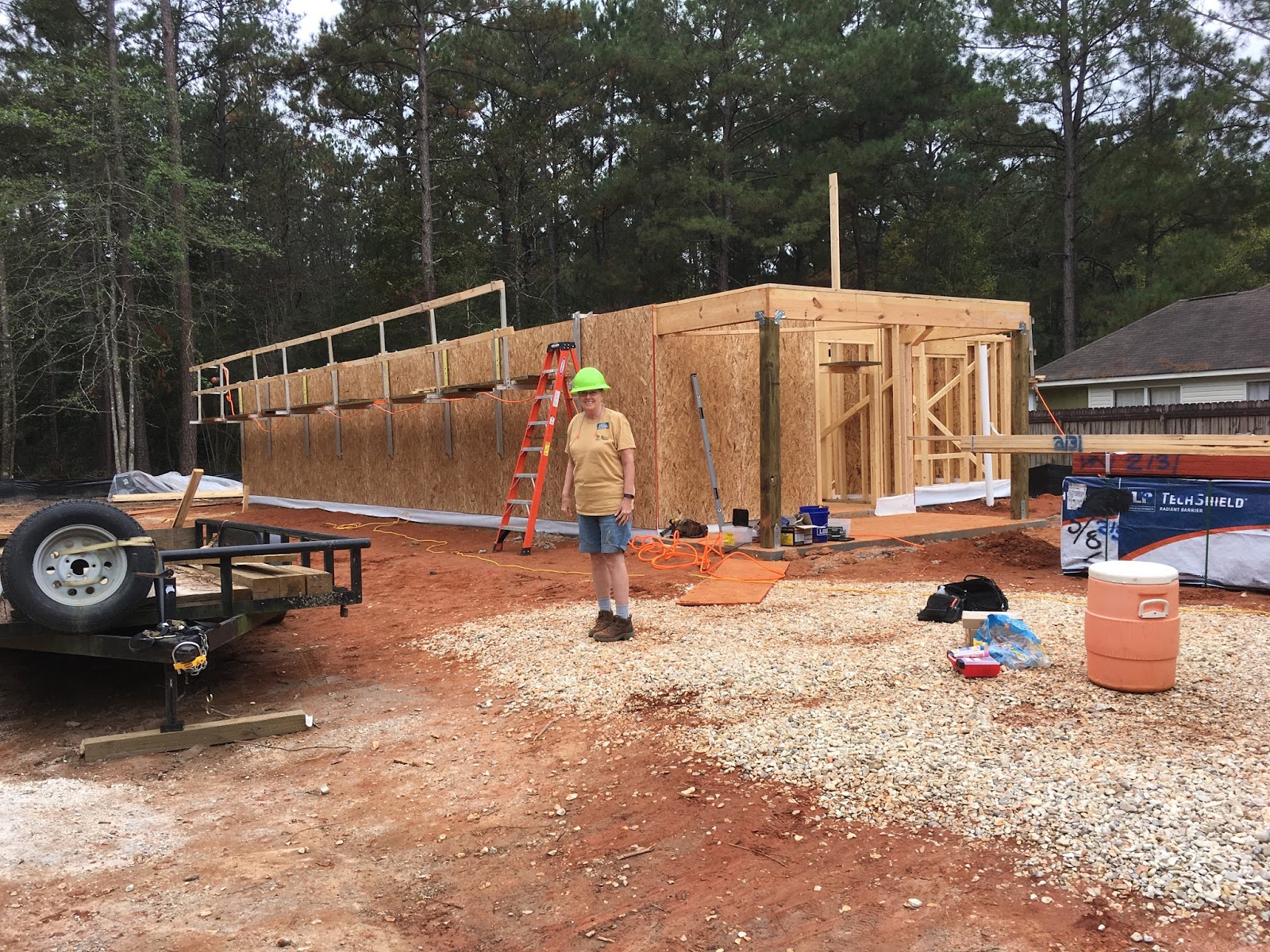
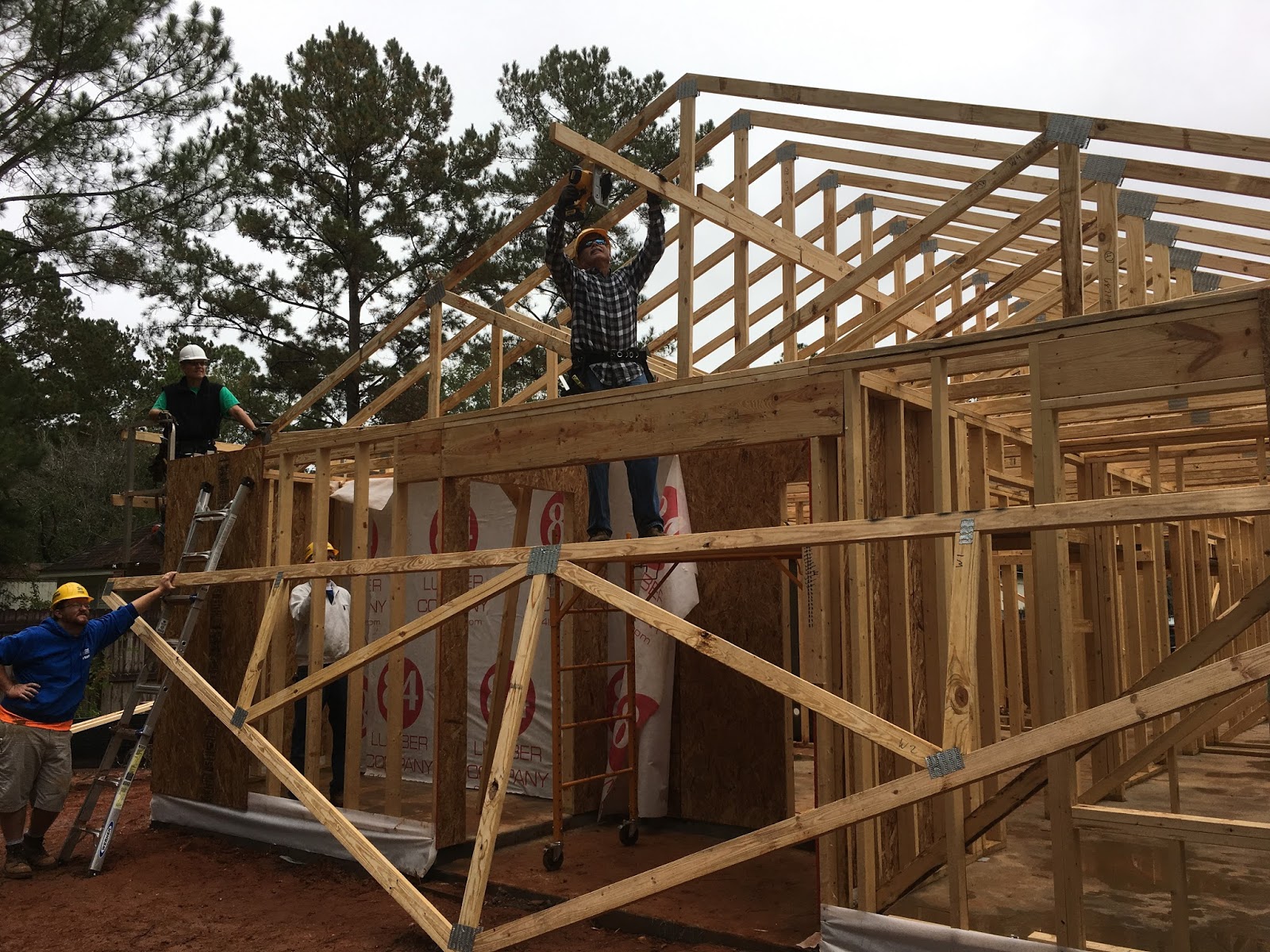
Well, actually my team of ten Care-A-Vanners (RV owners/volunteers) plus one construction manager from the Habitat for Humanity affiliate in Mandeville, LA built a home.  Maybe that's overstating it a little since there's still much work to be done, but at least we got the walls up and the trusses in place for the roof.  Nonetheless, the logo on the T-shirt I received for my participation says I did it, so I'm going to go with that.


Yet, much more of the credit should go to the great team of people with whom I worked.  Larry and Ty were our team leaders and the rest of us would have followed them anywhere.

Clockwise from upper left: Terry, Phil, Jeff, Judy, Barbara, Dee
See how attentively everyone listens to Brandon!

Not only would we have followed them, but I expect each one of us would have cheerfully jumped off a cliff had Brandon, our site supervisor, given us the command.  But given Brandon's fanatical attention to safety, I knew he would never ask that of us.

Our build site was in Covington, LA, a community on the outskirts of Mandeville that in recent years has almost doubled its population.  Many victims from the 2005 Katrina Hurricane fled to the north shore of Lake Pontchartrain which is linked to New Orleans by the 24-mile Lake Pontchartrain Causeway, the world's longest continuous over-water highway bridge.  Due to the influx of population, housing in the North Shore communities is in short supply.  That's where Habitat steps in to fill the gap.


This was the first time I worked on a build from the ground up.  We began with a cement slab, and by the end of our two-week build, we had the walls framed in and the trusses for the roof raised.


All this we completed despite two rainy days that turned the gummy red clay soil into a sticky quagmire.

I swear my boots were stuck in the muck more than once making me wonder if I would be able to free them.

Yet, look at what we accomplished!


Vinecia, the home buyer for this Habitat house, looks absolutely thrilled at the progress we achieved.  She's a single mom with three children who currently lives in cramped quarters with her mother.

From left to right, Vinecia and Derel

Derel, down the street, is another Habitat homeowner.  She moved into her home a year ago and she is so thankful for her very own place that she routinely fixes a home-cooked meal for each team of Care-A-Vanners who rotate through her neighborhood.


Speaking of food, Larry and Ty took us to a couple of their favorite restaurants.  Pictured above is our crew at the Crabby Shack.


And for our final day on the job, Brandon grilled chicken for our potluck dinner.


I know I've bragged in this post about building this home myself.  Then, I expanded my praise to give well-deserved credit to my team.


But ultimately, the real builder of this home, just as Phil's T-shirt attests, is God.


"For every house is built by someone, but God is the builder of everything."  Hebrews 3:4


Most Gracious Heavenly Father, I'm thankful to have been a "someone" on this project.  As Tim and I travel on to our next stop, please be with Vinecia, Derel, Brandon and this team of Care-A-Vanners.  In Jesus name, amen.


Cavorting in Covington

Car tag art worthy of our RV bus, the Dawntreader.

"All work and no play makes Jack a dull boy."  So says the proverb meaning that without time off from work a person becomes bored and boring.  Yikes!  Never let it said that Tim and I are boring.  Consequently, in the interest of gaining some charisma, Tim and I packed some play into our stay in Covington, LA, the parish seat of St. Tammany Parish.  We've been temporary residents here for the past two weeks while we participated in building a home with Habitat for Humanity.


Although we climbed up and down ladders, carried beams and studs, and cut boards and posts on the construction site, those activities do not really qualify as aerobic exercise.  So we took to the Tammany Trace, a paved 31-mile trail that links five communities along the north shore of Lake Pontchartrain.  One weekend we walked six miles of the leafy trail from its origin at the old-fashion train depot in Covington before turning back to our start.  The next weekend we ambitiously biked 15 miles from the Mandeville train station through Fontainebleau State Park; then 15 miles back again.  Because I haven't biked since my second cochlear implantation surgery last March, Tim practically had to pry me off my bicycle seat.  But I felt both virtuous and victorious to have covered that section of the Trace.


What wasn't so virtuous was our stop at New Orleans Original Daiquiris, a chain of drive-through stands that serve up alcoholic frozen drinks.  I couldn't believe these shops were legal.  The state of Louisiana must not have an "open container" law.  But what the heck!  Tim ordered a strawberry daiquiris while I asked for a Mardi Gras Mash that we carried back to the Dawntreader to consume privately.


The Covington Three Rivers Art Festival, an extravaganza of music, food and art, was held while we were here.


Four blocks of Columbia Street in Covington's quaint downtown were blocked off while festival goers frolicked and took in all that the fair had to offer.


There were many pieces of art that I loved, but once again the RV rule by which I live is "If something comes in, something else must go out."  Dog gone it!


Attendance at the historic Christ Episcopal Church (the adjacent white clapboard chapel is Covington's oldest public building still in use) cannot be considered "cavorting," but our spirits were revived while worshipping there.  In fact, Rector Miller was a funny guy.  A rabid fan of the Houston Astros, he'd gone to games 5, 6 and 7 of the World Series in the prior week.


Still on the emotional high induced by their victory, he wore his Astros jersey over his cassock that morning.  Miller is a born storyteller and his viewpoint of Game 7 was especially entertaining.  However, the point of his sermon was that Christ came to earth to tell us that we could have life and have it abundantly.  There is a different way to play life's game and when we play the game His way, we may lose in the short term but we will be champions and will reign with Him for all eternity.  For the closing hymn, he asked us to sing "Take Me Out to the Ballgame" which the congregates did with great gusto.  Very amusing!  Miller's timely and timeless message was memorable.


Wednesday, November 8, 2017

Dew Drop Jazz


Tim and I are currently in Mandeville, LA for another Habitat for Humanity build (more about that later) when our team leaders, Larry and Ty, told us, "You've got to go to the Dew Drop on Friday night, if you want to experience jazz."


So we, along with the rest of our Care-A-Vanner team, packed a picnic and drove over to the Dew Drop Social and Benevolent Association's hall, a place with a long and storied history beginning with its foundation on May 5, 1885.


Most of the information that follows I quote almost verbatim from the Dew Drop Inn website which has a more in-depth account of the history of the hall.

The years following the Civil War were desperate times for African Americans as they struggled to survive in the post-war economy.  The association, like many formed by African Americans after the Civil War, had altruistic goals.  Led by Olivia Eunio, this group of Mandeville's civic-minded black residents came together to care for the sick, to provide help with funeral arrangements, to give food to the needy and to organize temporary housing for the homeless.


Ten years after its founding in 1895 (the year that most scholars agree was the birth of traditional jazz in New Orleans), a small, wooden hall was built in the older part of Mandeville.  This hall on Lamarque Street is now considered the world's oldest virtually unaltered rural jazz dance hall.


Mandeville, situated on the north shore of Lake Pontchartrain directly across the lake from New Orleans, was developing as a lakefront resort at the turn of the century.  So it wasn't long before New Orleans jazz musicians made their way to the Dew Drop and its lively Saturday night dances.  Even Louis Armstrong is reported to have played here.


Positioning our lawn chairs for the best view through the hall's open windows, we settled back to hear the Pfister Sisters, a lively trio of ladies, sing songs such as "Gonna Take a Sentimental Journey" and "The Boogie Woogie Bugle Boy of Company B."

I think we had the best (free!) seats of the hall, much better than the wooden benches inside that cost $10 because we had an added attraction.  We could watch the rise of November's full moon.  All in all, it was quite an experience, one we'll long remember!

Thursday, October 26, 2017

Grounded


Grounded isn't just a word that applies to discipline for teenage misdemeanors or airplanes prohibited from flying.  It could also mean someone or something that is stable and well-established.

Our farmhouse, circa 1912, was built with the front entrance overlooking the road.
The porch was a perfect place for family photos.

In 1951 my parents moved in and changed the front entrance so it faces the driveway.
It's still a great place to capture a family photo.

I think this word is the perfect descriptor for my family farm, a place where my roots run deep despite my years of marriage to a city boy.  This is the place where I feel grounded in familial love and the faith of my forefathers.

My great-grandfather, Everett E. Gard, threshes wheat.
He'd be amazed at the 40-foot header on today's combine.

Established by my paternal great-grandfather in 1903, our farm qualified for the Kansas Farm Bureau's Century Farm Award, a program that recognizes family farms whose current owner is related to the owner of the farm in 1917 or before.  Qualifying farmers receive a farm sign designating "Century Farm" status and recognition from Kansas Farm Bureau, an advocacy organization for agriculture.  But, true to form, the sign, still in its cardboard box, languishes on the back porch, waiting its day in the sun or at least the half hour of down time it would take to stake it out by the road.  Indeed, that might never happen at all if my dad decides that, just as a fellow farmer present at the awards banquet mentioned, it would attract local gun-toters to use it as target practice.

My brother Jon fills the planter with wheat seed.

Is there a time on the farm that qualifies as down time?  That certainly hasn't happened in the past seven weeks Tim and I have camped here, helping my brother and father harvest corn and soybeans all the while trying to plant wheat.


It's been hectic, especially since I've tried to spend an hour or so every afternoon with my mom who's in a local assisted living situation.  So it might seem Tim and I have dropped off the face of the earth; we've been so out of touch with the world.  But one's focus narrows during fall harvest to getting the grain in the bin or planted in the ground.  I guess we've been grounded on the farm, so to speak.  But as of this morning, we are back on the road again, bound for another Habitat for Humanity build in Mandeville, LA.


I have few harvest photos to show for our time and many of the few I did take were of knobs, dials and parts of various pieces of farm implements and tools.  These I sent to my brother Jon to ask if this was the part he wanted or the switch I should turn on or off.  Cell phone photos sent via text messages are a huge step up from rudimentary drawings quickly sketched on a napkin at the dinner table.


I'm simply thankful that those knobs, dials and switches were firmly grounded--another use of this word--so the return path of the electric current bypassed me and I could greet another dawn, praising God for the gift of a new day.


Monday, September 4, 2017

Working on the Railroad

Ceremony for the driving of the golden spike at Promontory Summit on May 10, 1869
Photo by Andrew J. Russell
"What was it the Engines said,
Pilots touching,--head to head
Facing on the single track,
Half a world behind each back?"
~ Bret Harte, from the poem What The Engines Said

Tim and I are making a beeline back to the farm where corn harvest has already begun.  We're supposed to be part of the fall harvest crew, but I’d promised my railroad fan father we’d visit the Golden Spike National Historic Site when we passed through Brigham City, UT on our way home.  


That’s the place (marked in the photo below by the commemorative plank) where the final stake was hammered home to complete the Transcontinental Railroad, a monumental work of labor.  


Of course, the real golden spike resides at the Cantor Arts Center on the campus of Stanford University founded by none other than Leland Stanford, president of the Central Pacific Railroad.  

By mid-1868, Central Pacific Railroad crews had crossed from Sacramento through the Sierra Mountains.  Meanwhile, the Union Pacific had laid over 700 miles of railroad tracks across the plains from its terminus in Omaha, Nebraska.  The two railroad companies were destined to meet at Promontory Summit, Utah.


There at the Golden Spike National Historic Site, I'd hoped we'd see the replica steam locomotives of the Central Pacific's Jupiter and Union Pacific's No. 119 re-enact that historic meeting (a daily event during the summer months), but due to track maintenance, they were only on view in the Engine House.  Still, I found it worth our time to see this place where the two locomotives had inched forward to meet almost nose to nose for that 1869 historic celebration.  Luckily, the park wasn't too far out of our way home.

There was another celebration awaiting us in Denver.  Our friends Mike and Leslie whom we'd known since our days in Tucson, Arizona, were hosting a house warming for their new home.  Seeing where they now live and meeting their friends was a memorable occasion we won't forget.

By the time Tim and I return to the farm on Monday, we will have traveled over 4,000 miles on this summer’s vacation that began July 5th.  It’s been a memorable trip, punctuated with historic milestones, stunning vistas and opportunities to make new friends as well as visit old.  We’ve played a lot during these past two months so perhaps it’s fitting that we’ll get back to the farm on Labor Day.  I’m sure that with fall harvest in full swing there will be plenty of work awaiting us.

"Last week a premature blast went off, 
And a mile in the sky went big Jim Goff.
Now when next pay day come around,
Jim Goff a dollar short was found.
He asked the reason; came this reply,
You were docked for the time
You were up in the sky."
~ song sung by Irish immigrant workers of the Union Pacific Railroad

I hope our pay's not docked because we're late!