Sunday, April 24, 2016

Beacons of Light

Sanibel Island Lighthouse

The coast of Florida is dotted with over 30 active lighthouses.  During our time here, Tim and I have seen only five of them and not all of those still light the night.


But they are impressive, especially the view from the top!

St. Augustine Lighthouse's Lamp

However, the real impact of a lighthouse isn't its height.  It's the Fresnel lamp in the lantern room at the top which takes all available light and bends it horizontally, sending its beam far out to sea to guide sailors home.  At least, that's the explanation I read this week in a devotional from the web site, Today: Refresh, Refocus, Renew.

Crooked River Lighthouse near Carabelle, FL

The Israelites in the Old Testament, too, were to be a beacon to light to the depraved nations around them.  That's why you see these words over and over in the Bible, "I am the Lord your God." Chosen as God's special people, the Israelites were called to lead lives that reflected His goodness.

Cape St. George Lighthouse

In the same way, the candlepower of a Christian is the love of God which we are to reflect horizontally to those around us who are caught in the morass of disappointments, harmful choices and broken relationships.  If Christ is the light of the world, as it says in John 8:12, then I am to be the mirror that reflects that light.

Boca Grande Rear Entrance Lighthouse

This week in Foley, AL, we've attended a rally of Prevost owners, many of whom we met back in February at the Lakeland Air & Car Show.  We've begun friendships with several of these couples that I hope will continue to the next times we see them.  In my conversations, I've tried to push beyond the superficial topics to questions about the deeper issues of life.  How do they feel about being so far from family and friends?  What do they miss most about their previous lives?  Has life on the road been satisfying for them?  Have they found that viewing so many varied places has given them a wonder about nature?  And if so, who or what do they credit for the beauty they've seen?

With my hearing loss, it's not always easy to carry on a conversation in a crowded room, but I've tried and hopefully, I've been able to show them I care about them.  Still, I found the ending sentences in the above devotional convicting:

Port Boca Grande Lighthouse on Gasparilla Island
"Trying to fit in with the world will only get us lost.  And building high walls around our lives will only block the light we were meant to share.  How does your light shine?"  
St. Augustine's Lighthouse

That's the challenge, isn't it?


Wednesday, April 20, 2016

Fort Matanzas National Monument


Last Wednesday Tim and I traveled back in time.


Along with 20 other passengers, we boarded a pontoon boat owned by the National Park Service for a trip across Matanzas Inlet to the year 1742.  That's the year the Spaniards built Fort Matanzas to protect the southern river approach to St. Augustine fifteen miles away.


But, of course, the story of this fort, as told by our park ranger Grant,


goes back even further--almost 200 years further--to the beginning of the Spanish settlement of St. Augustine in 1565.  


At nearly the same time St. Augustine was founded, French Protestants called Huguenots landed near present-day Jacksonville, just 40 miles to the north, where they established Fort Caroline.  

Governor Pedro Menéndez de Avilés
Such an incursion into Spanish territory infuriated King Philip II who ordered the first Governor of Florida, Pedro Menéndez de Aviles, to oust the French colonists.


The French led by Jean Ribald sailed south to challenge the Spaniards, but a hurricane blew their ships into the inlet south of St. Augustine.  


Meanwhile, Menéndez attacked Fort Caroline, and because so many of its soldiers had accompanied Ribault, the fort was easily overpowered.


Menéndez and a party of his soldiers then marched to the inlet where the French ships were stranded and issued an ultimatum: either convert to Catholicism and become Spanish subjects or die.  One hundred and twenty Frenchmen surrendered but Menéndez slaughtered them anyway perhaps because there weren't enough provisions to feed them all.  The name "Matanzas" is Spanish for massacre and the inlet as well as the river that empties into it are known by that name today.


All up and down the coast, conflicts continued to rage between the colonial powers who sought supremacy over this finger of land that separates the Atlantic Ocean from the Gulf of Mexico. 


One hundred and seventy-five years later, in 1740, British General James Oglethorpe of Georgia initiated a 39-day blockade of St. Augustine.  He ended the siege when he realized he could not capture St. Augustine's fort, Castillo de San Marcos.  However, that siege revealed how vulnerable the city was and convinced then-Governor Manuel de Montana that a fort was necessary near Matanzas Inlet, the back door to St. Augustine. 


The British and Indian allies harassed the Spanish as construction proceeded on the fort built roughly in a square fifty 50 by 50 feet and topped by a 30-foot tower.


As the fort neared completion, Oglethorpe and his fleet of 12 ships entered Matanzas Inlet, but were repelled by the garrison of men stationed at the fort.


That was the only time in the fort's history that its cannons fired upon an enemy.


After Spain ceded Florida to the United States, the fort was no longer occupied and began to fall into ruin.  Restoration work began on the fort in the 1920s when it became a national monument.  Today the fort stands sentry over the habitats of Matanzas Wildlife Management Area.


Time travel at its best!  On location with a National Park Service ranger to give us a glimpse into the stories of this place!  Now, that was quite a boat ride!


Monday, April 18, 2016

The Mark of a Good Presbyterian

Ponce de Leon Hotel

Henry Flagler's name might not be as well-known as his Standard Oil Company partner, John D. Rockefeller, but Flagler certainly left his mark on St. Augustine, FL.

Henry Flagler (1830-1913)

The son of a itinerant Presbyterian minister, Flagler, who left school when he was 14, rose from poverty to become one of the wealthiest men in America.  

Clockwise from upper right, Mary Harkness (m. 1853-1881), Ida Alice Shrouds (m. 1883-1901), Mary Lily Kenan (m. 1901-1013)

He first visited St. Augustine while honeymooning with his second wife, Ida Alice Shrouds.  The city's charm so beguiled him that he and a local physician, Dr. Andrew Anderson, came up with the idea of turning it into a winter playground for the wealthy.  

From Anderson, Flagler purchased a tract of land just beyond the historic city wall and proceeded to build two lavish hotels.  To transport tourists to the city, he bought a short line railroad, the Florida East Coast Railroad which under his leadership, extended south to Palm Beach, then Miami and finally to the deep water port on Key West.

Ponce de Leon Hotel

When the 540-room Ponce de Leon opened in 1888, it was a tremendous success.  Instead of reserving a night or two, wealthy patrons willingly forked over $4,000 in cash to stay the entire winter season from December through April. 

Lobby of the Ponce de Leon Hotel

The lobby is stunning with its gold-leafed vaults and dome.  

Lobby's dome

So is the richly ornate dining room, now the cafeteria of Flagler College, a private 4-year liberal arts school, which acquired the hotel in 1966.  Tiffany windows and a theme of Spanish exploration make this, in the opinion of architect George E. Kidder-Smith, "one of the greatest rooms in America."

Dining Room of the Ponce de Leon Hotel

Tim and I signed up for a tour led by one of the college students.  Her extensive knowledge of  Flagler and the hotel was impressive.  

Front facade of the Ponce de Leon Hotel

One tidbit she pointed out are the Celtic crosses placed in a continuous row across the top of the hotel's roof-line and the cross on top of the domes, indicative of Flagler's strong faith.  Flagler and his partner Rockefeller both seemed to believe that their prosperity was given by God, quite an interpretation of Jesus's command to leave all and follow Him. 

Lounge of the Ponce de Leon Hotel

The lounge where hotel guests gathered to visit and play card games features a large fireplace made of white onyx.

Hotel Alcazar

The Hotel Alcazar was built almost simultaneously with the Ponce de Leon; it too, opened in 1888.  It featured a spa, a Turkish bath and a large indoor swimming pool.  

Courtyard of the Hotel Alcazar, now the Lightner Museum

Built around a central courtyard, the hotel served the overflow of tourists that its sister hotel turned away.  Today Hotel Alcazar functions as City Hall while three of its floors house the Lightner Museum with its exhibits of Gilded Age artifacts.  

Casa Monica

When another St. Augustine businessman, William W. Smith, fell into financial difficulties, Flagler purchased his hotel, Casa Monica, and promptly renamed it the Cordova.  

Casa Monica

With this trio of luxury hotels, Flagler had a lock on the city's tourist trade.  The Cordova once again called Casa Monica is now part of the Marriotts' string of hotels.

Memorial Presbyterian Church

Yet, my favorite of all the structures Henry Flagler built in this city is the Memorial Presbyterian Church.  
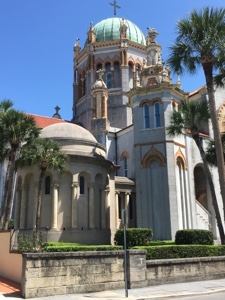
Mausoleum and dome of Memorial Presbyterian Church

Built in the Venetian Renaissance Revival style, the church was dedicated to the memory of Flagler's daughter, Jenny Louise Flagler Benedict, who died from complications from childbirth.


Clockwise from upper left: Dome, Chapel, Sanctuary, Windows that describe The Apostles Creed in stained glass


Using the plans Flagler requested from St. Mark's Bascilia in Venice, Italy, construction of the church was completed in a single year--1889.

Three wings of pews

Laid out in the shape of a Greek cross, three sides of the sanctuary are filled with parishioner pews.

Pulpit and Choir Loft

The pulpit commands the fourth side.  Tim and I stopped by the church Thursday afternoon for an informal visit with one of its docents; then, returned Sunday morning to worship at the early service.

Flagler Mausoleum

Upon his death in 1913, Flagler was interred here along with his first wife, Mary Harkness Flagler, his daughter Jenny and his granddaughter Margery.

Statue of Henry Flagler at the entrance to Flagler College

With these landmarks of St. Augustine, Flagler put his mark upon the city that continues to this day.  His Presbyterian minister father would be pleased.


Sunday, April 17, 2016

Waves of Mercy


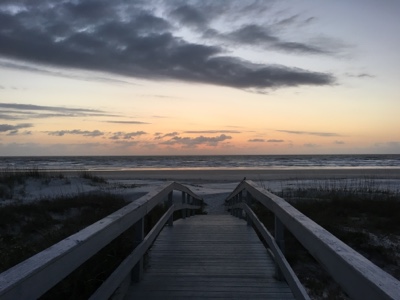
This week we've stayed at a campground by the beach. Several mornings we've gotten up early to watch the sun rise over the ocean.


The immensity of the ocean as it stretches to what looks like infinity makes me consider God's boundless love for each of us.  His love--to redirect the words of a popular song of the 60s--is deeper than the deepest ocean; wider than sky.


One of devotions I read this week said,  "The ebb and flow of the waves is an echo of God's voice calling me back to him."  Many times I've failed to follow God as fully as I could.  


I've let the weeds of my stubbornness and destructive feelings separate me from God's love.   But just like the gentle pull of the waves, God draws me back to Him.  Lamentations 3:22-23 reminds me--

Because of the Lord's great love we are not consumed, 
for his compassions never fail.
They are new every morning; great is your faithfulness.

His mercy is like the waves that return again and again to the shore, offering me the chance to trust Him anew each day. 


His love breaks through the clouds to shine into my hardened heart.   Every morning is a new opportunity to follow Him.  


Great is your faithfulness, O Lord!