Showing posts with label GA. Show all posts

Friday, September 7, 2018

Warm Springs

FDR's Little White House

The day Franklin Delano Roosevelt died there was an outpouring of grief from every corner of America.  FDR was the only president my parents could remember from their childhood.   They were born near the beginning of his unprecedented four terms in office and young adults when he died of a cerebral hemorrhage on April 12, 1945 in Warm Springs, Georgia.  They talked of how Roosevelt rescued America after the Great Depression and how he led the United States to the brink of victory in World War II.  Both of them could remember the shock of the nation at his passing.

So when I discovered that Warm Springs was only an hour away from where we were volunteering in Americus, Georgia, I persuaded Tim that we needed to visit there to pay our respects to one of the greatest leaders in American history.

The chair where FDR was sitting when he suffered his fatal stroke.

Roosevelt's Little White House in Warm Springs is now a State Historic Site maintained by the Georgia State Park system.  Roosevelt built the modest, six-room, single-story home in 1932 several years after learning that the warm springs nearby were reputed to have a salutary effect on polio patients.

FDR's wheelchair and leg braces are on display at the park's museum.

Roosevelt himself was stricken with polio in 1921 as a young man and his legs were paralyzed.


Swimming in the 88-degree spring waters did not bring a miracle cure, but he believed it brought improvement.


Roosevelt made 41 trips to the west Georgia town from 1924 until he died there.

FDR's custom built 1940 Willys Roadster is on display in the Warm Springs State Park Museum.

During his stays, Roosevelt loved to drive the county back roads in a succession of automobiles especially equipped with hand controls.  Along the way, he would often pull over to speak to townspeople and farmers alike.


Hearing the plight of the farmers, some say, directly influenced Roosevelt's New Deal programs.  In fact, the president called Warm Springs the birthplace of the Rural Electrification Administration.  Georgia farmers were especially hard-hit by the Depression and the lack of electricity slowed their recovery.  Electric companies were reluctant to string wire to widely dispersed farms, but by banding together, along with federal funding, farmers joined in electric cooperatives.  My grandfather, a staunch Democrat who enthusiastically voted for FDR each election, canvased neighboring farmers in southern Stafford County, Kansas to sign them up for the REA.

Elizabeth Shoumatoff, Unfinished Portrait of Franklin D. Roosevelt, 1945 [Watercolor], Warm Springs State Park Museum, Warm Springs, Georgia

The day FDR died, Elizabeth A. Shoumatoff was painting his portrait while he pored over documents at his desk.  An exhibit at the Warm Springs museum recounts that she lured his gaze from his work by asking questions about his stamp collecting hobby.  As the butler prepared the table for lunch, FDR prophetically said to her, "We have fifteen more minutes to work."  Elizabeth described in her memoir that soon after he suddenly "raised his right hand and passed it over his forehead several times, without emitting a sound, his head bending slightly forward."  She immediately rushed to tell the Secret Security guard that something was wrong.  She never finished the portrait.

After his collapse, FDR was carried by his staff to his bed in the next room where at 3:35 p.m. after tremendous medical effort, President Franklin D. Roosevelt, age 63, was pronounced dead.

Scandalously, it was Roosevelt's mistress, Lucy Mercer Rutherford--and not his wife--who was present with him when he died.  She, along with Shoumatoff, quickly left the Little White House in expectation of the arrival of his wife Eleanor.  Although shocked and angered by the renewal of his extramarital affair first begun in 1916, Eleanor set aside her feelings to notify her daughter Anna, her four sons who were scattered around the world while serving in the military and Vice President--now President--Harry Truman.  Then she made funeral arrangements.


Thousands like the man pictured above lined the rails to bid farewell as FDR's casket was taken by train to Washington.

Orson Welles encapsulated the nation's grief when he wrote the New York Post's eulogy for President Franklin D. Roosevelt beginning with these simple words: "He's gone.  We can't believe it, but he's gone.  The dark words throw their shadow on the human race; Franklin Roosevelt is dead."


Tuesday, September 4, 2018

The Highlands of North Carolina and Georgia


Tired of living out of a suitcase during this summer's series of hotel stops and Airbnb stays, Tim and I decided we needed five days of staying in place before reporting to work in Americus, Georgia.


When we looked at the map, we noticed Nantahala National Forest, near the southern end of the Blue Ridge Mountains, was not far out of our way.


Hoping to find relief from the South's hot and humid summer temperatures by heading to a higher elevation, we searched for a cabin in the woods.  And we found it in Warne, North Carolina.


A.  Warne, NC
B.  Fires Creek Recreation Area
C.  Lake Chatuge
D.  Highlands, NC
E.  Crane Creek Winery
F.  Hightower Creek Winery

I'd never before been to this neck of the woods where the corners of Tennessee, North Carolina, South Carolina and Georgia converge in close proximity, but it is beautiful.

We spent several days hiking at Fires Creek Recreation Area and near the shores of Lake Chatuge, a reservoir created by the Tennessee Valley Authority.


Lake Chatuge

Across the state line in Georgia is the Dahlonega Plateau, designated as an American Viticultural Area by the U. S. Department of the Treasury.  Judiciously and on two separate days (we know our limits!), we visited two of the seven wineries on the scenic and well-established Dahlonega Wine Trail.


When we wanted to venture further afield, our hostess Lori told us that if you like the feel of rubber fighting for a grip on a curvy mountain road, then you absolutely must make the drive from Franklin to Highlands, North Carolina, allowing plenty of time to stop at a waterfall or two along the way.  So we did!  And it was incredible!


Dry Falls so named because one stays dry when walking behind it.


When we finally threw our suitcases back in the Jeep's trunk, it was with the refreshed attitudes we gained in this beautiful place.


Wednesday, August 29, 2018

Two Presidential Libraries

Tim sits in Pres. Ford's seat at the Cabinet's table.

Tim has a goal to visit every presidential library beginning with Herbert Hoover, the first president to have such an institution.  As of today, and with the exception of John F. Kennedy, we are current through 1980 when Jimmy Carter left office, thanks to three stops we've made this summer.  First was Hoover's library in West Branch, Iowa which I wrote about in July.

Then, with a visit to our friends, Gary and Judy, in Grand Rapids, Michigan a few weeks ago, we stopped at the Gerald R. Ford Museum.  Gary and Judy are dear friends from our first stint in D.C.  Their son Devin now teaches K-12 grades in a remote school in Alaska; he was Richard's best buddy so we were delighted that he was also visiting his parents while we were there.

Now, Tim and I are in Americus, Georgia, where we've spent the month of August attending Habitat for Humanity training to become faciliators for a course in volunteer management. In addition, for the past two weeks we've volunteered with the facilities manager for the Habitat headquarters here to reduce the number of odd jobs on his to-do list.  All this to say, that I'm woefully behind on posting our summer adventures to our blog.

So, let's begin with President Gerald R. Ford.


While Ford's presidential papers are stored on the campus of the University of Michigan in Ann Arbor, it was the memorabilia of his life and the life of his wife Betty that we wished to see at The Gerald R. Ford Presidential Museum in his hometown, Grand Rapids.

Leslie Lynch King, Jr. and his mother Dorothy Gardner King

I am always interested in what makes for greatness so I found the story of Ford's childhood captivating.  His start in life was not the easiest of beginnings.  His father abandoned his mother soon after Ford (once named Leslie Lynch King, Jr.) was born.  At an Episcopal Church social, Dorothy Gardner King met Gerald R. Ford, a hard-working, kind man who was affectionate towards her toddler son.  They married in 1917.

Gerald R. Ford, Sr. with Junior Ford

From that point on, they called the young boy Junior Ford, and Ford Sr. became the father Jerry Ford "loved and learned from and respected."

Jerry Ford posing with his half brothers, Tom and Dick, while his step-father holds baby Jim.

Soon Tom, Dick and Jim were born and the family was complete.


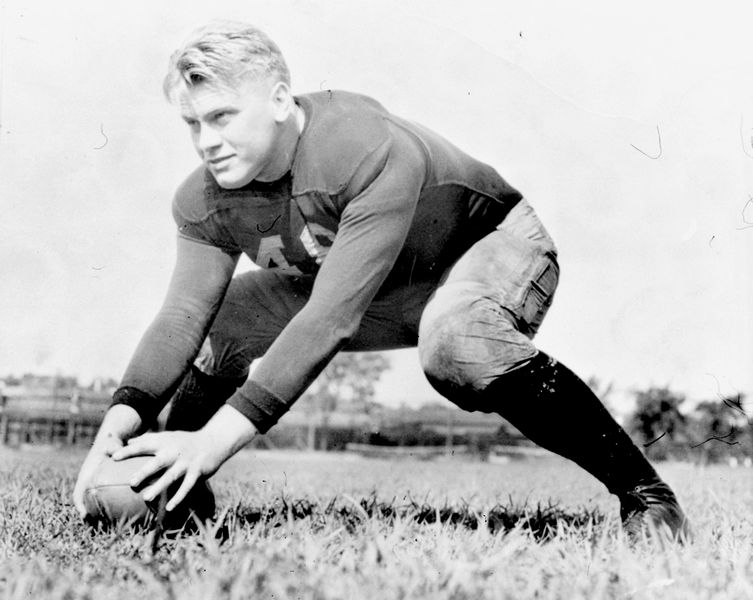
Jerry joined the Boy Scouts and at age 14, proudly earned the rank of Eagle Scout.  In 1929, the governor of Michigan selected Ford, along with several other Eagle Scouts from around Michigan to serve as honor guards at Fort Mackinac on Mackinac Island.  Throughout his life, Ford remained dedicated to the Boy Scouts and the organization's principles.

When Jerry was ready to attend high school, his parents debated whether to send him to the newer, more elite Ottawa High or to South High where students came from diverse backgrounds: recent immigrants, African Americans and the working class.  They chose South High largely because a family friend and high school basketball coach advised "he will learn more about living there."  It was a good choice.  There Ford learned to get along with many different people.


He also joined the football team, a decision that paid off later when he earned a scholarship to play football at the University of Michigan.  After college, Ford was tempted to play professionally.  He received offers from the Green Bay Packers and the Detroit Lions, but he turned them down to pursue a law degree at Yale, graduating in May 1941 in the top quarter of his class.  He returned to Grand Rapids and opened a law firm with a friend, Philip Buchen.

A bronze statue of LCDR Jerry Ford was unveiled on the USS Gerald R. Ford in April 2016.  

Soon after the attack on Pearl Harbor, Ford enlisted in the U. S. Navy Reserve and saw action in the South Pacific on the USS Monterey.  During Typhoon Cobra, he almost lost his life when the high winds caused many of the carrier's aircraft to break loose and crash into each other.  He had to cross the flight deck on his way to the bridge and as he did so, the ship rolled sideways.  Ford fell and almost slid overboard but fortunately, he caught himself on the edge of the deck and survived the storm.

Elizabeth Anne "Betty" Bloomer Ford
When the war ended, Ford returned to Grand Rapids and his law office.  He met a beautiful divorcee, Elizabeth Bloomer, at Grace Episcopal Church and soon married her.  Betty was a fashion model and a dancer with the Martha Graham Dance Company.  During their engagement, Ford was campaigning for office as a U.S. Representative, a position he won for the next 13 terms until President Richard Nixon appointed Ford as Vice President following the resignation of Spiro Agnew in 1973.

Ford is sworn in as the 40th U. S. President

Of course, we know how that turned out.  Nixon was forced to resign the presidency following Watergate, making Ford the only person to have served as both Vice President and President without being elected to either office.

Hoping to heal the nation from the scars of Watergate, Ford gave Nixon a full pardon for any crimes he might have committed while president.


This pardon undoubtedly cost Ford the presidential election of 1976 which he lost to the Democratic nominee, Jimmy Carter.


That brings us to this weekend's visit to the Carter Presidential Center.

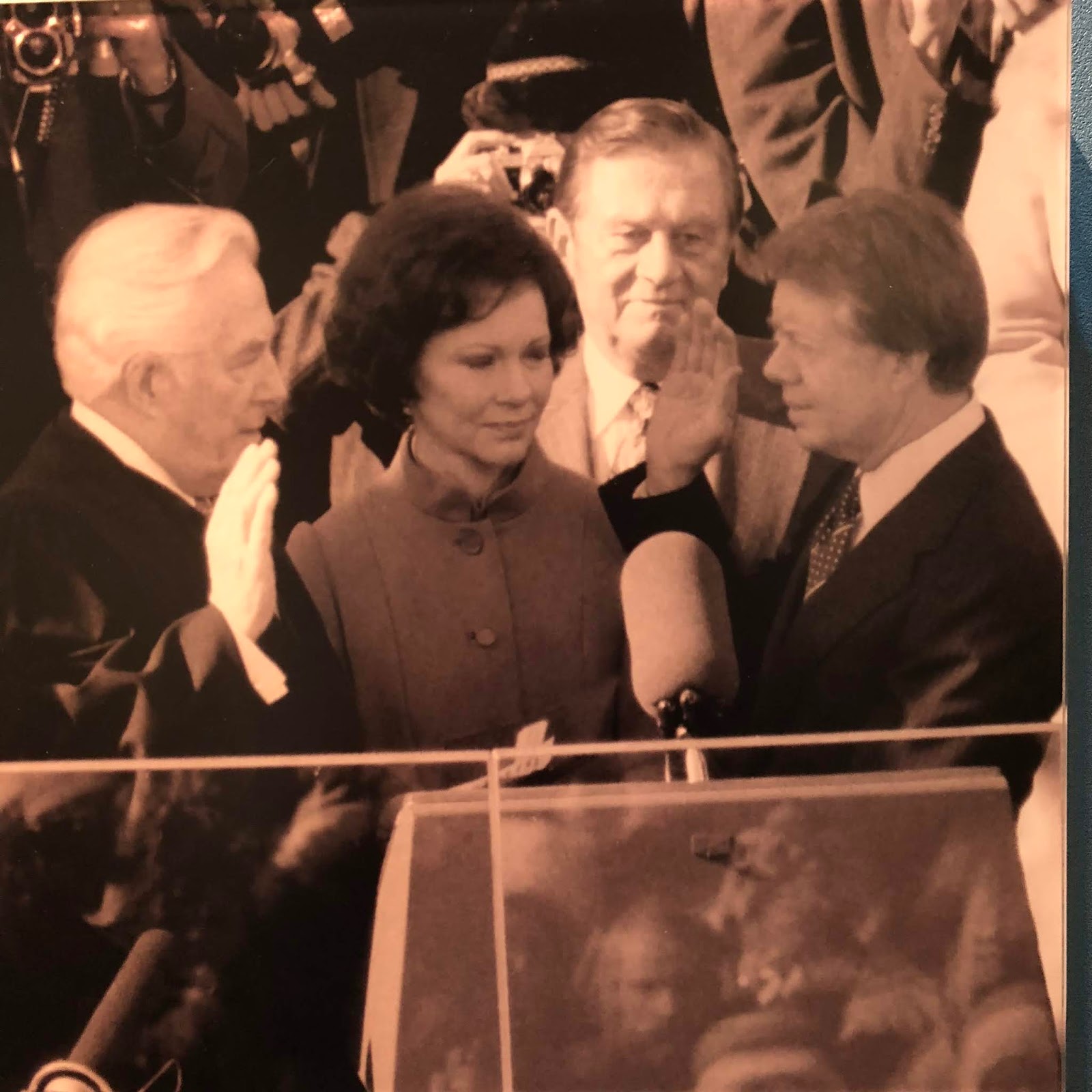
Carter takes the oath of office on Jan. 20, 1977.

A year ago, Tim and I learned much of Jimmy's life story when we visited his home town, Plains, Georgia.  Now with this visit, I've come to believe that Jimmy Carter has accomplished more since he left the presidency at age 56 than he was able to achieve during his four years in office.

One of Carter's most notable achievements while in office was the Camp David Accords signed by Israeli Prime Minister Menachem Begin and Egypt's President Anwar Sadat at Camp David, 1978

The Jimmy Carter Presidential Library and Museum is on the same Atlanta campus as the Carter Center, the nongovernmental organization Carter and his wife Rosalynn founded in 1982 which has helped improve life in more than 80 countries by advancing democracy and human rights, fighting disease and promoting mental health.  His center has monitored more than 100 elections in Africa, Latin America and Asia.  In addition, the Carter Center leads the fight to eradicate diseases such as schistosomiasis, trachoma and Guinea worm globally.

On Feb. 4, 1993, Carter and Jay Leno demonstrated their nail-driving skills on The Tonight Show.
Rosalynn's carpenter tape measure

Of course, of particular interest to Tim and I is the Carters' involvement with Habitat for Humanity.  One week a year for over 25 years, the Carters have helped Habitat build houses for people in need.

Octavio Ocampo, Jimmy Carter, 1979 [Oil on canvas], The Carter Presidential Center, Atlanta
Enlarge this portrait and you'll see the national symbols and personal images Ocampo incorporated. 

There was an article in the Washington Post on Saturday that profiled Carter as the "un-celebrity president," noting that he has bypassed the wealth and perks that flow so freely to other former presidents to live a simple life in the home he and Rosalynn owned before their term in Washington, D.C.  One interesting statistic the article related was the following:

"Carter costs U.S. taxpayers less than any other ex-president, according to the General Services Administration, with a total bill for him in the current fiscal year of $456,000, covering pensions, an office, staff and other expenses.  That's less than half the $952,000 budgeted for George H. W. Bush; the three other living ex-presidents--Clinton, George W. Bush and Obama--cost taxpayers more than $1 million each per year."


What a bargain!  In the above article, Carter says, "It just had never been my ambition to be rich."  I admire Carter for how he has lived his life.

Carter's Noble Peace Prize medal on display at Carter Presidential Library

What he said in his acceptance speech when he received that Nobel Peace Prize on Dec. 10, 2002 resonates with me.  "The bond of our common humanity is stronger than the divisiveness of our fears and prejudices.  God gives us the capacity for choice.  We can choose to alleviate suffering.  We can choose to work together for peace.  We can make these changes--and we must."