Tuesday, September 11, 2018

Highest Point In Alabama

Cheaha State Park near Pulpit Rock

Soon after Tim and I married, he was transferred to Fort McClellan in Anniston, Alabama, for a six-month stint at the military police academy there.  It was our first introduction to living in the South where the Civil War is still called by some, The War of Northern Aggression.  Somehow in those six months, we never realized that just a short twenty miles away was Cheaha Mountain, the highest point in the state of Alabama.


When plotting our route back to the farm for fall harvest, I googled "top tourist attractions in Alabama" and Cheaha State Park popped up.  Online photos of the park were stunning.


Learning that the park had both a hotel and a restaurant, I quickly made reservations for a three-night stay.


Twice we missed turns as we made our way to the park.  To say that it is off the beaten path is a true assessment.  But it was worth it to finally reach the summit where the vista unrolls for miles and miles.


During our stay we practically had the park to ourselves.  In fact, one evening we dined alone in the restaurant with its floor-to-ceiling windows.  Questioning our young waitress, she told us in her sweet Southern accent that while business was slow now that children are back in school, the park will be flooded with leaf-peepers come fall.  Oh, how I wish we could be here then!


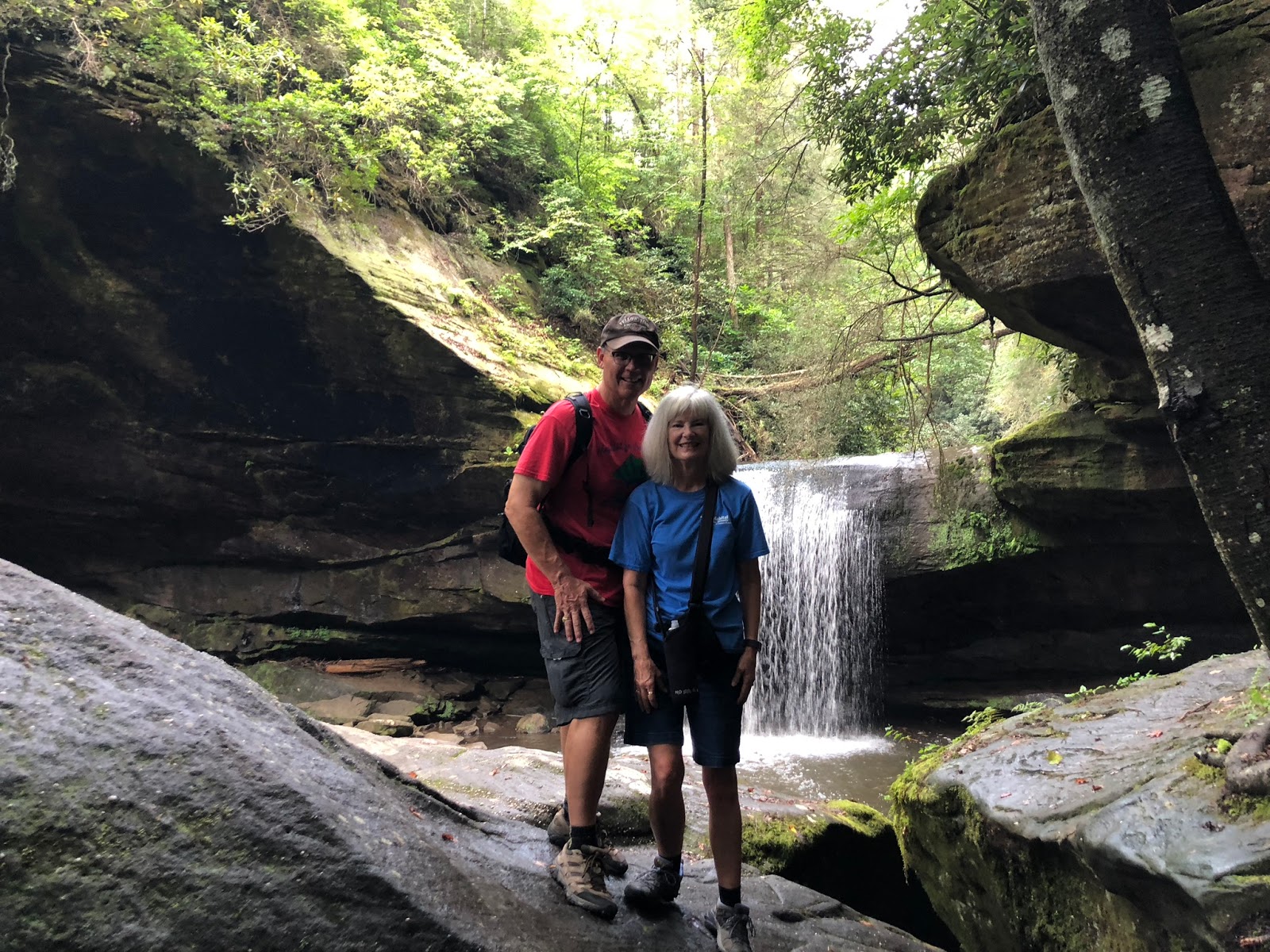
Ever on the prowl for waterfalls, I persuaded Tim to hike to Cheaha Falls with me.  This three-tiered cascade flows over a rock face located three miles into the Talledega Forest.  It's a beautiful place.


Another day we hiked a few miles of the Pinhoti Trail which stretches 171 miles across Alabama (and another 100 miles through the mountains of northern Georgia) before it connects to the Appalachian Trail.  The section we crossed was a narrow tract overgrown with brush, not as well maintained as I'd hoped.  Tim's reconstructed knee was aching by the time we returned to the car.

Pulpit Rock

So I left him behind at the hotel while I made the pilgrimage to Pulpit Rock.  Wow!  The vista seen from that outcropping of rock was amazing.  Well worth the effort, despite the fact that I missed the trail blaze on the way back and had to backtrack for a time to find it.


All of that, however, could not compare with the magnificent sunsets for which we had ringside seats.


On the last day of our stay we drove to Horseshoe Bend National Military Park, the scene of the end of the Creek Indian War.

Chief Menawa

There on March 27, 1814, Tennessee militia under the command of General Andrew Jackson massacred 1,000 Red Stick Creek Indians led by Chief Menawa.


The Creeks hoped the protection of the river bend on the Tallapoosa River and a log barricade across the neck of the peninsula would suffice to save them, but Jackson sent Brigadier General John Coffee and his troop of 700 infantry to surround the bend across the river from where the Creeks were camped.

White posts tell the approximate location of the barricade.

Then Jackson ordered a frontal assault on the wooden barricade.


At the end of the day, at least 800 of Chief Menawa's men were dead.  The peace treaty following the battle added 23 million acres of Creek land to the southeastern United States--roughly three-fifths of  Alabama and one-fifth the state of Georgia.

General Andrew Jackson

For Andrew Jackson, the victory at Horseshoe Bend was the first step on the road to national fame and the White House.

Likewise, Cheaha State Park was our first step on the road back to the farm for fall harvest.  I'm thankful I had a second chance to find this beautiful place.


Friday, September 7, 2018

Warm Springs

FDR's Little White House

The day Franklin Delano Roosevelt died there was an outpouring of grief from every corner of America.  FDR was the only president my parents could remember from their childhood.   They were born near the beginning of his unprecedented four terms in office and young adults when he died of a cerebral hemorrhage on April 12, 1945 in Warm Springs, Georgia.  They talked of how Roosevelt rescued America after the Great Depression and how he led the United States to the brink of victory in World War II.  Both of them could remember the shock of the nation at his passing.

So when I discovered that Warm Springs was only an hour away from where we were volunteering in Americus, Georgia, I persuaded Tim that we needed to visit there to pay our respects to one of the greatest leaders in American history.

The chair where FDR was sitting when he suffered his fatal stroke.

Roosevelt's Little White House in Warm Springs is now a State Historic Site maintained by the Georgia State Park system.  Roosevelt built the modest, six-room, single-story home in 1932 several years after learning that the warm springs nearby were reputed to have a salutary effect on polio patients.

FDR's wheelchair and leg braces are on display at the park's museum.

Roosevelt himself was stricken with polio in 1921 as a young man and his legs were paralyzed.


Swimming in the 88-degree spring waters did not bring a miracle cure, but he believed it brought improvement.


Roosevelt made 41 trips to the west Georgia town from 1924 until he died there.

FDR's custom built 1940 Willys Roadster is on display in the Warm Springs State Park Museum.

During his stays, Roosevelt loved to drive the county back roads in a succession of automobiles especially equipped with hand controls.  Along the way, he would often pull over to speak to townspeople and farmers alike.


Hearing the plight of the farmers, some say, directly influenced Roosevelt's New Deal programs.  In fact, the president called Warm Springs the birthplace of the Rural Electrification Administration.  Georgia farmers were especially hard-hit by the Depression and the lack of electricity slowed their recovery.  Electric companies were reluctant to string wire to widely dispersed farms, but by banding together, along with federal funding, farmers joined in electric cooperatives.  My grandfather, a staunch Democrat who enthusiastically voted for FDR each election, canvased neighboring farmers in southern Stafford County, Kansas to sign them up for the REA.

Elizabeth Shoumatoff, Unfinished Portrait of Franklin D. Roosevelt, 1945 [Watercolor], Warm Springs State Park Museum, Warm Springs, Georgia

The day FDR died, Elizabeth A. Shoumatoff was painting his portrait while he pored over documents at his desk.  An exhibit at the Warm Springs museum recounts that she lured his gaze from his work by asking questions about his stamp collecting hobby.  As the butler prepared the table for lunch, FDR prophetically said to her, "We have fifteen more minutes to work."  Elizabeth described in her memoir that soon after he suddenly "raised his right hand and passed it over his forehead several times, without emitting a sound, his head bending slightly forward."  She immediately rushed to tell the Secret Security guard that something was wrong.  She never finished the portrait.

After his collapse, FDR was carried by his staff to his bed in the next room where at 3:35 p.m. after tremendous medical effort, President Franklin D. Roosevelt, age 63, was pronounced dead.

Scandalously, it was Roosevelt's mistress, Lucy Mercer Rutherford--and not his wife--who was present with him when he died.  She, along with Shoumatoff, quickly left the Little White House in expectation of the arrival of his wife Eleanor.  Although shocked and angered by the renewal of his extramarital affair first begun in 1916, Eleanor set aside her feelings to notify her daughter Anna, her four sons who were scattered around the world while serving in the military and Vice President--now President--Harry Truman.  Then she made funeral arrangements.


Thousands like the man pictured above lined the rails to bid farewell as FDR's casket was taken by train to Washington.

Orson Welles encapsulated the nation's grief when he wrote the New York Post's eulogy for President Franklin D. Roosevelt beginning with these simple words: "He's gone.  We can't believe it, but he's gone.  The dark words throw their shadow on the human race; Franklin Roosevelt is dead."


Tuesday, September 4, 2018

The Highlands of North Carolina and Georgia


Tired of living out of a suitcase during this summer's series of hotel stops and Airbnb stays, Tim and I decided we needed five days of staying in place before reporting to work in Americus, Georgia.


When we looked at the map, we noticed Nantahala National Forest, near the southern end of the Blue Ridge Mountains, was not far out of our way.


Hoping to find relief from the South's hot and humid summer temperatures by heading to a higher elevation, we searched for a cabin in the woods.  And we found it in Warne, North Carolina.


A.  Warne, NC
B.  Fires Creek Recreation Area
C.  Lake Chatuge
D.  Highlands, NC
E.  Crane Creek Winery
F.  Hightower Creek Winery

I'd never before been to this neck of the woods where the corners of Tennessee, North Carolina, South Carolina and Georgia converge in close proximity, but it is beautiful.

We spent several days hiking at Fires Creek Recreation Area and near the shores of Lake Chatuge, a reservoir created by the Tennessee Valley Authority.


Lake Chatuge

Across the state line in Georgia is the Dahlonega Plateau, designated as an American Viticultural Area by the U. S. Department of the Treasury.  Judiciously and on two separate days (we know our limits!), we visited two of the seven wineries on the scenic and well-established Dahlonega Wine Trail.


When we wanted to venture further afield, our hostess Lori told us that if you like the feel of rubber fighting for a grip on a curvy mountain road, then you absolutely must make the drive from Franklin to Highlands, North Carolina, allowing plenty of time to stop at a waterfall or two along the way.  So we did!  And it was incredible!


Dry Falls so named because one stays dry when walking behind it.


When we finally threw our suitcases back in the Jeep's trunk, it was with the refreshed attitudes we gained in this beautiful place.


Saturday, September 1, 2018

Corbin


Besides Cumberland Falls which I wrote about in my last post, our friends Rick and Julie showed us two more reasons why they love their hometown of Corbin, Kentucky.


A hike to a hidden waterfall with a picnic supper as a reward revealed the beauty of the area.


There you can walk behind the waterfall's drop just as the girl above is doing!


Or clamber up a rock for the perfect photo op!


Back in town is the Harland Sanders Cafe and Museum.


You might better know Harland Sanders as Colonel Sanders, the man behind Kentucky Fried Chicken fast food restaurants.  After working a variety of jobs (farmhand, soldier, railroader, insurance salesman and ferryboat operator), Sanders moved his family into quarters behind a gas station in Corbin which is on the main route to Florida from the north.  Traffic slowed during the Great Depression so Sanders who liked to cook, augmented his earnings by serving meals to travelers.  And thus, Kentucky Fried Chicken was born!


The Sanders Cafe in Corbin was Colonel Sanders' first restaurant.  Inside you can place your order at the KFC counter or browse the exhibits, memorabilia and restorations of 1940s-vintage rooms including the kitchen where Kentucky Fried Chicken was perfected.  Ah, finger lickin' good!

I can see why Rick and Julie love it here!