Tuesday, March 14, 2017

Heading in the Wrong Direction


Unlike Gerneral William Tecumseh Sherman's 'March to the Sea' in 1864, Tim and I are headed in the opposite direction north to Atlanta.  Why you might ask?  Why leave sunny Florida to trek into the arctic north?  The answer is I have surgery scheduled at Johns Hopkins Medical Center for the end of March.  I've decided I need a cochlear implant in my right ear to match the one in my left.  So we set sail in the Dawntreader, our RV, bound for Atlanta.


But first, we stopped in Americus, Georgia, where the headquarters of Habitat for Humanity is.  We wanted to see the Global Village that Habitat has built there to draw attention to their work in over 40 countries around the world.

We watched an introductory video that highlighted the abysmal living conditions of the poor globally.

Sri Lanka

One in every five people in the world today lives in absolute poverty.  

Cairo

More than 1 billion people worldwide live in slum housing.  

Bangladesh

Nearly 3 billion people--close to half of the world's population--live on less than $2 per day.  Seems to me, those statistics are a call to action.


Leaving the Discovery Center, we walked initially through a narrow alley of ramshackle dwellings that might be found in many urban slums.
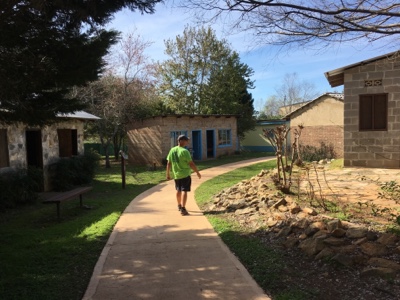

It was a relief to emerge on the walkway where stand replicas of homes Habitat builds in representative countries.  

Guatemala

Haiti

Kenya

Sri Lanka


Every house was distinctive.  That's because Habitat uses readily available local materials found in the country where they work.


Although it wasn't in use the day we visited, there was also an area where a Habitat volunteer could demonstrate brick-building techniques.

This beautiful quilt hangs in the Discovery Center.

Returning to the Discovery Center, we talked with a staff member who told us about the Global Village's volunteer trips (see this link for a list of prospective trips).  There are various opportunities from building homes to disaster recovery to working with vulnerable populations like children or the disabled.  There are even trips just for women.  I'm not sure I could do that, given my hearing loss and my need for an electrical source to recharge my hearing aid batteries every night.


Perhaps I'll just send Tim in my place.  That at least would be a step in the right direction!

Saturday, March 11, 2017

Florida's First Tourist Attraction


Before Orlando's Disney World was ever built, there was Silver Springs Park, Florida's first tourist attraction.


Ever since its opening in 1878, millions of tourists have visited this place and climbed aboard its glass-bottomed boats for a glimpse of its crystal clear springs and the fish, turtles and alligators within its environs.  Now that number includes Tim and I.


Where once there was an amusement park and a reptile farm with two albino alligators, now this state park hosts a number of hiking trails, 


a museum, an environmental education center, a campground and 


a grassy amphitheater that hosts nationally recognized names and local talents.   


It's a poplar place for kayakers.


Still, the glass-bottomed boats remain.  And with good cause!


Silver Springs' translucent waters are so stunning that it became a favorite location with Hollywood's movie and television producers.  


Sea Hunt, the television series airing from 1958 to 1961 starring Lloyd Bridges, was filmed here as were countless movies.  During the 1930s and early 1940s, one might have encountered Tarzan (or rather Johnny Weissmuller who portrayed the Ape Man) within the park.  Five of the original Tarzan movies were made here.  


Scientists tried to capture the Creature from the Black Lagoon from its waters in the 1954 eponymous movie.


Best of all, the park retains its charm of an earlier age.  For a view of natural Florida the way it used to be, a stop at Silver Springs cannot be missed.

Thursday, March 9, 2017

A Rainy Day in St. Pete

On a rainy day when the walls of our RV seemed to close in us, Tim and I fled to the scenic downtown waterfront of St. Petersburg, FL, the location of the city's museums.

St. Petersburg Museum of History

St. Petersburg Museum of History is a small museum and home to St. Petersburg's oldest resident Our Lady of the Nile, an Egyptian mummy estimated to be 3,000 plus years.


When King Tutankhumun's tomb was discovered in 1922, a wave of Egyptomania swept the country.  A circus operator staged shows up and down the Mississippi River that featured this Egyptian mummy which somehow ended up on a ship bound for Tampa Bay.  When it arrived, the ship's captain could not afford to pay the port fees so its cargo, including Our Lady, was confiscated.  The mummy apparently changed hands several more times before it found a permanent home here.


The museum also boasts an extensive display of 4,895 (at last count) baseballs autographed by famous coaches and players.  I suppose the size of this exhibit is not surprising, given that back in 1914, the St. Louis Browns began spring training here.  Today so many professional baseball teams train and play in Florida that their competition is informally known as the Grapefruit League.


Currently, the museum is hosting Fighting for the Right to Fight: African Americans Experience in WWII, a collection of artifacts, photographs and oral histories that we found absorbing.  

Alex Haley (1921-1992)

My favorite was the account of Alex Haley who wrote the 1976 bestseller, Roots, later released as a mini-series blockbuster on television.  I never knew about his military stint; how he served in WWII's Pacific Theater as an officer's steward and then as a career Coast Guard member.  His talent as a wordsmith was noticed by his fellow soldiers who paid him to write their letters home and by his superiors who promoted him to Journalist First Class.


The Dali Museum

Afterwards, we dodged raindrops as we dashed along a few city blocks to the Dali Museum, the most comprehensive collection of works by surrealist painter Salvado Dali outside Europe.  

Salvado Dali (left) with Reynolds and Eleanor Morse whose collection of his works formed the foundation of the museum.

Dali was a leading representative of surrealism, what is described as "the 20th century advant-garde literature and art movement that tried to unlock the creative potential of the unconscious mind."  Yet his body of works ranges from his early landscapes, portraits and still lifes to his mid-life surrealistic artwork to the immense religious paintings he created later in life.


The building itself is a work of art, with an interior three-story staircase that resembles a strand of DNA.  


We accepted audio tour cassettes and wandered through works from every major period of Dali's long career spanning the years from 1917 through 1976.  Listening to the cassettes while viewing selected paintings, we learned about the symbols prevalent in Dali's paintings such as his melting clocks that represent the omnipotence of time and its mastery over humans.

Below I've linked a few of the paintings I especially liked to their web pages in the Dali Museum's online Permanent Collection.

Daddy Longlegs of the Evening--Hope!

The Disintegration of the Persistence of Memory

Geopoliticus Child Watching the Birth of New Man

The Discovery of America by Christopher Columbus

Gala Contemplating the Mediterranean Sea which at Twenty Meters Becomes the Portrait of Abraham Lincoln-Homage to Rothko

The Gala really must be seen in person for its optical illusion to be so startling.


Tim's top pick was the Dreams of Dali, a virtual reality tour of Dali's 1935 Archaeological Reminiscence of Millet's "Angelus.

Archeological Reminiscence of Millet's "Angelus"

To venture inside the painting's twin towers or to view them from afar, we donned headsets that made us look like clone troopers from a Star Wars movie.  


It was a novel way to experience art.  And a great way to spend a rainy day!

Saturday, March 4, 2017

Fort De Soto


On August 19, 2016 at midnight, Tim tried to reserve a campsite in the popular Fort de Soto campground on the beach near St. Petersburg, FL.  But by 12:01 a.m., all the spots had been snapped up.  So he tried again the next night, only for this attempt, he was posed to quickly tap his way through the reservation web site.  


And this time he was successful!  That's how we came to find ourselves in this beautiful place on the Gulf of Mexico.  I guess it pays to plan ahead, especially when such primo places can only be booked six months in advance. 


Fort de Soto County Park sits on five interconnected keys (islands) at the mouth of Tampa Bay.  


From its white sandy beaches, we've had a ringside seat to watch the shipping trade headed in and out of the Port of Tampa.  


With over 37 million tons of cargo logged in 2016, there's been plenty of shipping activity for us to see.  But that's all taking place beyond the breakers.


We've stayed much closer to shore, instead enjoying the park's two swimming areas, North Beach and East Beach.  These are very popular on the weekends, but during the week, we've been part of a small crowd made up mostly of snowbirders and families with preschoolers.  


The park also has seven miles of hiking and biking trails and even a canoe trail for kayakers.


The historic Fort de Soto stands at the southernmost point of the park on Mullet Key.  First surveyed in 1849 by Brevet Colonel Robert E. Lee, the famed Civil War general, the point was occupied during the Civil War by Union troops who were stationed there to blockade Tampa Bay.


During the Spanish American War, Tampa became the port of embarkation for U.S. troops and supplies going to Cuba.  Consequently, in 1898 at the onset of that war, a military battery was constructed here and named Fort de Soto in honor of Spanish explorer Hernando de Soto.  Later the fort was turned over to the Marine Hospital Service and became a quarantine station, inspecting people arriving from foreign ports for disease and infections.  During World War II, the War Department decided to turn Mullet Key into a bombing range.  After the war, the area was sold to Pinellas County and in 1963 finally became a public park.  


Last weekend we enjoyed watching reenactors bring a portion of this history to life.


Our campsite sits on St. Christopher Key on the east side of Mullet Key Bayou, a popular location for kayakers.


There is heavy vegetation here which creates privacy screens between the campsites.


We were fortunate to snag a site right on the bayou which has been a great location for watching the sun set over Shell Key.


Of course, our main activity, if you can call it such, has been lounging in our beach chairs with a book to read.  Tim is working his way through The Wright Brothers by David McCullough.


Meanwhile, I've finished--
1.  Dead Wake: the Last Crossing of the Lusitania by Erik Larson;
2.  Summer Before the War by Helen Simonson, finds the inhabitants of the village of Rye tested as they prepare for WWI, a novel that is reminiscent of Downtown Abbey;
3.  Hero of the Empire: the Boer War, a Daring Escape and the Making of Winston Churchill by Candice Millard;
4.  What Alice Forgot gives her the chance for a do-over after a fall during her spinning class at the gym leaves her concussed, a novel by Liane Moriarty; and
5.  Lilac Girls by Martha Hall Kelly, a fictionalized account of a New York socialite cum charity worker Caroline Ferriday during WWII.

However, in Tim's defense, I must say that he has spent much more time swimming in the surf than I have.


Fort de Soto is the second county park campground we've stayed at this year.  We are fast becoming fans of Florida's county parks, finding them to be scenic, spacious and close to biking trails and waterfronts whether it's a lake as at John Prince campground or the beach here at Fort de Soto.

I don't know if life, as it says on so many kitschy tourist souvenirs, is truly better at the beach, but we've found that to be so here.