Friday, February 23, 2018

Helping Hurricane Irma's Victims


Sebring, FL was particularly hard hit by the effects of Hurricane Irma last September.  Gathering strength as the storm swirled across the Caribbean, its winds clocked near 185 mph, the storm's heavy rains and high winds blew debris, toppled trees and wrecked havoc with power lines leaving 98 percent of the Highlands County without electricity for a week or more.  Governor Rick Scott declared Sebring the second hardest hit in the state.  Five months later blue tarps still cover roofs where the storm ripped shingles off.


That was the situation when Tim and I arrived on Feb. 11, 2018 to join a Habitat for Humanity disaster recovery team.

Tim

Although we weren't directly involved in contacting affected residents and assessing their needs, Tim and I worked to finish a pair of homes by the end of February for two families displaced by the storm.

The Powells

The Powells with their baby and toddler have been living in a motel since their house was destroyed.  The other family of six is also eagerly awaiting their move-in date.

Mike and Cory

To meet that deadline, our zany site manager Mike and his cool assistant Cory ordered our tasks.

Rick

We set up ladders,

Linda

painted,

Doug

laid flooring

Tim and I

which even Tim and I learned to do,

Fran

painted,

Sandy

set tile,

Tom

painted,

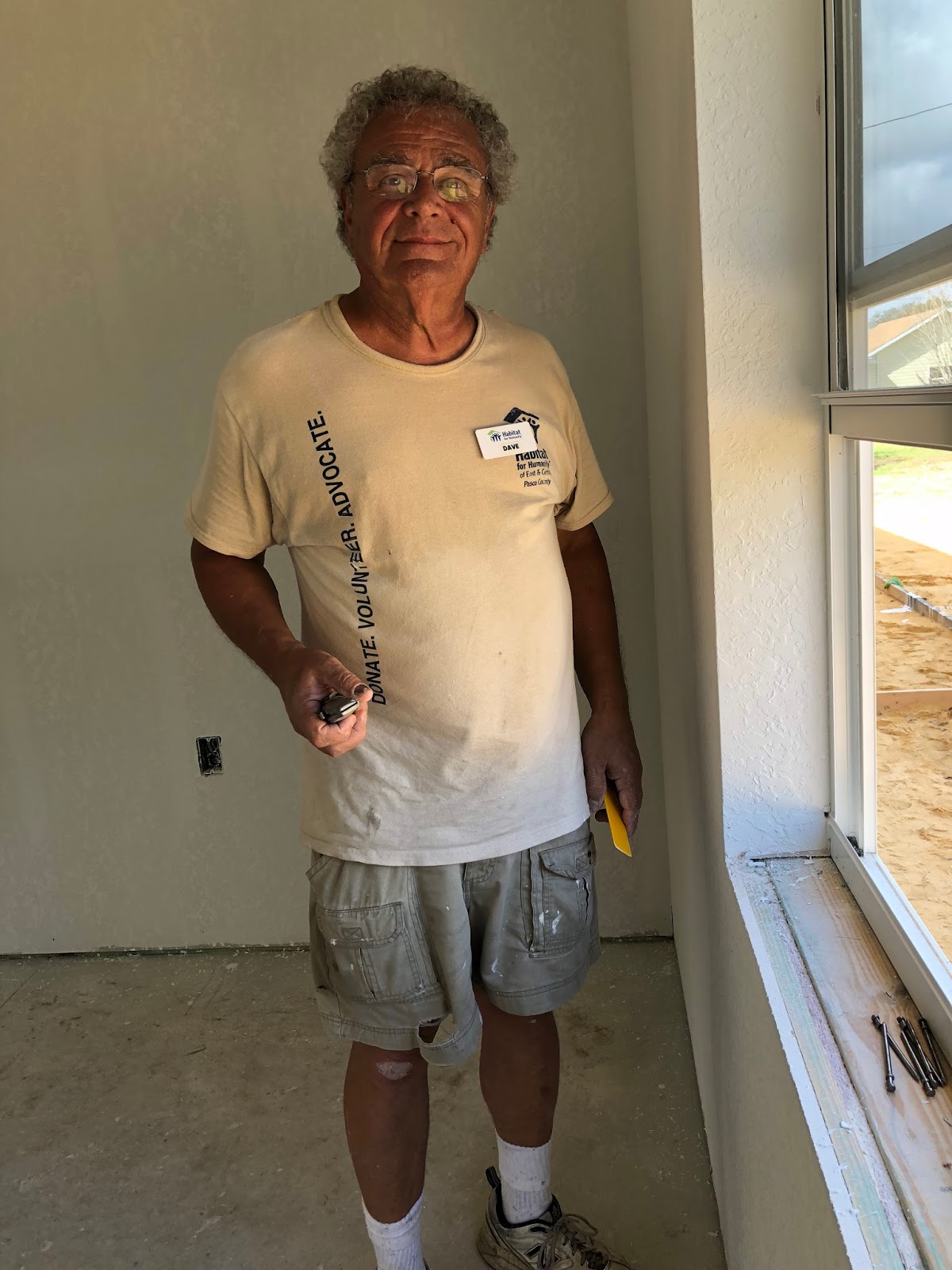
Dave

installed baseboard

Leon

and frames around the doors,

Nanci

painted,

Paula

caulked seams,

Chris

painted,

Bucky

hung doors inside, outside and


over the garage entrance,

Diane

painted,


and poured concrete driveways and sidewalks in the final stages of construction.


Oh, and did I mention?  We painted.

Ed

We also took well-deserved breaks as needed.


Along the way to our deadline, we forged friendships with members of our team and did our best to ensure that this cute little guy has a safe and secure home.

Saturday, February 3, 2018

The Sponge Docks of Tarpon Springs


The city of Tarpon Springs, FL where Tim and I have camped these last two weeks has the highest percentage of Greek Americans of any city in the United States.


Many of these immigrants were drawn here in the 1905, recruited by John Cocrois to work in the sponge industry.


In fact, the Sponges Docks, situated near the point where the Anclote River empties into the Gulf of Mexico, are still a place where one can watch the sponge boats return to harbor at the end of the day.  Greek restaurants, established to feed hungry crews, now cater to curious tourists eager to sample dolmades (grapevine leaves stuffed with rice and vegetables; meat is often included), spanakopita (a spinach and feta cheese pie stuffed between top and bottom layers of phyllo), or moussaka (a casserole featuring eggplant and other vegetables layered with meat sauce and topped with custard).  I chose the spanakopita for my lunch while Tim, never a gastronome, settled for gyros.


For dessert, neither of us could say no to a serving of baklava, a pastry created from layers of flaky phyllo with rivers of crushed nuts (walnuts, pistachios or pecans) and honey oozing out the sides.  Delicious!


Stuffed just like dolmades, we wandering in and out of tourist shops stocked with sponges, curios and Greek foods until we came to the visitors center.  There a knowledgeable docent related some of the history of Tarpon Springs.

St. Nicholas Greek Orthodox Church
Tarpon Springs, FL
St. Nicholas Greek Orthodox Cathedral is a historic church building and the center of Greek-American life in Tarpon Springs.  Its gold-gilded sanctuary is a sight to see, but even more mesmerizing is the story of its weeping St. Nicholas icon which I've quoted from the church's web site here.


"Beginning December 5, 1970, observers noticed the image was weeping watery tears, but no one can explain why this phenomenon occurred.  Finally, when Archbishop Iakovos arrived from New York City, he examined the icon and instructed the local priest to have qualified professionals study it and state their findings so that "belief may be strengthened or disbelief established."  None could explain it.  The icon continued to weep during the Christmas season for three more years.  December 8, 1973 was the last time the weeping was seen."


The church hosts an annual epiphany celebration on January 6 in which Greek Orthodox boys aged 16 to 18 dive into Spring Bayou to retrieve a cross, using the same free-diving techniques their Greek forefathers brought to America.


Before the Greek immigrants arrived at Tarpon Springs in the early 1900s, black and white fishermen from Key West and the Bahamas wielded hooks to harvest sponges from the Gulf of Mexico.  The Greeks, however, were accustomed to diving for the sedentary aquatic invertebrates with the soft porous bodies.  According to Wikipedia, Greek seamen "went out into the Mediterranean Sea in a small boat and used a cylindrical object with a glass bottom to search the sea floor for sponges.  When one was found, a diver went overboard to get it.  Free diving, he was usually naked and carried a 15 kilograms (33 lb) skandalopetra, a rounded stone tied on a rope to the boat, to take him down to the bottom quickly.  The diver then cut the sponge loose from the bottom and put a special net around it.  Depth and bottom time depended on the diver's lung capacity.  They often went down about 30 meters (100 ft) for up to 5 minutes."


I would love to see that.  Indeed, there are chartered boats today that will take you out to the Gulf to watch the divers (nowadays no longer naked) work.  But we settled instead into our beach chairs back at the campground where we had a ringside seat for watching the boats, trailed by opportunistic pelicans, return to the docks.


Monday, January 29, 2018

A Dedication Celebration


Tim and I have volunteered at 14 Habitat for Humanity builds since we began our full-time RV lifestyle in January 2016, but we've never been present when the keys to a finished house were handed over to the homebuyers.


However, at our most recent build in Dade City, FL, we were at the right place and the right time to witness such a dedication ceremony.


This family of three have experienced many challenges because of the medical needs of their daughter, but now they have a home that will provide some stability to their lives.

"Today, we gather to seek God's blessing upon this home.  By the favor of God and human labor, this home has been made ready" was the opening prayer of the family's pastor.


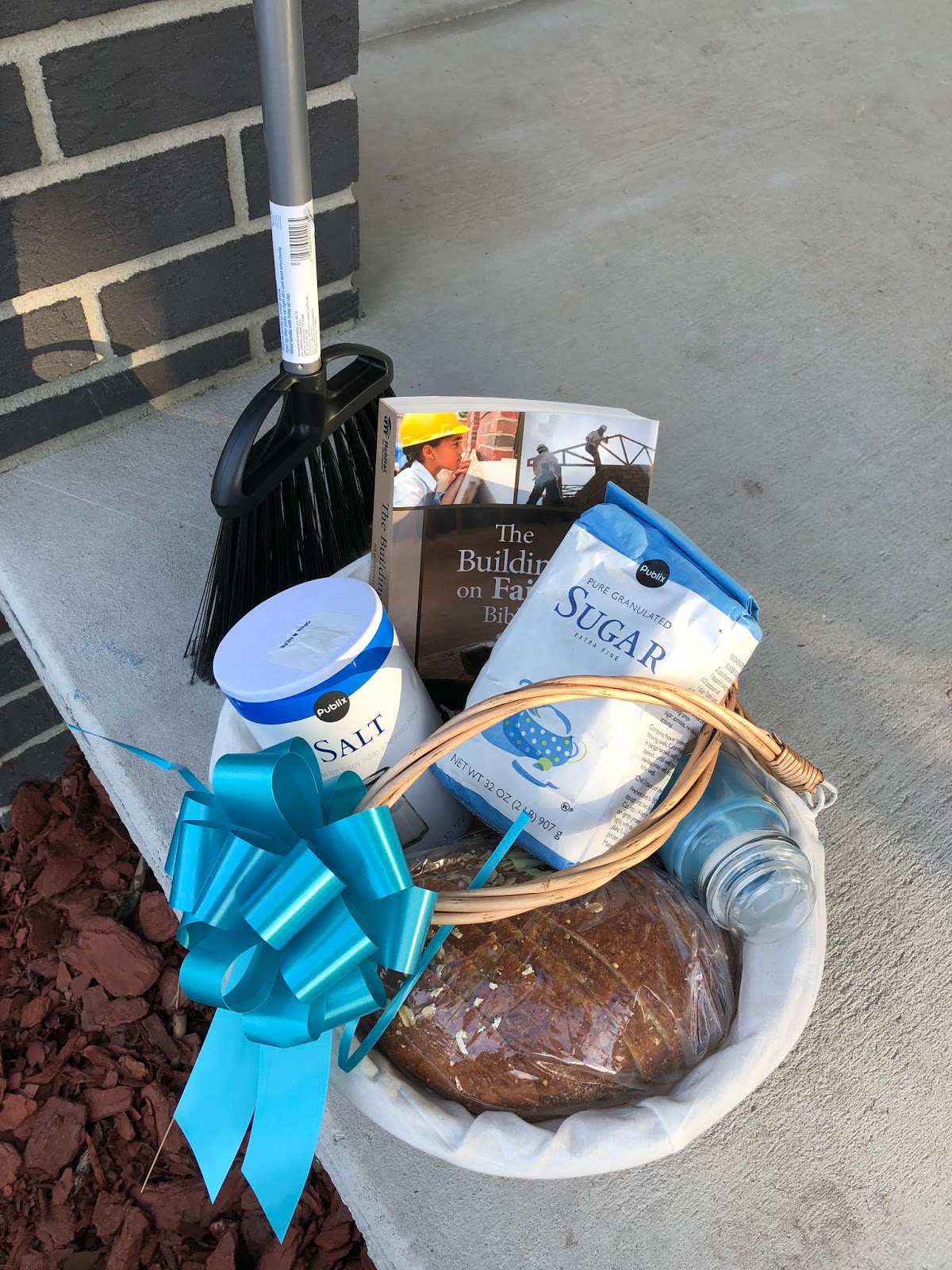
Then the family was given symbolic gifts: bread that the home will never know bare shelves; salt that the family will season the community by living lives of faith in God; sugar that they will always know the sweetness of life, even in tough times; a broom to sweep out the bad and sweep in the good; a candle that its light might remind them that God will always be their guide; and a Bible to feed their souls.


The local quilt guild also presented the family with a beautiful quilt made just for them.

The Habitat for Humanity affiliate in Dade City has been partnering with working needy families in Pasco County since 1992.  Homebuyers are carefully screened prior to their selection.  A down payment of $500 is made and subsequent monthly mortgage payments of no more than 30 percent of the family's earned income are assessed.  The money homeowners pay goes toward funding the construction of more homes in the community.  Homeowners put in 500 hours, if married, and 350 hours, if single, of sweat equity to help build their home or the homes of others in the program.  They also attend classes that teach them budgeting, basic home maintenance and other homeownership topics.

In the 26 years of its existence, the Dade City Habitat affiliate has never had a family default on their mortgage, an impressive statistic.  And only two families have sold their mortgages back to the affiliate because of life changes.

Welcome home, Chris & Meredith!

Friday, January 26, 2018

Demolition in Dade City


My experience during our first Habitat for Humanity build of 2018 held in Dade City, FL was more about demolition than construction.


I, along with the rest of the demo crew, spent six days removing two mobile homes from a lot where the local affiliate plans to build a future home.


John, a fellow Care-A-Vanner from Michigan, drove the bucket of the tractor into the sides of the homes to collapse the walls.


Then the women on our  team moved in to carry the debris into the dumpster.  I can't say that this was my favorite job of all the builds I've worked, but it was satisfying to see the lot finally cleared.


Tim, on the other hand, joined the construction crew.


The guys raised the trusses on the roof and then nailed the plywood to cover them.


For the final four days of this two-week build, my demo crew moved to a former migrant workers camp, a subdivision built in the sixties by the U.S. Department of Agriculture to house workers who picked and processed citrus from the orange groves that once were plentiful in the region.  The land where the now-vacant subdivision sits has been sold to Pasco County.  The county's Commissioners propose to bulldoze the buildings and turn the land into an industrial area.


But first, my crew moved in to salvage the aluminum siding used on the gables and soffits.


As the smile on Nanci's face attests, this was a much easier job than our first demo assignment.

Even though our two crews worked separately for the most part, we still developed close friendships with our teammates, forged by playing cards and games late into the night.

Sue & Kent, our team leaders

Jerry & Julie

Joe & Ron

Leon & Nanci

John & Janie
On our last day, local volunteers joined our Care-A-Vanner team for a group photo.


This was not a typical build, but sometimes you have to tear down in order to rebuild.  In a couple weeks, we're signed up for a Habitat build in Sebring, FL, an area hard hit by Hurricane Irma.  Undoubtedly, my demolition experience will come in handy there.

Sunday, January 7, 2018

The Best and Worst of 2017

"It was the best of times, it was the worst of times...," wrote Charles Dickens in the opening line of his novel, A Tale of Two Cities.  As I thought about our experiences over the past year, that sentiment seem to fit our 2017 year, too, in several categories.


Habitat Builds

When Tim and I set goals for our full-time lifestyle back in October 2015, we planned to participate in eight Habitat for Humanity builds a year.  We've discovered that's a little ambitious for us, given that we spend three months out of the year on the family farm helping with harvest.  This year we were only able to fit in six Habitat builds, three in Florida (Del Ray, Fellsmere, Eustis), Salisbury, CT, Sisters, OR and Mandeville, LA.

Delray Beach, FL

Fellsmere, FL

Eustis, FL

Salisbury, CT

Mandeville, LA

That low number was due in large part to my recuperation period from the surgery I had to implant a second cochlear device in my right ear last March.

Sisters, OR

But in reviewing those six builds, I would have to rank the build in Sisters, OR as the lowest contender, basically because of the air quality conditions we endured due to the proximity of the Milli wildfire that raged nearby.  Wearing respirators while we worked was not much fun; plus, spending two weeks painting the exterior of one house and the Thrift Store was not Tim's favorite assignment.

On the other hand, selecting the best Habitat build is not so easy.

Sue, Judy, Cindy & Marty in Fellsmere

Returning to Fellsmere, FL last January for a reunion with the people we worked with during our very first Habitat experience in 2016 was a joy.  It was wonderful to renew friendships and see the progress in the neighborhood the local Habitat affiliate is establishing there.

Mike, Marguerite & Tim in Salisbury

We also enjoyed the build in Salisbury, CT, where the small affiliate is just beginning to host Care-A-Vanners.

Mandeville, LA

And finally, the build in Mandeville, LA was the most rewarding work-wise because we started with a blank slate, just the concrete slab, and ended by raising the trusses and seeing the home take shape.

Milli Wildfire

Natural Phenomena

I mentioned the worst natural disaster we encountered above, the Milli wildfire that burned 24,079 acres before it was finally contained.  But the town it threatened, Sisters, OR, was also the scene of the most fascinating natural phenomena we saw.  Sisters was situated squarely in the middle of the 2017 solar eclipse's path of totality.  Darlene, our construction site manager, hosted a brunch at her mountaintop home where we were above the smoke that enveloped the town.


There we marveled as the moon progressively blocked the sun, causing birds to sing their nighttime calls and nocturnal species like bats to venture out as day turned into night for a brief 34 seconds.

Navigation 

The scariest navigation blunder we made in 2017 took us across the George Washington Bridge from New Jersey into Manhattan, NY.  Yikes!  Our miscalculation saw us inadvertently enter a parkway where we barely squeaked through the bridge underpasses.

Chimney Rock


In contrast, following the Oregon Trail through sparsely populated states last summer was a breeze.

Campgrounds

James County Campground near Charleston, SC

We stayed at so many of beautiful campgrounds this past year that picking only one is impossible.  Those that made our list were John Prince County Park, Fort DeSoto County Park, James County Park, Myrtle Beach and St. Lucie Lock.  We also liked the Mike Roess Gold Head State Park, even though it was the scene of our worst misadventure of the year.


Mike Roess Gold Head State Park

Cities

We logged over 15,000 miles as we traveled from Kansas to Florida to Connecticut to Kansas to Seattle to Kansas to Florida once again.  Along the way we visited many cities and found our favorites on both coasts.  The southern charm of Charleston, SC beguiled us while scintillating Seattle, WA wooed us in the West.  We also visited Victoria, British Columbia, another city we loved.

National Parks

Three more national parks were ticked off our list, Cuyahoga, Olympia and Mount Rainier as well as 14 other National Park Service historic sites.


Olympia with its three distinctive ecosystems was our favorite.  It's breathtaking vistas were stunning.  Unfortunately, our plans to visit Crater Lake were scuttled by the wildfires in Oregon last summer.


Personal Loss

Finally, the worst event of 2017 was the death of my dear mother on Dec. 6, 2017.  Although her dementia robbed us of her sparkling personality years before her passing, her face still lit up whenever she saw me.  I'm so thankful I was able to spend three months of this year caring for her.


The Bible says in Ecclesiastes 3:1 that "to everything there is a season and a time to every purpose under heaven.  That chapter goes on to list the best and worst of times in different seasons of life.  In many ways, that seems to sum up 2017 for me.