Monday, July 25, 2016

A Hikers' Paradise


Although its highest peak, Mount Cleveland, is less than 10,500 feet in elevation, Glacier National Park is nevertheless an alpine heaven for hikers. With over 700 miles of trails within the park to choose from, Tim and I traversed only a fraction of them. Still, the scenery we saw was beyond spectacular.

Dawn as seen from the KOA campground

We camped at the KOA campground in St. Mary, MT on the east side of the park.  That was best decision we made.  The east portion of the park is much less crowded than the western side.  Plus, we were only a quick drive to two sections of Glacier that are off the beaten path, the Many Glacier and Two Medicine areas.  

On our first day in the park, we jumped on the park's free shuttle and rode it up Going-to-the-Sun Road all the way to Logan's Peak.  That was a helpful introduction to the lay of the land.  


The early morning light at Logan's Peak
On the return trip, we bailed out at the trailhead near the St. Mary Falls shuttle stop so we could hike the Waterfalls Loop from St. Mary Falls to Virginia Falls and finally to Baring Falls.

St. Mary Falls


Virginia Falls


Baring Falls


One of the reasons I began this blog was to have a place where I could organize the photos I take on our journey by date and location and searchable labels.  With an Apple laptop, it's easy then to drag and drop the photos I need for any future projects. 

I'm afraid I got carried away with the camera on my iPhone.  There were so many incredible vistas that I kept snapping photos left and right.  I'm sad to say that behavior held true for the rest of our time in Glacier.  Too bad I don't have an editor to rein me in.  


Sunday, July 24, 2016

The Chateau de Mores

A watercolor of the Chateau de Mores by Medora Vallombrosa, the Marquise de Mores

Antoine Amedee Marie Vincent Amat Manca de Vallombrosa, the Marquis de Mores et Montemaggiore, named the town of Medora in honor of his wife.

Medora Vallombrosa, the Marquise de Mores

But that's not the only contribution he made to this community.

Marquis de Mores

He also came up with a simple but ingenious plan.  Instead of shipping cattle to the meat packing plants in Chicago, he would butcher the cattle there in Medora and capitalize on the new technology of refrigerated boxcars to transport the carcasses by rail back east.

The Chateau de Mores

Tuesday afternoon Tim and I visited the Chateau de Mores, a large frame house the Marquis built on a bluff overlooking the town.  The Marquis and his family used it as their summer home. There we learned more of the Marquis' venture.  

Optimistically, the Marquis bought a herd of cattle and built a slaughterhouse which opened in 1883.  Soon the business was butchering 25 cattle a day, but the Marquis wanted more. 

"I will become the richest financier in the world," he avowed. 

He built an addition to his plant with dreams of slaughtering 500 cattle a day.  In reality, though, the plant handled, at best, 85 beeves a day. 

Still, that was enough to satisfy the independently wealthy Marquis. All went along swimmingly until the Marquis was accused of the murder of a drunken hunter, Riley Luffsey. 

As the Marquis languished in jail, he wrote an angry letter to his neighbor, Theodore Roosevelt, accusing Roosevelt of framing him for the crime. Roosevelt replied, "I am most emphatically not your enemy."

Acquitted of the murder charges, the Marquis shook the dust of the town from his feet and departed for New York City. 

Only the chimney and the buildings' foundations remain.

In 1907, a fire broke out in the meat packing plant, a disaster that forced the closing of the plant. The town of Medora dwindled until the Theodore Roosevelt National Park was established in 1947, bringing tourists to the town. According to the spokeswoman at Medora's visitor information center, the town's population of 112 people, numbered in the 2010 Census, swells 90 percent during the tourist season, an astounding statistic. 

So, there you have it!  A brief history lesson about the boom, bust and rebirth of this frontier town!

We are en route to Glacier National Park, a place neither Tim nor I have ever been.  This road trip has already led us to some very spectacular spots.  Yet, people we've talked to have told us that Glacier is stunning.  We're excited to see Glacier's beauty for ourselves.  


Saturday, July 23, 2016

The Marvelous Medora Musical


When we pulled into our campsite Sunday afternoon, our next-door neighbor told us we must attend the Medora Musical.  "People come from miles around to see it," he said,  "In fact, it is the biggest show in all North Dakota."  With a rave revenue like that, how could we resist?

As its web site asserts, it was the rootin'-toutinest, boot-scootinest show in all the west.

Arriving at the Burning Hills Amphitheater with plenty of time to spare before the 7:30 p.m. show began gave me a chance to meet Theodore Roosevelt and his second wife Edith.  


That's not true!  Actually, I met Joe Wiegand, his impersonator, whose likeness and mannerisms were enough like the real Teddy to fool me. 


There was also time to duck into the gift shop for a look at the rows of Teddy Bears dressed in Rough Rider uniforms and wearing spectacles like those worn by the real Teddy. 


Then it was time to make our way down the steps of the outdoor amphitheater to our seats. 


There we watched the shadows grow as the sun slipped behind the hills. 


Dominating a nearby bluff overlooking the amphitheater were two live elk.  Corralled in a small pen, their silhouettes stood out in sharp relief against the darkening sky. 


Anticipation built; then, startled by the appearance of a stagecoach whose horses pulled to a stop in center stage, we settled back to enjoy the show.  The mistress of ceremonies climbed out of the coach and launched into the opening number.  And from there, the show only got better as the troupe of singers/dancers tripped the light fantastic. 


To put icing on the cake, the full moon rose in the eastern sky during the intermission and, for a few minutes, hung perfectly posed between the buildings of the set.  Cameras and iPhones flashed as the audience tried to capture the sight. 


Soon the singers returned for a Rough Rider tribute to Theodore Roosevelt before concluding with the song, Proud To Be An American. 


Two cowboys whose figures were lit with spotlights rode up to the summit of the bluff.  Fireworks burst in the sky as the spotlights dimmed; then, faded away, leaving the hillside illuminated by the Medora Musical logo. 


It was a grand finale to a marvelous show. 


Wednesday, July 20, 2016

A Home Where the Buffalos Roam


You have one, you know!  A home where the buffalo roam and it's one that belongs to all Americans.  

For the past four days, we've been in Medora, ND, where the buffalo roam.  No, they don't wander the streets here; they're quite happy to stay within the boundaries of Theodore Roosevelt National Park.  Still, their presence is felt.  And how could it not be so? The entrance to the park is found right off Pacific Avenue, the main street through the town.   


This national park is the only one named in a person's honor and there's none better for the National Park Service to salute than Theodore Roosevelt, the man who, during the course of his presidency, set aside 230 million acres of land for public use.


Burdened with grief from the deaths of his mother and his wife who passed away on the same terrible day in February 1884, Teddy fled west to the badlands of North Dakota.


There he found solace in the vastness of the landscape.

He never spoke of his wife after that, but with time he did heal.  Emerging from his sorrow with the restlessness that was so characteristic of his nature, he became a cattle rancher, although not a very successful one.  Still, the badlands changed him in ways that shaped the remainder of his life.

"I have always said I never would have been President if it had not been for my experiences in North Dakota," said Roosevelt. 

And we Americans are all the richer, thanks to his transformation.


The Maltese Cross cabin, the three-room structure that was Roosevelt's first Dakota home, stands behind the park's South Unit Visitor's Center.  Foundations of the buildings at Elkhart Ranch, also found within the park, are all that remain of his second cattle operation.


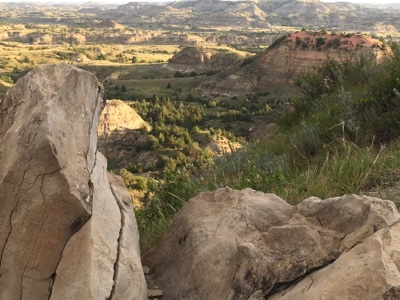
Sunday, as we drove west across the state to where the park began at Painted Canyon, I was thunderstruck by the colorful bluffs and hills that rose out of the prairie grassland.  The hills stretched as far as my eyes could see.  This morning we returned to Painted Canyon Visitor Center which, by the way, doubles as a rest stop on Interstate 94, to hike its nature trail loop.  The nature trail was not our first choice, but we decided in its favor after our access to the main trail was blocked by a herd of the woolly beasts I mentioned above.

Painted Canyon Nature Trail

Within the park itself, the 36-mile Scenic Loop Drive takes 90 minutes at a minimum to circumvent--longer if one stops to hike the trails as we did.  

Lower Paddock Creek Trail

Jones Creek Trail

Buffalo guarding our exit from Jones Creek Trail

We tried to keep our distance from the bison and wild horses who call the park home. This fellow, however, was waiting for us at the end of Jones Creek Trail.  We gave him a wide berth, taking his photo from the car after we scrambled safely inside. 


A buffalo can weigh up to 2,000 pounds and sprint at 30 mph.  I think a mama buffalo could probably exceed that, if you are foolish enough to come between her and her calf.  After all, that would be a very impolite way to treat the lady who is hosting you in her home.

Happy buffalo, happy home, happy life!  We preferred to keep it that way!


Sunday, July 17, 2016

A Close Encounter with Devil's Tower


If you've seen the 1977 movie, Close Encounters of the Third Kind, then you've seen Devil's Tower National Monument where much of the movie was filmed.  Richard Dreyfess, the movie's leading character, is a blue collar worker in Indiana, who becomes obsessed with UFOs after a close encounter with one. Subsequently, he is troubled by mental images of a unique-looking mountain, Devil's Tower.  He becomes convinced that alien beings will land at Devil's Tower.  What happens next, I'll leave to your imagination.


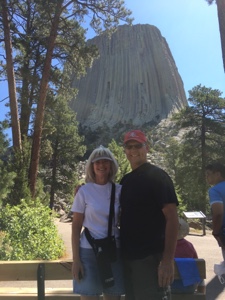
Fantasy and reality merged for Tim and I when, for the past two nights, we stayed just outside the gates of Devil's Tower at the KOA campground, the purported location of the landing pad used by the aliens' mothership in the movie. 


Capitalizing on the movie's cache, the campground's management hosts showings of the movie every night at 8 p.m.  With Devil's Tower towering over us, we set up our lawn chairs with the other families staying at the camp, suspended all belief, and settled back to be transported into this science fiction story.  


Periodically, I found my eyes drawn upward to the night sky, searching for any UFOs. I wasn't the only one to do so; I noticed many of the kids were looking skyward, too. I hope none had nightmares that night.  


Earlier in the day, we caught the two-hour guided hike with Erin, a seasonal ranger at the park.  She told us how molten magma was forced into the sedimentary rocks above it where it cooled, contracted and fractured into columns. Over time, the sediment eroded, leaving Devil's Tower exposed. 


"The Tower," she said, "is a sacred site to the six Native American tribes who live in the area."  Indeed, we saw many prayer pouches tied to trees as we followed Erin around the boulder field at the base of the tower.


Tribal legends tell of a boy and his seven sisters playing at the base of a giant tree when the boy is struck dumb. His fingers turn into claws and fur sprouts all over his body, turning him into a bear.  Terrified, the sisters run from him to the tree which bids them to climb it.  As they do so, the tree begins to rise in the air.  Angered by their flight, the bear rakes his claws down the tree, scoring its sides into columns.  The seven sisters were borne into the sky and become the stars of the Pleiades. 

There are two climbers in this photo: one standing 2/3's up the center column; the other 1/3 from the bottom in the cleft.

As she recounted the legend, we looked at the tower's columns and spotted, at several points, a dozen technical climbers ascending to the summit.  The National Park Service struggles to maintain the site in a way that is respectful of the Native Americans' beliefs while accommodating the recreational pursuits of those who visit the park. To that end, the park is voluntarily closed to climbers during the month of June. 

Climbers have ranged in age from a six-year-old boy to an eighty-year-old man.  

George Hopkins

Most famous was George Hopkins who, in 1941, parachuted from a plane to land upon the summit and remained there for six days until he was rescued by a party of technical climbers. 


Although the road into the park was empty early Saturday morning, it soon was clogged with visitors who came for this weekend's Festival of Bats. Rangers and volunteers manned booths that ranged in topic from bat detection and elocution to the white nose syndrome that is decimating bat populations in the eastern United States. 


Tim was most fascinated by the ranger climbers who tag bats living on the tower. In addition, the rangers place web cameras within certain columns of the tower to observe their behavior. 

Now, that's a close encounter!   


Postscript:  The Circle of Sacred Smoke (shown above) is one of three sculptures created by Japanese artist Junkyu Muto as part of his International Peace Project. He placed the rest at other spiritually significant sites in the world, the Vatican in Rome and Bodh Gaya, India where Buddha reached his enlightenment.  It does look like smoke, doesn't it?