Showing posts with label Famous Homes. Show all posts

Monday, August 12, 2019

Idyllic Seaside Village Or Gritty Industrial City?


St. Andrews-By-the-Sea, New Brunswick

Our first three days in New Brunswick were a study in opposites.  The magical charm of St. Andrews-By-the-Sea casted its spell over us while the bustling industry of Saint John made us thirsty for its great craft beers.

As I mentioned in my post, Our Canadian Road Trip, I was given the job of planning my family's trip to our neighboring country to the north.  Luckily for me, the list of places we wanted to see fell neatly into three very distinct sections: New Brunswick's Bay of Fundy, Prince Edward Island, and Québec City.

Having spent the last three years living full time in an RV as my husband and I traveled across the United States, I knew we needed to stay at least two nights in one spot if we were going to experience even the slightest introduction to an area.  Richard's schedule was not a problem.  As a middle school teacher, he had the summer off.  Jillian, on the other hand, was limited by the amount of leave time she had and even with that leave, she still needed to spend time logged into her work.  With that in mind, I mapped out our trip.

Leaving Portland, we drove four hours through the sparsely populated north woods of Maine where yellow hazard signs warned of moose crossings.  I hadn't seen such signs before, nor did we actually encounter a moose, much to Jillian's disappointment and Tim's relief.  A run-in with one of Maine's official state animals that weigh nearly 1400 pounds could have put an end to our road trip very quickly.  We crossed the Canadian border with little fanfare at St. Stephen, New Brunswick, our first saintly city.  The guard, after perusing our passports at the little-traveled post, waved us through with a welcoming smile.  Oh, Canada!  We have arrived!


I'd made reservations at a bed-and-breakfast in St. Andrews-By-the-Sea, a quaint seaside village voted Best Destination in Canada in 2017 by USA Today.  Founded by British Loyalists who fled the colonies in 1783, the names of the town's streets--William, Edward, Augustus, Frederick, Adolphus, Elizabeth, Sophia and Mary--are a roll call of the children of then reigning monarch, King George III.

After checking in to our B&B, we walked down to the harbor in search of dinner.  Our B&B host had recommended The Gables Restaurant so we gave that a try, and boy!  Were we glad we did!


With its outdoor patio and delicious menu choices, The Gables served us a scrumptious supper with a spectacular sunset as the backdrop.


Turning in the opposite direction, we could see the Pendlebury Lighthouse at the mouth of the harbor.  It was a good introduction to this charming city by the sea.


The next morning we visited the Algonquin Resort.  With its view of the Passamaquoddy Bay, this historic hotel commands the town's high ground as it has since it was built in 1889.  The Canadian Pacific Railway took over the luxury hotel's management in 1903 and holiday passengers flocked to this terminus.  Uncharacteristically, Tim and Richard passed up a chance to play golf on the resort's links, choosing instead to visit nearby Ministers Island.
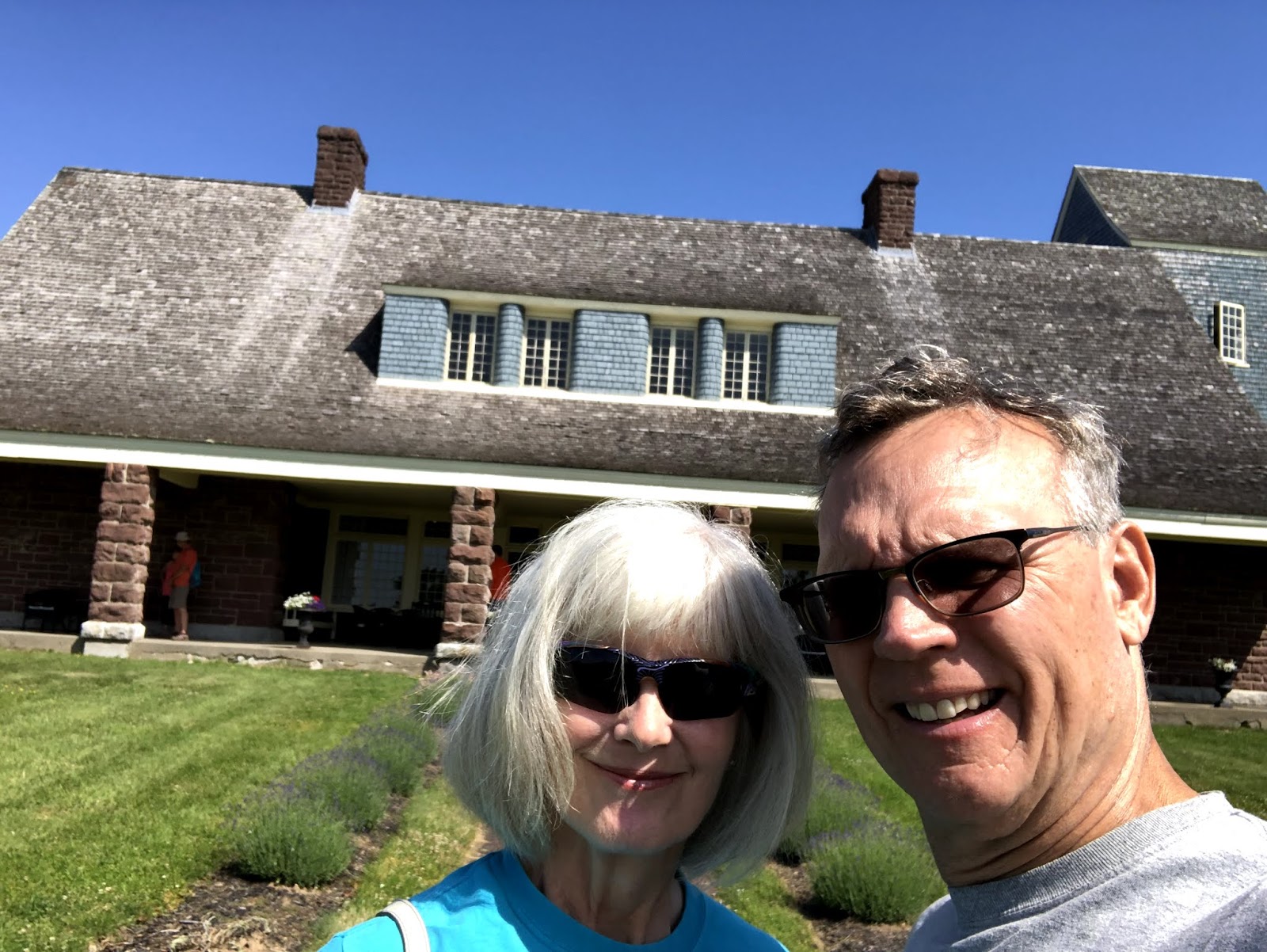


Sir William Van Horne built his summer home, Covenhoven, (see above) on Ministers Island.  He was the president of the Canadian Pacific Railway who extended the railroad all across Canada in 1885, a feat he accomplished in half the projected time.

Courtesy of Proptonics
www.ministerisland.net
Visitors to the island have to keep an eagle eye on the tide charts because one must drive across the ocean floor when the tide is low enough to reveal it.  I thought the ocean floor would be muddy and sandy, but just like the biblical parting of the Red Sea, the exposed bar was firm enough for a car's passage.  The trip was worth it to see the "modest" (if you believe that a home that has 50 rooms is modest) manor of Covenhoven and its beautiful grounds.


We were most intrigued by Covenhoven's bathhouse.  This turret allows one to descend from the headland to the changing rooms at beach level.


Later we hiked a portion of the island's circumference, passing Parson Andrew's house for whom Ministers Island is named.  Now that is what I'd call modest!  However, we had to cut our hike short in order to make the trip back across the sea bottom before the tide would overrun the road.  We returned later that evening at high tide to find the causeway buried under 14 feet of ocean water, a good example of the Bay of Funny's renown tides, the highest in the world.

Photo courtesy of Kingsbrae Garden

St. Andrews has other attractions as well.  Kingsbrae Garden at the top of King Street is a beautifully designed masterpiece of perennials and sculpture gardens, made even more amazing when you consider how short the growing season is in New Brunswick.  We also made time to visit the Sheriff Andrews House, Greennock Presbyterian Church and the Loyalist Burying Ground.


After another stunning sunset, we hit the road the following morning with plans to spend the next two nights in Fundy National Park.

Lepreau Falls


Along the way, we stopped at Lepreau Falls and then Saint John, New Brunswick.  Is every town in this sparsely populated province named for a saint?  It certainly seemed that way.  Saint (which is never abbreviated!) John is a gritty industrial city with a reputation for good eats and great craft beers.

Reversing Falls

It's also the location of Reversing Falls, a geological wonder.  Water streaming out of the St. John Gorge is backed up by the incoming tide from the Bay of Fundy, making the river seemingly reverse direction.


Knowing we had time to kill before we could check into the cabins at Fundy National Park, we decided to take a tour of the Moosehead Brewery, Canada's oldest independent brewery.  Susannah Oland began brewing beer here in 1867 and six generations later Oland descendants still own and operate the business.


Throughout the tour, our guide gave us small tastings of the different beers they craft.  My favorite was their version of Radler, a brew that mixed beer and grapefruit soda, a weird combination that nevertheless was tasty.  Richard  liked their small batch Stout while Tim's and Jillian's favorites fell somewhere in the middle of the spectrum.

Thankfully, our designated driver Tim did not sample all the tour's offerings and so he was fit to continue our trip to Fundy National Park.  Goodbye, saintly cities!

Friday, September 7, 2018

Warm Springs

FDR's Little White House

The day Franklin Delano Roosevelt died there was an outpouring of grief from every corner of America.  FDR was the only president my parents could remember from their childhood.   They were born near the beginning of his unprecedented four terms in office and young adults when he died of a cerebral hemorrhage on April 12, 1945 in Warm Springs, Georgia.  They talked of how Roosevelt rescued America after the Great Depression and how he led the United States to the brink of victory in World War II.  Both of them could remember the shock of the nation at his passing.

So when I discovered that Warm Springs was only an hour away from where we were volunteering in Americus, Georgia, I persuaded Tim that we needed to visit there to pay our respects to one of the greatest leaders in American history.

The chair where FDR was sitting when he suffered his fatal stroke.

Roosevelt's Little White House in Warm Springs is now a State Historic Site maintained by the Georgia State Park system.  Roosevelt built the modest, six-room, single-story home in 1932 several years after learning that the warm springs nearby were reputed to have a salutary effect on polio patients.

FDR's wheelchair and leg braces are on display at the park's museum.

Roosevelt himself was stricken with polio in 1921 as a young man and his legs were paralyzed.


Swimming in the 88-degree spring waters did not bring a miracle cure, but he believed it brought improvement.


Roosevelt made 41 trips to the west Georgia town from 1924 until he died there.

FDR's custom built 1940 Willys Roadster is on display in the Warm Springs State Park Museum.

During his stays, Roosevelt loved to drive the county back roads in a succession of automobiles especially equipped with hand controls.  Along the way, he would often pull over to speak to townspeople and farmers alike.


Hearing the plight of the farmers, some say, directly influenced Roosevelt's New Deal programs.  In fact, the president called Warm Springs the birthplace of the Rural Electrification Administration.  Georgia farmers were especially hard-hit by the Depression and the lack of electricity slowed their recovery.  Electric companies were reluctant to string wire to widely dispersed farms, but by banding together, along with federal funding, farmers joined in electric cooperatives.  My grandfather, a staunch Democrat who enthusiastically voted for FDR each election, canvased neighboring farmers in southern Stafford County, Kansas to sign them up for the REA.

Elizabeth Shoumatoff, Unfinished Portrait of Franklin D. Roosevelt, 1945 [Watercolor], Warm Springs State Park Museum, Warm Springs, Georgia

The day FDR died, Elizabeth A. Shoumatoff was painting his portrait while he pored over documents at his desk.  An exhibit at the Warm Springs museum recounts that she lured his gaze from his work by asking questions about his stamp collecting hobby.  As the butler prepared the table for lunch, FDR prophetically said to her, "We have fifteen more minutes to work."  Elizabeth described in her memoir that soon after he suddenly "raised his right hand and passed it over his forehead several times, without emitting a sound, his head bending slightly forward."  She immediately rushed to tell the Secret Security guard that something was wrong.  She never finished the portrait.

After his collapse, FDR was carried by his staff to his bed in the next room where at 3:35 p.m. after tremendous medical effort, President Franklin D. Roosevelt, age 63, was pronounced dead.

Scandalously, it was Roosevelt's mistress, Lucy Mercer Rutherford--and not his wife--who was present with him when he died.  She, along with Shoumatoff, quickly left the Little White House in expectation of the arrival of his wife Eleanor.  Although shocked and angered by the renewal of his extramarital affair first begun in 1916, Eleanor set aside her feelings to notify her daughter Anna, her four sons who were scattered around the world while serving in the military and Vice President--now President--Harry Truman.  Then she made funeral arrangements.


Thousands like the man pictured above lined the rails to bid farewell as FDR's casket was taken by train to Washington.

Orson Welles encapsulated the nation's grief when he wrote the New York Post's eulogy for President Franklin D. Roosevelt beginning with these simple words: "He's gone.  We can't believe it, but he's gone.  The dark words throw their shadow on the human race; Franklin Roosevelt is dead."


Friday, July 20, 2018

We're Baaack!


We're baaack!  On The Great River Road, that is!  After a detour to the Winnebago Factory in Forest City, we rejoined the The Great River Road at Prairie du Chien, Wisconsin.

"Prairie of the Dog?"  That made little sense to me until I learned that early French traders named it as a tribute to Chief Alim, whose name meant Dog in the language of the area's Fox Indians.  This small town (population 5,911 at the 2010 census) was first established on the strategic triangle of land where the Mississippi and Wisconsin rivers join as a trading post by French fur voyeurers who sold goods to the Fox in exchange for pelts.


One of the jewels of this pretty town is Villa Louis, the estate begun by fur trader-turned-entrepreneur Hercules Dousman in the mid-1840s and expanded by his son, H. Louis Dousman.  When Louis inherited the property upon his father's death in 1868, he dismantled the earlier home and replaced it with this Italinate mansion built to reflect the family's wealth.  He began to breed and race horses and even built a race track on the estate.  His wife Nina was an accomplished hostess who held lavish entertainments in the elegant home.  I could almost picture the lawn and dinner parties held here.


Across the Mississippi are the Effigy Mounds now maintained by the National Park Service.


These bear-shaped mounds best seen from the air march in a line along the top of the limestone ridges in Iowa just across the Mississippi from Prairie du Chien.  Created by people now known as Woodland Indians between 800 and 1,400 years ago, they were possibly religious sites or burial grounds.


To Tim and I, they appeared as gentle rises barely discernible until we looked closely.  Then you could see them take shape.


The park also has some of the most scenic overlooks of the Mississippi we've seen.


That's also true at Pikes Peak State Park just a few miles south.  There one can easily see where the Wisconsin River flows into the Mississippi.  Tim and I enjoyed the view before hiking to Bridal Veil Falls just a short distance away.


On our back to our hotel room, we took advantage of the free wine tastings at Eagles Landing in Marquette, Iowa.  We walked out the door with two bottles of Sassy Cindy's Wild Rhubarb Wine which that sort of negated the "free" come-on placard on the sidewalk, but it was delicious.

So we're back on track with 350 miles to go before we reach Minneapolis, miles that will unroll, I'm sure, with many more Great River Road attractions.


Monday, July 9, 2018

America's Hometown


Hannibal, Missouri is a town with a big heart.  Not content with being Mark Twain's childhood haunt, this town of nearly 18,000 people wants all its visitors to feel welcome here in 'America's Hometown.'  We couldn't think of a better place to spend the 4th of July than this Mississippi river town in the northeast corner of Missouri.


Well, I can think of a few other memorable locations where we've celebrated Independence Day.  There was the 4th of July summer symphony concert and fireworks display in Colorado Springs' Memorial Park where Tim popped The Question and lost his independence by marrying me.  I can also recall numerous celebrations on the rooftop of our home in Tucson, the best vantage point for watching the fireworks displayed by several of the city's resorts.  Finally for many years, we joined approximately half-a-million Americans on the National Mall in Washington, D.C. for a Capitol 4th concert that always ended with the stirring sounds of Tchaikovsky's 1812 Overture as the opening salvo of cannons and rockets lit up the sky.  But I'd have to say that for homespun charm, Hannibal takes the cake.


Many small towns hold parades and a few even host arts & crafts fairs, but nowhere else may you watch wannabe Tom Sawyers compete in whitewashing a fence.  And that's not the only test.


Teens with an encyclopedic knowledge of Twain's literary masterpiece and Hannibal history go through several rounds of auditioning to make it to the top ten finalists who will portray Tom and Becky Thatcher at appearances throughout the year.


Their first responsibility is to lead the parade down Broadway to Main Street.


The parade was a spectacle that included the fire department's pumper truck, shriners on scooters, break dancers from the academy of dance and a cement-mixer truck masquerading as Uncle Sam.  All sashayed down the street to the tune of John Phillip Souza's Stars and Stripes Forever played by the high school marching band.


After the parade, the crowd dispersed as families headed off to sample the many attractions of Hannibal.  The Mark Twain Hotel, the Mark Twain Riverboat, the Mark Twain Cave--are you beginning to see a pattern here?  I believe Twain himself would be proud to see how his hometown has prospered by appropriating his name for its many attractions.

"I was born the 30th of November, 1835, in the almost invisible village of Florida, Missouri...[My parents'] first crop of children was born [in Tennessee], but as I was of a later vintage, I do not remember anything about it.  I was postponed--postponed to Missouri.  Missouri was an unknown new state and needed attractions."  ~ Autobiography of Mark Twain

Mark Twain's Boyhood Home

We decided the best place to start our exploration of the town was to visit Mark Twain's Boyhood Home.  For the price of one ticket, we gained entry six properties.

Becky Thatcher's House

Becky's house was actually the home of Laura Hawkins, a lifelong friend of Twain.

Huckleberry Finn's House

I had a hard time believing that Huckleberry Finn ever lived in a house.  So I was reassured to learn that was the home of another of Twain's childhood friends, Tom Blankenship, upon whom Twain based the character of Huckleberry Finn.  The office of his father, J.M. Clemens, who was Hannibal's Justice of the Peace Office, the Interpretive Center and the Museum Gallery were the other three properties.


In the Museum Gallery are the illustrations Norman Rockwell created for the 1935 editions of The Adventures of Tom Sawyer and The Adventures of Huckleberry Finn.  To make his drawings as authentic as possible, Rockwell visited the city of Hannibal and the famous Mark Twain Cave.


There he realized that all the previous illustrators of Twain's classics had got it wrong.  They'd painted the cave with stalactites hanging from the roof when it was actually a limestone formation where rock had fallen away leaving horizontal jutting ledges and a corridor that led deep into the bluff.


Ready to get out on the river, Tim and I climbed aboard the Mark Twain Riverboat for a hour's ride.  Among the sights pointed out by the pilot were

The Mark Twain Memorial Bridge

See?  What did I tell you! Every place in and near Hannibal is named for Mark Twain.

Lovers' Leap

We restrained ourselves from making the plunge and in the background, Jackson's Island, the real landmark that famously became Huck and Injun Joe's hideout in Twain's book.


Finally, it was time for the fireworks.  We, along with hundreds of Hannibal natives and visitors, climbed to the top of the levee that protects the city from flooding.


From that vantage point, we watched the pyrotechnics as they were launched from Lovers' Leap into the darkened sky.  The end to a very memorable 4th of July.