Showing posts with label History Museums. Show all posts

Friday, September 14, 2018

Last Train to Clarksville

Miniature Train display at Clarksville's Customs House Museum

Our stopover in Clarksville, Tennessee, brought to mind this song by The Monkees, that wanna-be-the-Beatles band of the 1966-1968 television show.

"Take the last train to Clarksville
And I'll meet you at the station
You can be there by four-thirty
'Cause I've made your reservation,
Don't be slow
Oh, no, no, no
Oh, no, no, no"

The final line of the lyrics is a mournful, "And I don't know if I'm ever coming home."  Well, I do know that I'm coming home.  Tim and I are en route to the farm in Kansas where corn is standing tall in the fields waiting to be harvested.  We'll be there until November to harvest not only corn but soybeans as well.  Yet, on our way we took two days to see the historic city of Clarksville, Tennessee.


As the Civil War moved closer, Clarksville, with its 5,000 inhabitants, was considered a prize for the Union Army because of its location on the Cumberland River, its steamboat landings and railroad crossing, plus its iron works which were capable of producing small arms, cannon and shells.  Clarksville and the Confederate defense at Fort Defiance were critical to stopping federal forces from reaching Nashville.


When Union iron-clad gunboats steamed toward the town, city leaders decided that a wiser course would be surrender.  Thus, the fort was taken without a shot being fired.


Little remains of Fort Defiance today.  Its earthworks are slowly being reclaimed by nature as you can see below, but the Fort Defiance Interpretative Center's exhibits explain its importance.


Union control of the Mississippi and its tributaries meant control of North America and guaranteed victory of the war.  With so much riding on this key location, Tim and I felt our stop at the interpretative center to learn more about Clarksville's history was well-worth our time.


We also enjoyed our stroll along the downtown's scenic McGregor Park Riverwalk beside the Cumberland River.  The river's east-west course with its connection to the Ohio and Mississippi rivers made Clarksville an important link for shipping goods from Pennsylvania to New Orleans.


Today, as we saw, barges still float goods along its waterway.


The Customs House Museum and Cultural Center is another must-see.  The beautiful building built in 1898 was once a post office and also a customs house created in response to the area's huge tobacco trade.  Now it tells the story of the city and nearby Fort Campbell, home of the 101st Airbourne Division which its first commanding general, Major General William C. Lee, said "had a rendezvous with destiny."  Certainly the Division has played a role in every war since World War II and is still vital to our nation's defense today.


Before we left town, we hiked a portion of the Clarksville Greenway, a 6-mile trail that follows an abandoned railroad bed.  The greenway meanders along a creek underneath a canopy of hardwood trees.  With outcroppings of rock, it's a pretty place to work off pounds.

However, a text from my brother Jon told us he has started to pick corn.  So--

"Don't be slow!
Oh, no, no, no!
Oh, no, no, no!"

Postscript:
Tim and I arrived at the farm two weeks ago but with all the hubbub, I laid aside this last installment until now.  We're here until November.  Thanks for following our travels!

Saturday, September 1, 2018

Corbin


Besides Cumberland Falls which I wrote about in my last post, our friends Rick and Julie showed us two more reasons why they love their hometown of Corbin, Kentucky.


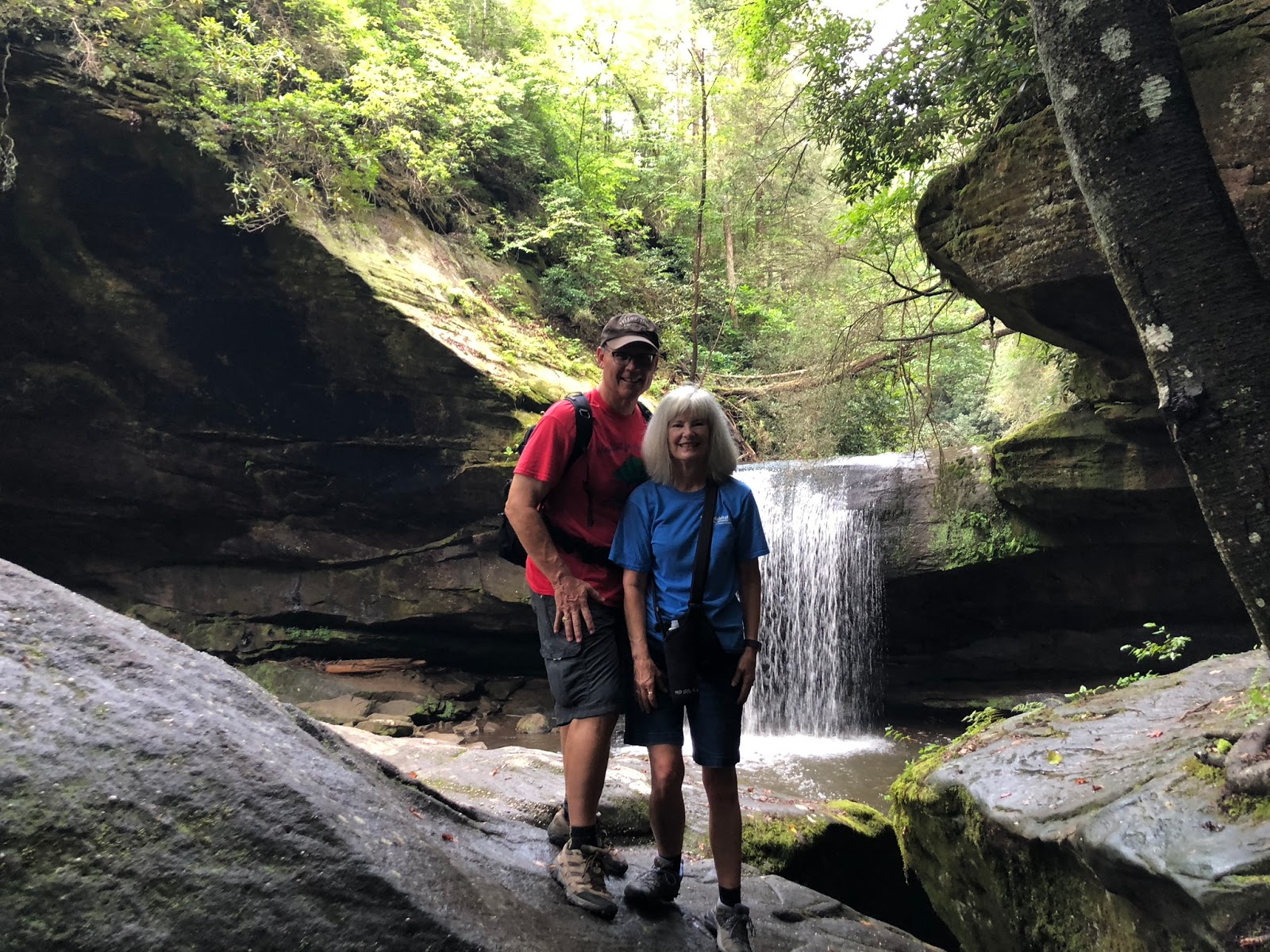
A hike to a hidden waterfall with a picnic supper as a reward revealed the beauty of the area.


There you can walk behind the waterfall's drop just as the girl above is doing!


Or clamber up a rock for the perfect photo op!


Back in town is the Harland Sanders Cafe and Museum.


You might better know Harland Sanders as Colonel Sanders, the man behind Kentucky Fried Chicken fast food restaurants.  After working a variety of jobs (farmhand, soldier, railroader, insurance salesman and ferryboat operator), Sanders moved his family into quarters behind a gas station in Corbin which is on the main route to Florida from the north.  Traffic slowed during the Great Depression so Sanders who liked to cook, augmented his earnings by serving meals to travelers.  And thus, Kentucky Fried Chicken was born!


The Sanders Cafe in Corbin was Colonel Sanders' first restaurant.  Inside you can place your order at the KFC counter or browse the exhibits, memorabilia and restorations of 1940s-vintage rooms including the kitchen where Kentucky Fried Chicken was perfected.  Ah, finger lickin' good!

I can see why Rick and Julie love it here!


Monday, July 30, 2018

Mary's City


In the 1970s hit TV series of the Mary Tyler Moore Show, her character Mary Richards, newly arrived in Minneapolis from the fictional small town of Roseburg, Minnesota, exuberantly flings her beret into the air, an iconic toss featured each week in the opening sequence of the show.  Hoping to make a fresh start in a new career, Richards had fled to Minneapolis after breaking up with her boyfriend and fell in love with this city of skyways.  When we visited the city a couple weeks ago, I did, too.


Tim and I had planned to spend our week in Minneapolis with our children, but conflicts arose and they were unable to join us.  Disappointing, but since neither Tim nor I had visited here before, we decided to give the city a fair trial.


First on our itinerary was a major league baseball game between The Twins and the Tampa Rays.  Smarting from a demoralizing loss to the Rays the night before (19-6, ouch!), the Twins roared back to defeat their opponents 11 to 7 on Sunday, July 15th.


Under a clear blue sky we, along with 25,559 other fans, cheered them on.  When Brian Dozier hit a grand slam with loaded bases in the overtime 10th inning at Target Field, the crowd went wild and I fell in love with the Twins.  How thrilling!  America's game at its best!


Then back to our downtown Airbnb condo to quickly shower off the sunscreen and don our best clothes.  We had tickets to see West Side Story at the Guthrie Theater.


The director, Joseph Haj, tweaked this musical retelling of Romeo and Juliet to speak to contemporary immigrant tensions by turning the white gang members of the Jets into a mix of Afro-Americans and second generation whites who rumble with the more recently arrived Puerto Ricans.

The stage's backdrop showed a tilling State of Liberty.

The tragic story of Maria and Tony, the star-crossed lovers caught between the racial loyalties of the Jets and the Sharks, shines amid finger-snapping choreography and the music of Stephen Sondheim and Leonard Bernstein.  I loved it!


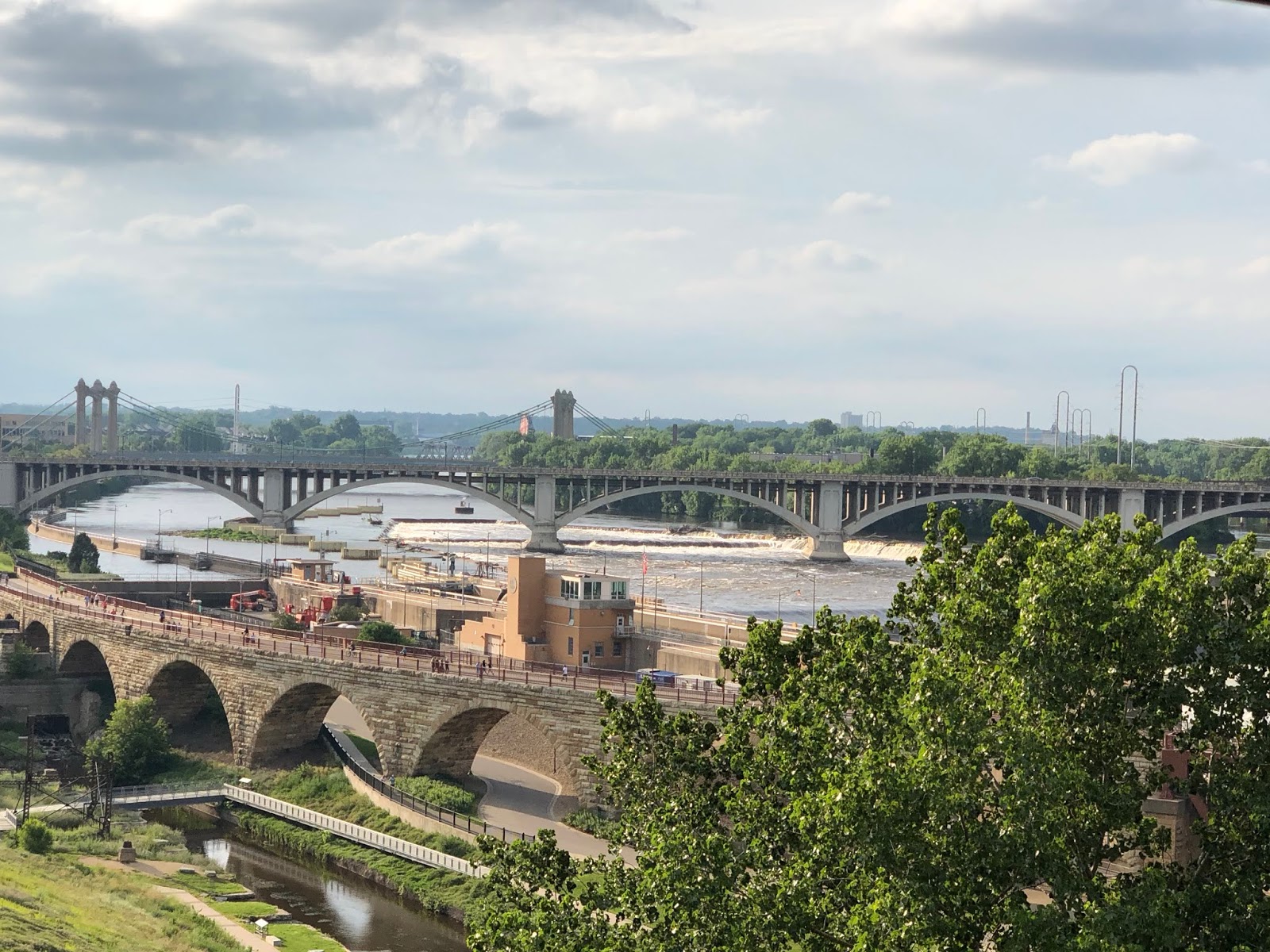
I also loved the view of the Mississippi River from the 4th floor outdoor balcony of the Guthrie Theater.


On Monday our friends Chris and Doug who we met at our very first Habitat build in January 2016 showed us their beloved city by bicycle.


Their friends, (now our friends) Gary and Joanne, joined us as Doug cycled us along the Mississippi River to Minnehaha Falls and past five beautiful bodies of water in the Chain of Lakes (Nokomis, Lake Harriet, Bde Maka Ska, Lake of the Isles and Cedar Lake).


Doug even took us to see the fictional Mary Richards' apartment which is actually a house that was recently on the market for $1.6 million.

With stops for lunch


and ice cream


and numerous photo ops,


Spoonbridge and Cherry is the centerpiece of the Walker Art Center's Sculpture Garden.

we enjoyed much of what makes Minneapolis consistently ranked as one of the top bike cities in the country.


Plus, we had a great time with friends, both new and old.

Frederick R. Weisman Art Museum
Artist unknown, "Ring It Again, Buy U.S. Gov't Bonds," 1918
James Montgomery Flagg, "I Want You For U.S. Army," 1917

During our bicycle ride, I'd caught a glimpse of the futuristic-looking Weisman Art Museum across the Mississippi River on the campus of the University of Minnesota and determined to pay it a visit the next day.  Designed by Frank Gehry, the museum was hosting an exhibition entitled "Fight or Buy Bonds," a collection of propaganda posters produced to rally Americans to support the Allies during World War I.  All the posters included in the exhibit were wonderful but James Montgomery Flagg's Uncle Sam poster is undoubtedly the most famous.


Our final day in this city nicknamed The Mill City began appropriately at the Mill City Museum built in the ruins of the Washburn "A" Mill, once the world's largest flour mill, which was destroyed by an 1878 explosion and rebuilt the following year.

St. Anthony Falls 

Cadwallader Colden Washburn bought the waterpower rights on the Mississippi in Minneapolis in the early 1870s and with his partner, John Crosby, built a number of flour mills that along with his rival competitor, Charles A. Pillsbury, put Minneapolis on the map as the nation's flour-milling capital.  "It required 375 railroad cars, or a train two and a half miles in length, to move the average daily output of the Minneapolis flour mills," wrote a reporter for the Kittson County Enterprise in 1886.  Washburn-Crosby became General Mills in 1928 with a focus that gradually shifted from milling flour to producing cereals and baking mixes.  When the mill was closed in 1965, machines that had been here for decades were simply left in place.


Most of those machines were destroyed on February 26, 1991, when a fire swept through the building.  The mill was abandoned until the Minneapolis Historical Society took it over and refurbished it as this museum which opened in 2003.


Interesting to me was the museum's exhibit about Betty Crocker.  My mom's Betty Crocker Picture Cookbook which she received as a wedding gift in 1951 is losing its front cover and its well-worn pages are smeared with flour and stained with ingredients.


I learned to cook with the help of its step-by-step instructions illustrated with pictures.  When I was a little girl, I thought Betty Crocker was a real person, but instead she was created to answer the flood of questions about baking the Washburn-Crosby Company received following a 1921 promotion for the company's Gold Medal Flour.  As a high-school senior, I took the Betty Crocker Homemaker of Tomorrow exam as a lark, but my test results embarrassingly earned me the award.


I'm sure Mary Richards, a feminist icon during the Equal Rights Amendment era, would have been just as appalled by the award as my adolescent self was.

Tuesday, July 17, 2018

Going Off The Road


Tim and I left the Great River Road temporarily for a detour to Forest City, Iowa where Winnebago RVs are manufactured.


Tim wanted to tour their factory and I had no choice but to come along.  Not that I'm complaining; it's pretty amazing to see how these homes on wheels are made.  Plus, Tim allowed me to plot our course to some interesting places along the way.


With our first stop being the Herbert Hoover Presidential Library and Museum in West Branch, Iowa, we added another presidential library to the list of those we've already visited.

Cartoon on display at the Herbert Hoover Presidential Library and Museum.

I think we Americans have denigrated Hoover as the president who failed to bring the United States out of the Great Depression, but after visiting here, I have a new respect for him.

This two-room cottage is where Hoover was born.

I never knew that he was raised by his maternal aunt and uncle after his Quaker parents died.

Herbert Hoover, Age 3
Photo on display at the Herbert Hoover Presidential Library and Museum

Nor did I know that after graduating from Stanford, he made a fortune as a mining engineer working for companies in Western Australia and China and later as an independent mining consultant who traveled the world until the start of World War I.

Herbert Hoover
Photo on display at the Herbert Hoover Presidential Library and Museum

By 1914 with wealth more than $4 million, Hoover used his a portion of his fortune to organize an unprecedented relief effort for the hungry citizens of Belgium who were caught between the warring nations of Germany and France.  This earned him world-wide recognition as "The Great Humanitarian," notoriety that brought him to his first elected office, the presidency in 1928.  Yet, within a few short months, the global hero had become a scapegoat in his own land eventually losing his bid for re-election in 1932.

President Harry Truman with former President Herbert Hoover
Photo on display at the Herbert Hoover Presidential Library and Museum

Still, when President Harry Truman invited Hoover to undertake a post-World War II global relief effort, Hoover did what he did best, rescue those ravaged by war.


Next stop, Cedar Rapids, Iowa!  There Tim accompanied me to see the loft studio of Grant Wood.

Grant Wood, American Gothic, 1930 [Oil on beaver board], The Chicago Institute of Art,.

This was where the artist painted American Gothic in 1930, a painting that reminds me of my grandparents.  The farmer above is almost a dead ringer of my paternal grandfather.


Famous for wearing farmer's bib overalls, Wood lived here with his mother and often his sister as well while he created the paintings that soon linked his name with other Regionalist artists like Thomas Hart Benton and John Steuart Curry.


After seeing Wood's studio, who could resist visiting Cedar Rapids Museum of Art where the world's largest collection of Wood's paintings may be found?  Tim, that's who!  A little dose of art is enough for him, but he graciously allowed me 30 minutes to visit the museum while he sat in the car, checking his email.

Grant Wood, Young Corn, 1931 [Oil on masonite], Cedar Rapids Museum of Art, Cedar Rapids, Iowa.

My favorite was Wood's bird's eye view of a corn field in his Young Corn painting.  The precision of the corn plants on the rolling hills vies with the puffy trees for your attention and almost overwhelms the farm family figures below.  After traveling halfway across Iowa with its miles and miles of corn fields, I could understand why Wood would choose corn for his subject.  Such fields are everywhere!

Grant Wood, The Mourner's Bench, 1921-1922 [Oak, carved and stained] Cedar Rapids  Museum of Art, Cedar Rapids, Iowa.

His "Mourning Bench" especially caught my eye as an example of his sense of humor.  He carved the three woeful and crying children's heads for the bench while the rest was made with the help of his art students from McKinley Junior High School.  As a former middle school teacher myself, I could imagine the warm relationships he forged with his students.

The Historic Park Inn Hotel

Passing through Mason City, Iowa, we stopped at the Historic Park Inn Hotel, the last remaining hotel designed by Frank Lloyd Wright.  His commission here was to build a bank, a hotel and law office in one unified building that would anchor a downtown corner in this small county-seat community.


The result is vintage Prairie School: a long, low look with an overhanging roof and his signature windows.


Windows, however, are what's missing from the ground floor of the bank he added to the east side of the structure.  That ploy gives the bank a vault-like appearance, a "strong box," indicative of the building's purpose.  The hotel reopened its doors to the public in 2011, following a 18.5 million-dollar renovation that added en suite baths to rooms where no two are alike.


Finally, the law office on the second floor is now a quiet spot for hotel guests to read or work.


Then on to the Winnebago factory tour, the main reason for this side jaunt.  There we were tempted to buy this new Class B recreational vehicle, a miniature model of the real van.  At least, its price fit our pocketbook!