Showing posts with label TN. Show all posts

Friday, September 14, 2018

Last Train to Clarksville

Miniature Train display at Clarksville's Customs House Museum

Our stopover in Clarksville, Tennessee, brought to mind this song by The Monkees, that wanna-be-the-Beatles band of the 1966-1968 television show.

"Take the last train to Clarksville
And I'll meet you at the station
You can be there by four-thirty
'Cause I've made your reservation,
Don't be slow
Oh, no, no, no
Oh, no, no, no"

The final line of the lyrics is a mournful, "And I don't know if I'm ever coming home."  Well, I do know that I'm coming home.  Tim and I are en route to the farm in Kansas where corn is standing tall in the fields waiting to be harvested.  We'll be there until November to harvest not only corn but soybeans as well.  Yet, on our way we took two days to see the historic city of Clarksville, Tennessee.


As the Civil War moved closer, Clarksville, with its 5,000 inhabitants, was considered a prize for the Union Army because of its location on the Cumberland River, its steamboat landings and railroad crossing, plus its iron works which were capable of producing small arms, cannon and shells.  Clarksville and the Confederate defense at Fort Defiance were critical to stopping federal forces from reaching Nashville.


When Union iron-clad gunboats steamed toward the town, city leaders decided that a wiser course would be surrender.  Thus, the fort was taken without a shot being fired.


Little remains of Fort Defiance today.  Its earthworks are slowly being reclaimed by nature as you can see below, but the Fort Defiance Interpretative Center's exhibits explain its importance.


Union control of the Mississippi and its tributaries meant control of North America and guaranteed victory of the war.  With so much riding on this key location, Tim and I felt our stop at the interpretative center to learn more about Clarksville's history was well-worth our time.


We also enjoyed our stroll along the downtown's scenic McGregor Park Riverwalk beside the Cumberland River.  The river's east-west course with its connection to the Ohio and Mississippi rivers made Clarksville an important link for shipping goods from Pennsylvania to New Orleans.


Today, as we saw, barges still float goods along its waterway.


The Customs House Museum and Cultural Center is another must-see.  The beautiful building built in 1898 was once a post office and also a customs house created in response to the area's huge tobacco trade.  Now it tells the story of the city and nearby Fort Campbell, home of the 101st Airbourne Division which its first commanding general, Major General William C. Lee, said "had a rendezvous with destiny."  Certainly the Division has played a role in every war since World War II and is still vital to our nation's defense today.


Before we left town, we hiked a portion of the Clarksville Greenway, a 6-mile trail that follows an abandoned railroad bed.  The greenway meanders along a creek underneath a canopy of hardwood trees.  With outcroppings of rock, it's a pretty place to work off pounds.

However, a text from my brother Jon told us he has started to pick corn.  So--

"Don't be slow!
Oh, no, no, no!
Oh, no, no, no!"

Postscript:
Tim and I arrived at the farm two weeks ago but with all the hubbub, I laid aside this last installment until now.  We're here until November.  Thanks for following our travels!

Thursday, July 5, 2018

More Memphis Museums


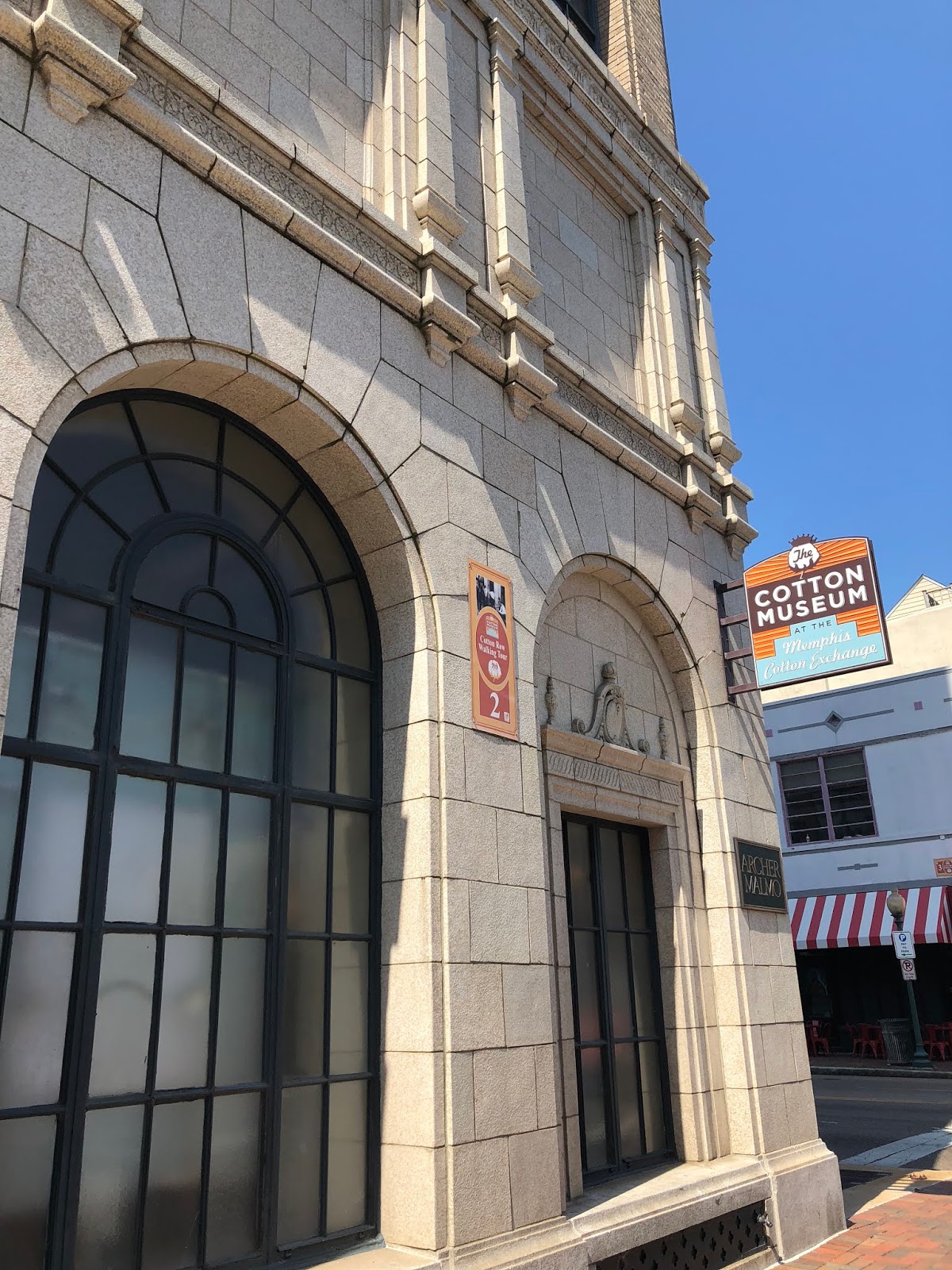
Tim and I were in Memphis for just three days, one of which we spent with Ron, the new owner of our Prevost bus.  None of those days fell on a Tuesday when many of the city's museums offer free admission after 1:00 p.m., but we lucked upon the Cotton Exchange Museum.  This small museum is always free and even better, it was just around the corner from the downtown apartment we rented through Airbnb.


Walking into the Cotton Exchange Museum, we stepped back in time to when Memphis cotton traders stood on this very floor and made their bids on shipments of cotton.


By 1850 America was growing three-quarters of the world's cotton and much of it passed through Memphis.  To buy and sell on the Memphis Cotton Exchange, one had to become a member or work through a member.


The Exchange was a flurry of activity.  Every national brokerage firm had representatives on the floor; telephone operators updated the rapidly changing market; markers wrote changing prices on the board and Western Union runners hurried from the floor to offices up and down Front Street where cotton factors, merchants, and mill representatives did business.

Members of the Exchange were the upper crust of Memphis society.  The Memphis Cotton Carnival, organized in 1931, was a series of parties and festivities with a Royal Court of young debutantes.  Everything changed in the mid-1980s with the advent of the computer which made it possible to get prices and make trades electronically.  The character of the cotton business may have altered, but echos of the importance of cotton to the economy and culture of Memphis may still be heard here.


Turning to another huge influence upon Memphis, we visited the Mississippi River Museum at River Park on Mud Island.  Mud Island is actually not an island but a peninsula almost completely surrounded by the Mississippi River.


It's accessible by a quarter-mile walk over a covered bridge or by a quick ride on the monorail suspended beneath the bridge.  Of course, we chose to take a unique ride on the monorail and best of all, its ticket was included in the price of admission to the museum.


Once there we found a marvelous scale model of the Mississippi River in a flowing water feature that stretches five city blocks.  This miniature river is marked with the cities, bridges and historical markers to give visitors a unique perspective of the river.  My previous experiences with the Mississippi River were only quick crossings over interstate bridges and while the span of the Mississippi is impressive at Memphis or St. Louis, I had no idea how the river twists and turns back upon itself like a serpent.  Indeed, who knew of its horseshoe bend at New Madrid, Missouri!  Certainly not I, but then I'm getting ahead of myself.  More about New Madrid, Missouri will be forthcoming in a future post.

Having read Hernando DeSoto's name on so many historical markers while we wintered in Florida, I was surprised to learn that his 1539 expedition led him to the Mississippi River Valley.  He expected to find gold and treasures as great as those in the Inca and Aztec empires.  Instead, sick and disappointed, DeSoto died during the expedition and was buried somewhere on the banks of the river.


Unlike DeSoto, the next explorers came from the north determined to find a passage to the Pacific Ocean and claim the continent's interior for France.  Their names were Louis Joliet and Jesuit Father Jacques Marquette.  Upon reaching the mouth of the Arkansas River, the two realized that the Mississippi flowed into the Gulf of Mexico and wishing to avoid a confrontation with the Spanish, they returned north.

French explorer Sieur de LaSalle's expedition of 1682 was much more successful.  On April 9, 1682, after reaching the mouth of the Mississippi, LaSalle and his men erected a column affixed with the royal arms and claimed the entire Mississippi Valley for France.

Fast forward to the 1819 when Memphis was laid out by General Andrew Jackson, Judge John Overton and General James Winchester on a 5000-acre land tract which they owned and promoted for settlement.  Although population growth was slowed by recurring bouts with cholera, malaria, yellow fever and smallpox, the favorable location of the port to both the South and the West attracted large numbers of settlers.  By 1860, Memphis was a city of over 18,000.


A segment of the population that was not so settled were the river pilots and gamblers who brought entertainment and vice to the people living in the scattered and isolated river towns.  Prior to this visit, when I pictured Memphis, I always imagined a heroine twirling a parasol while promenading on the upper deck of a steamboat as it pulled into the city's dock.


Usually present in my imaginary plot was a swarthy river gambler, the villain of the story.   Appeasing my imagination, the museum gives more than just a tip of the hat to the Golden Age of the Steamboats that ran roughly ten years before the Civil War and for a few years after.


Perhaps no other river in the world has spawned as many music styles as the Mississippi River.  The sounds of spirituals, work songs, field hollars, Delta blues, ragtime, jazz, swing and soul music resound throughout the Mississippi Valley.  The Mississippi River Museum does justice to them all.


I titled this post "More Memphis Museums" and indeed there are more for us to visit the next time we come.  These two museums, plus the attractions I wrote about in the preceding two posts, were all we could cram into our three days here.  All the more reason to plan a return trip to Memphis at a future date!

Tuesday, July 3, 2018

I've Been To The Mountaintop


“I’ve been to the Mountaintop,” declared Martin Luther King, Jr. in his final speech the night before his assassination.  He was tired, having flown from Atlanta to Memphis to lend his support to the sanitation workers’ strike, now in its 52nd day.  Memphis sanitation workers had walked off the job to protest the unsafe conditions, unjust treatment and unfair wages they faced every day.  Dr. King supported them, saying “all labor has dignity.”


The strike was provoked by the gruesome deaths of Echol Cole and Robert Walker who were crushed in the compactor of their garbage truck on February 1, 1968.  Now the garbage piled up on the city streets of Memphis while black and city leaders negotiated terms to end the strike.  City leaders were determined to deny the sanitation workers a living wage while black leaders wanted not only that but the recognition of their right to equality and dignity. 


On April 3, 1968, Dr. King left his room at the Lorraine Motel to attend a rally at Mason Temple, the original headquarters of the Church of God in Christ.  Fierce wind and driving rain rattled the windows as the crowd awaited King’s arrival.  When he took to the podium, he stirred the crowd with his vision of having been to the mountaintop, looked over and seen the Promised Land.  It was one of his most memorable speeches and it was also his last.  


The next evening King was in a jovial mood as he left his motel room in the company of his brother A. D. King, Rev. Andrew Young and Reverend Samuel Kyles bound for dinner at Kyles’ home.  Across the Mulberry Street, James Earl Ray lay in wait for a clear shot, the shot that ended Dr. King’s life.


Tim and I visited the Lorraine Motel, now the site of the National Civil Rights Museum while we were in Memphis.  I was only fourteen years old when King was assassinated and totally oblivious of the events leading up to that fateful night so the story of the sanitation workers’ deaths with the subsequent strike was new to me.  However, that is only a tiny fraction of the stirring stories the National Civil Rights Museum shares.  


Rosa Parks, 


the Freedom Rides, and 


Greensboro sit-ins plus several other important civil rights events are creatively exhibited at the museum.  


Growing up in a small town in Kansas did not afford me much interaction with blacks, but viewing the exhibits here created an empathy within me for the hardships they face.  This museum is well-worth a visit.

Sunday, July 1, 2018

The Birthplace of Rock & Roll


After several months of deliberation, Tim and I have decided to sell our bus.  Although we've enjoyed our two and a half years of full-time RV life, we miss the sense of being part of a community with friends, neighbors and a church family nearby.

Our buyer Ron

Tim found a buyer from Florida who was interested enough to meet us halfway in Memphis, Tennessee.  Low and behold, Ron brought cashier checks with him, sufficient to meet our asking price.  So, in one fell swoop, we've gone from being--in Tim's words--trailer trash to being homeless.

This decision doesn't mean we never plan to travel again.  We're committed to helping Habitat for Humanity at builds across the country.  Plus, there are still so many places we'd like to see in the U.S. and Canada, but we're downsizing from a motorhome to possibly a van camper while we look for a place in Florida or South Carolina.  Towards that end, we plan to work our way up to the Winnebago factory in Forest City, Iowa, for a closer look at the Travoto.  But first, there's Memphis to see, the birthplace of rock and roll.


Of course, the mecca here is Graceland, the 13.8-acre estate of the legendary Elvis Presley, the "King of Rock and Roll."  Fans from around the world line up to see where "The King" lived and so did we.   Caught in a time warp of the 1960s-1970s, Graceland recalls what was truly state-of-the-art technology for luxury homes of that time period.


Peacock stained glass windows in the living room, green shag carpet on the ceiling of the "Jungle Room," more than 350 yards of fabric covering the billiard room and three televisions tuned to the three major networks in the man cave downstairs wowed us.  The home is not huge, but the surrounding acreage included a swimming pool, the corral for Elvis' palomino horse named the Rising Sun and enough garages to shelter his pink Cadillac and the rest of his fleet of cars.

Gladys, Elvis and Vernon Presley

However, what impressed me most about Graceland was the sense of family.  Elvis was very close to his parents, Vernon and Gladys Presley, perhaps because he was their only child made so by the stillborn death of his identical twin brother, Jesse Garon.  Elvis always swore that he would build a house for his poverty-stricken parents, if he had the chance.  When he moved to Graceland, his parents moved in with him along with his paternal grandmother, Minnie Mae.  Minnie Mae outlived them all, remaining at Graceland until her death at age 89 on May 8, 1980.  Lisa Marie, Elvis' only child, still returns to Graceland on occasion, moving into the upper story that is sealed off from the viewing public.


Tim and I didn't pay the extra bucks so we could behold all those sequined and fringed jumpsuits Elvis wore.  Nor did we drop a dime to peek at his favorite automobiles.  However, it was only a $5.00 upgrade to climb aboard his two private jets so what the heck!  We splurged.  The cabins of both were custom-designed to fit the preferences of Elvis.


What caught my eye were the gold-plated seat belts.  Can you imagine buckling yourself into such splendor?


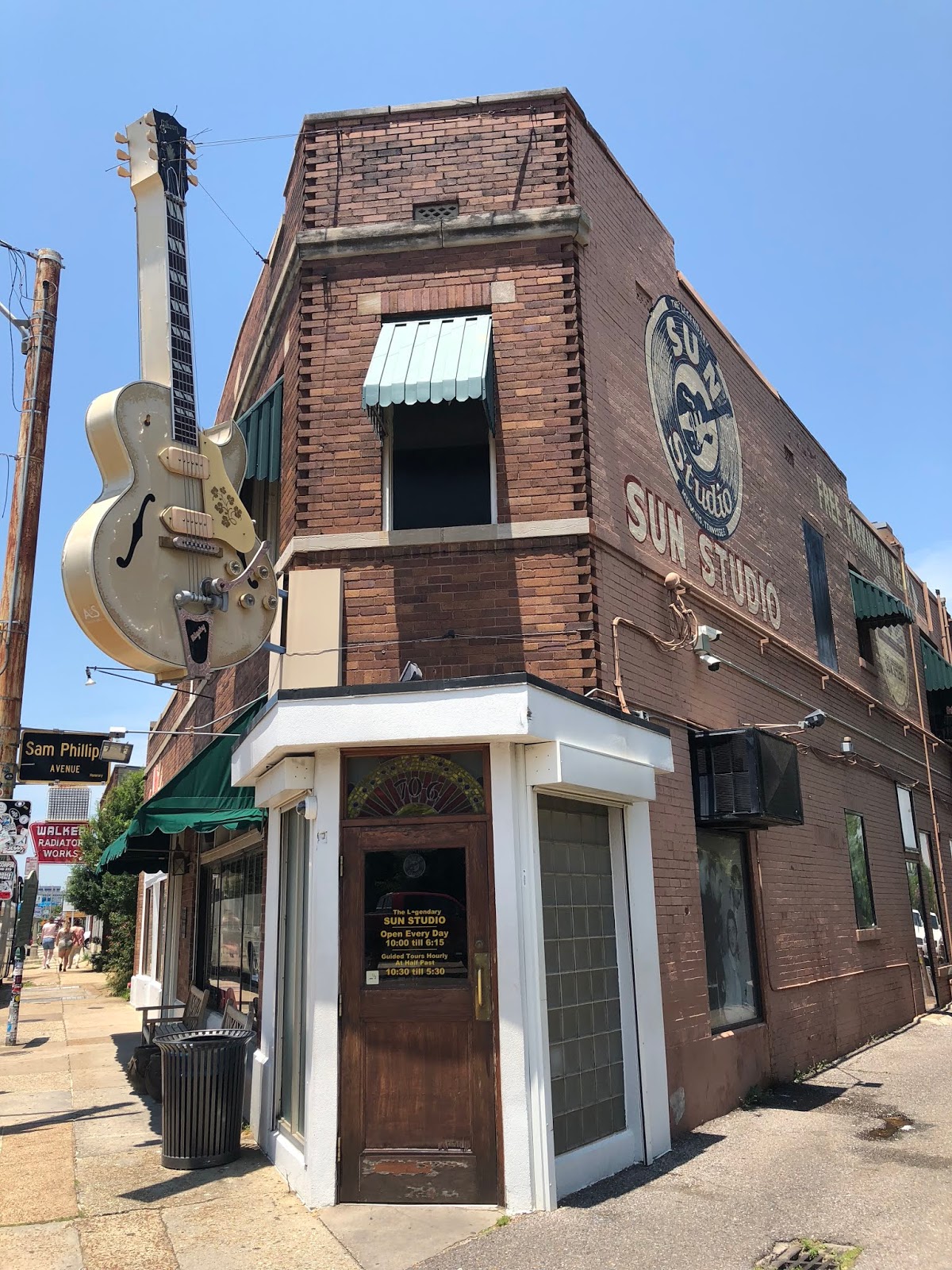
After our tour of Graceland, we visited the Sun Studio, formerly the Memphis Recording Studio, to see the sound booth where Elvis made his first recording.


On July 18, 1953 nineteen-year-old Elvis walked into the studio and paid $3.98 to cut a personal record for his mother.


The 45RPM record was a double-sided recording of "My Happiness" and "That's When Your Heartaches Begin."


Sam Phillips, the studio owner, was looking for a fresh talent that would bridge the gap between the African-American soulfulness of the blues and white gospel songs.


His assistant, Marion Keisler, recalled, "Over and over I heard Sam say, 'If I could find a white man who had the Negro sound and the Negro feel, I could make a billion dollars!"  And he would always laugh, Marion said, as if to underscore that money was never the point--it was the vision.

But even Phillips could not foresee the passionate fanbase that grew into a cult surrounding Elvis.  Otherwise, Phillips probably would have asked for more than $30,000 when he sold Elvis' contract to RCA.  Still, there were other unknowns that Phillips made into stars: B.B. King, Roy Orbison, Jerry Lee Lewis, Johnny Cash, Carl Perkins, to name just a few.


Those last three musicians along with Elvis Presley were called the Million Dollar Quartet because of a spontaneous photo opportunity that occurred on December 4, 1956.  Carl Perkins was in the middle of a recording session with Jerry Lee Lewis sitting in as the piano player when Presley and Cash stopped by to observe.  Sensing that this gathering was epic, Phillips called a local news photographer who took a snapshot of the four musicians gathered around the piano.

My own epic photo of my favorite singer Tim

After listening to this story plus many more from our very entertaining tour guide at Sun Studio, Tim and I took his advice and made our way to Beale Street just as dusk was beginning to fall.


Beale Street with its honky-tonks, bars and restaurants is the place to soak up the blues and R&R sounds that Memphis made famous.


As luck would have it, we were there on a Wednesday night, Bike Night on Beale, when motorcyclists converge to park on the most iconic street in town.


At B.B. King's Blues Club, we listened to a blues band while we dug into some barbecued ribs.  After supper we wandered down the street to see motorcycles of every size, shape and color.  It was a fun way to end a day in the birthplace of rock and roll.

Sunday, April 2, 2017

Woo, Woo, Chattanooga!

Steam Locomotive on display at Terminal Station

When you hear the whistle blowin' eight to the bar
Then you know that Tennessee is not very far
Shovel all the coal in
Gotta keep it rollin'
Woo, woo, Chattanooga there you are.
~ lyrics to Glen Miller's popular song, Chattanooga ChooChoo

Tim and I continued to roll north towards Nashville for a planned weekend with our daughter Jillian.  Yet, woo, woo!  There was Chattanooga, a city we'd driven through before but never had time to explore.  So we pulled our RV, the Dawntreader, off the interstate and camped three nights at Holiday Travel Park of Chattanooga.

Although I majored in history as a college undergraduate, I didn't focus my studies on the Civil War.  However, Tim and I became Civil War buffs when we moved to Virginia back in 1987.  Ever since then, we've tried to visit the war's battlefields; we planned to see three such grounds on this leg of our journey.  Perhaps one day we'll revisit these battles in their proper order by following the victorious path of the Union Army of the Cumberland south towards Atlanta, but that's a future trip.


This time we are heading north.  Our first stop was a brief visit to Kennesaw Mountain National Battlefield.  With our Jeep in tow behind the RV, we were limited in what we could do there.  Instead of touring the battlefield, we had to settle for learning what we could of this significant Union tactical defeat at the park's Visitors Center.

Given the objective to capture Atlanta, the South's major industrial center, General William T. Sherman pressed further into Georgia in the summer of 1864.  He sent this report to Washington: "The whole country is one vast fort, and Johnston must have at least 50 miles of connected trenches...and finished batteries.  We gain ground daily, fighting all the time...Our lines are now in close contact and the fighting incessant, with a good deal of artillery.  As fast as we gain one position the enemy has another all ready...Kennesaw...is the key to the whole country."

But when he couldn't unlock the key of Kennesaw Mountain, Sherman outflanked the Confederate forces time and again as his Union men leapfrogged the twenty miles from Kennesaw to the outskirts of Atlanta.  There overwhelmed at last, Confederate General Joseph E. Johnston's soldiers gave way their defense of the city.  "Atlanta is ours, and fairly won," wrote Sherman in a dispatch dated on September 3, 1864.


After viewing the excellent film and exhibits at Kennesaw Mountain's Visitors Center, Tim and I returned to the Dawntreader and continued north.  When we arrived at our campground on the outskirts of Chattanooga, we found that we were only five miles from the battlefield of Chickamauga.


Before the Union forces could topple Atlanta, they had to first go through Chattanooga.  That small city of 2,500 people lay on the banks of the Tennessee River where it cut through the Appalachian Mountains, allowing four major railroads to converge.  If Union forces could secure Chattanooga, it could cripple Confederate supply lines.

Chickamauga's Wilder Brigade Monument (open seasonally) was an icy challenge to climb.

U.S. General William Rosecrans tried.  In September 1863, Rosecrans moved his Army of the Cumberland south, crossing the Tennessee River and threatening the Confederates from the rear, but his forces were routed in the Battle of Chickamauga by Confederate soldiers led by General Braxton Bragg.  Falling back to Chattanooga, Rosecrans and his men found themselves isolated and surrounded by Confederates. 

Southern Belle Steamboat

Then, newly appointed Major General Ulysses S. Grant focused his sights on lifting the siege of Chattanooga.  He opened the "Cracker Line" using steamboats and a partial overland route to bring food and supplies down the Tennessee River to the beleaguered town.  On November 25, 1863, the reinforced Union troops began to fight their way out of the city.  


At Lookout Mountain and on Missionary Ridge, the battle for Chattanooga raged until the Union emerged victorious, thus sounding the death knell for the Confederacy and opening the way to Atlanta.


Our visit to Chattanooga wasn't all about battlefields.  We also found time to stroll along the Riverwalk where many of the city's attractions are found.

Tennessee Aquarium

Ross Landing where the Trail of Tears began

The Riverwalk switchbacks up to the Hunter Museum.

The Hunter Museum of American Art

The Hunter Museum of Decorative Arts

Walnut Street Bridge, now a pedestrian walkway

Bluff View Overlook

The Riverwalk with Walnut Street Bridge in the background

University of Tennessee at Chattanooga's rowing crew

After our promenade along the Riverwalk, we drove by the Terminal Station, a former railroad station and now a hotel (pictured below).  We didn't stop to visit, but perhaps next time we're in Chattanooga, we'll make plans to stay in one of its Pullman train cars.

Photo by Andrew Jameson - Own work, CC BY-SA 3.0,
 https://commons.wikimedia.org/w/index.php?curid=10031991


From Lookout Mountain to the banks of the Tennessee River, Chattanooga has captured our hearts, too.  We've added this beautiful city to our list of possible places to settle once we leave the life of full-time living in a RV.
"Chattanooga choo choo
Won't you choo-choo me home?"
But that is years away!  There's still so many places we'd like to see.