Tuesday, April 10, 2018

Ghost Hunting In Macon

Tim and I have been hanging out with the ghosts of the Allman Brothers, the Mississippians, and the families of Judge Asa Holt and William Butler Johnston.  At one time all resided in Macon, GA.  Investigating the locations significant to their lives has been an interesting way to see this town of 90,000 residents.

The Big House

One can hardly visit Macon without hearing of the Allman Brothers, the Southern rock group formed in 1969 by Duane and Gregg Allman whose unique blend of blues, jazz, rock and country music drew fans from around the globe.  The brothers, along with other members of the band--their roadies, friends and families--lived in the Big House, a residence on Vineville Avenue and now a museum, as their music took off.

Hanging above our heads is a photo of the Allman Brothers eating at the cafe.

Prior to their fame, the struggling musicians were regular customers at the H & H Cafe, sitting up at the counter to devour the soul food cooking of Inez Hill ("Mama Hill") and "Mama Louise" Hudson.  Ron, a fellow volunteer at our Habitat for Humanity build in Macon, directed Tim and I to the cafe's downtown location where we, too, ordered biscuits, eggs and sausage for breakfast.

Rose Hill Cemetery

Another hangout for the band was Rose Hill Cemetery which inspired one of the band's most famous instrumental songs, In Memory of Elizabeth Reed.  According to the web site SongFacts which I quote here: Allmans' guitarist Dickey Betts wrote this song for a girl, but not the one in the title.  Elizabeth Reed Napier (b. November 9, 1845) is buried at the Rose Hill Cemetery where Betts would often write.  He used the name from her headstone as the title because he did not want to reveal who the song was really about: a girl he had an affair with who was Boz Scaggs' girlfriend.

The Allman Brothers' first album

Photos for the Allman Brothers' album covers were taken at various locations around Macon including their first album's cover of the white-columned building that is now home to the Robert McDuffie Center for Strings at Mercer University.

Graves of Duane Allman and Berry Oakley

Sadly, Duane Allman and the band's bass guitarist Berry Oakley were killed in separate motorcycle accidents, Duane on Oct. 29, 1971 and Berry Nov. 11, 1972.  The crash sites are a block over and a block up from one another in Macon.  Both are buried in Rose Hill Cemetery and so is Gregg Allman who died in 2017.

The entrance to Earthlodge

But enough about the Allman Brothers.  There are much older haunts to probe.  Over a period of 10,000 years, Ice Age hunters to Creek Indians lived along the banks of the Ocmulgee River.

The Great Temple Mound

Basketful by basketful, these people collectively called the Mississippians, carted dirt up from the riverbed to make a series of earth mounds important to their societies and religions.  The mounds they created are now preserved at Ocmulgee National Monument, a property of the National Park Service, located on the outskirts of Macon.  But that doesn't mean that Americans have always seen their worth.


Troops dug trench works heedlessly across the area during the Civil War and 19th-century industrialists financed the railroad that cuts through the center of the park.  Still, what does remain--Earthlodge, Cornfield Mound, Funeral Mound and the Great Temple Mound--are well worth a visit.

The Cannonball House

Next in line on our list of Macon must-sees was the Cannonball House, built by Judge Asa Holt in 1853.  The home was struck by a cannon ball from Union General George H. Stoneman's guns during the Battle of Dunlap's Hill on July 30, 1864, when the Union army tried unsuccessfully to take Macon.  The iron ball crashed through one of the home's columns and passed through a parlor before landing in the entrance hallway.  Lucky for Judge Holt's family, it did not explode and no one was injured by its passage.

Hay House

Just up Mulberry Street from the Cannonball House is the Johnston-Felton-Hay House located at the top of Coleman Hill.  William Butler Johnston and his wife Anne Tracy Johnston built and furnished this Palace of the South as it is nicknamed, from 1855-1859 for an astronomical sum that exceeded $200,000.  Mr. Johnston made his fortune as a jeweler in New York and subsequently diversified his money into banking and railroads.  He married Anne who was 20 years his junior in 1851 and the couple took a 3-year honeymoon to Europe.

The dining room is just one of the opulent rooms of the Hay House.

There they purchased many of the home's furnishings which they had shipped back to Macon.  Returning home, they built the 18,000 square foot, 24 rooms home with four levels and three-story cupola, incorporating many technological advances including central heat, an intercom system, hot and cold running water and a French lift similar to an elevator.  The Johnstons' daughter Mary Ellen Felton and her husband lived in the home following the deaths of her parents before selling the property to Parks Lee Hay and his wife Maude. Upon their deaths, the home was turned into a museum and finally transferred to the Georgia Trust for Historic Preservation.

Easter morning's moonset

Finally, we were in Macon in time to celebrate Easter.  We attended an Easter Sunrise Service at Coleman Hill Park where the sponsoring church had set up a lighted cross.

Easter morning's sunrise

As we watched the full-moon give way to dawn, I meditated upon the great sacrifice of Christ who willingly chose to die on a cross in payment for all my wrongdoings.  Unlike the people I've mentioned above, He rose again that first Easter Sunday so I could claim His promise of eternal life and the gift of His Holy Spirit.

Saturday, April 7, 2018

Revitalizing a Neighborhood


The Macon Area Habitat for Humanity affiliate has partnered with the city of Macon, Georgia, to try to revitalize the Lynmore Estates neighborhood, a tract of houses built after World War II for newly urbanized, first-time homebuyers.  During the 1990s, many of the original homeowners died, leaving properties vacant or selling them to absentee landlords.  The most recent census figures reveal a current population of minorities that is predominantly African-American.  Forty-one percent of the adults living here have less than a high school or equivalency diploma.  It is estimated that 35.8 percent live below the poverty line with a median income of $29,500.  This is the pocket of poverty where Tim and I have been working to complete two homes in the final stages of construction.


When finished, these will raise the number of Habitat houses built in the neighborhood to over 30 homes.

This was an unusual build for us because our Care-A-Vanner group was so small.  It was supposed to number three rigs.  However, one couple had to cancel due to health issues.

Ron

So that left a work crew composed of Ron, Tim and I.

Alicia and Mike

We were ably supervised by Alicia and Mike, the two MAHFH site managers.


Ron and Tim installed the fascia on the eaves of the two roofs.


Alicia showed me how to construct the stairs leading up to the entrances.  I had little opportunity to snap photographs, so focused were we on getting as much done as possible before the two weeks were up, but our additional tasks were to install the subflooring and doors including the doorknobs and jams.  And my favorite task--painting said doors and doorframes.  More needs to be done, but when we leave Macon tomorrow, we'll do so knowing that two more families will soon have a decent place to live.


Saturday, March 24, 2018

Hillsborough River State Park


According to Florida's Division of Recreation and Parks, there are 175 state parks, trails and historic sites which encompass nearly 800,000 acres and 100 miles of sandy beaches in the Sunshine State, providing recreational opportunities for both residents and tourists.  Tim and I are two tourists who have grown to love these places.  (Click here for an interactive map of parks in the Florida State Parks system.)


When we first took to the road as full-time RVers back in January 2016, we thought our RV, the Dawntreader, was too long to fit in any state park.


However, we've since learned from friends like Doug and Chris that while our 45-foot length is on the long side, there are usually campsites that can accommodate us.  You just have to look carefully at the state park listings on ReserveAmerica.com when making a reservation.


This winter we've discovered that if you want to experience "the real Florida" as the park service's logo claims, there are no better places than these parks.  Off the beaten track, these protected areas are full of natural scenery with unbeatable beauty.


Hillsborough River State Park is a case in point.  The river that flows through it tumbles over rapids, then quiets to a calm where its current is hardly discernible.


It's perfect for kayakers and canoeists.


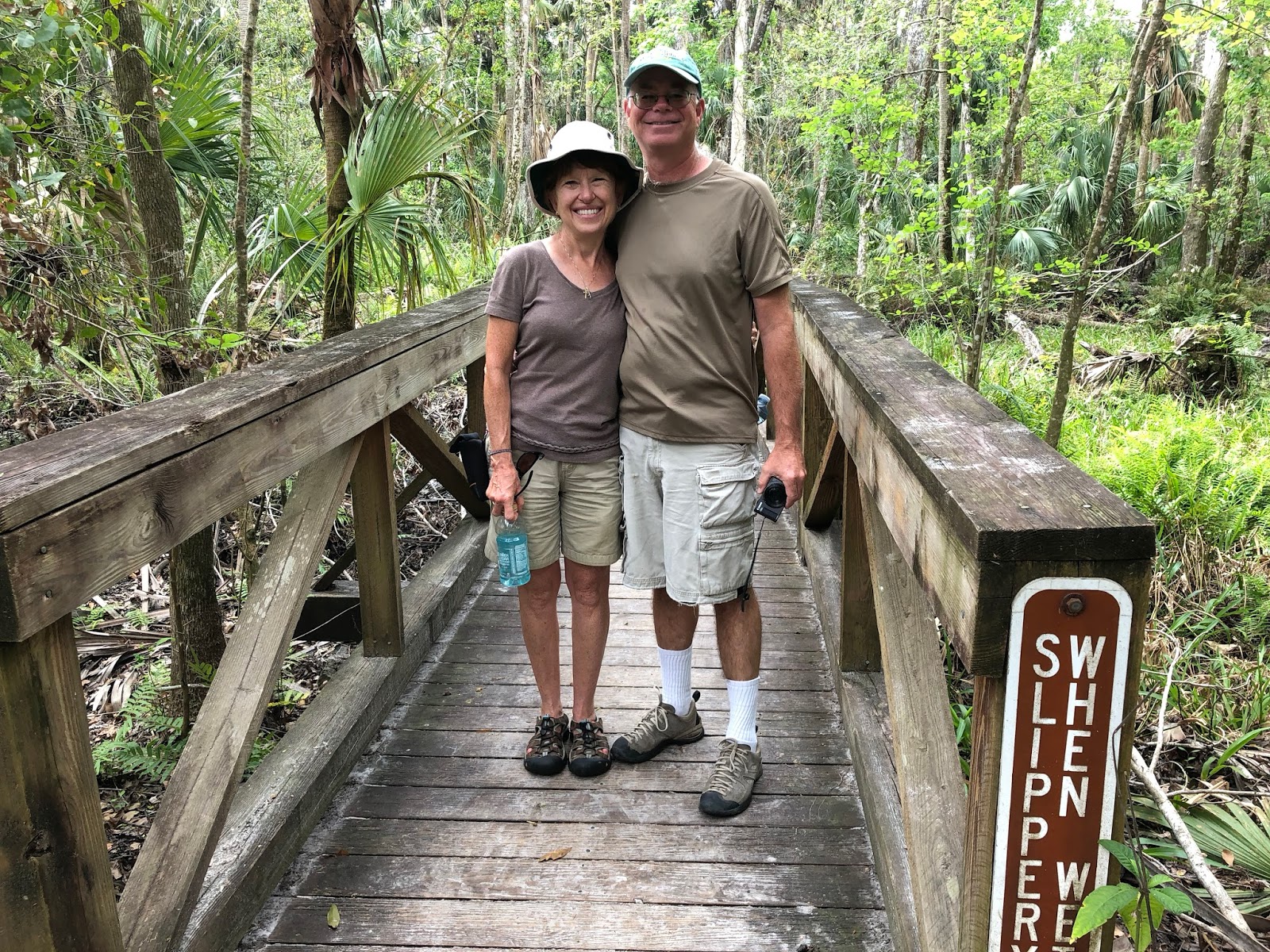
If a hike is more to your taste than a paddling adventure, pretty as a picture natural trails run parallel to the river's banks.


Bicycles may be rented at the park's cafe.


And for history buffs, Fort Foster, a reconstructed log stockade that during the Second Seminole War guarded a pivotal bridge over the river, sits in the northeast corner of the park.

Campsites have plenty of elbow room set apart as they are from one's neighbors.  Like most state park campgrounds, Hillsborough River State Park has water and electric hook-ups but no sewer connections.  However, there is a dump station where you can jettison waste on your way out of the park.


This morning Tim and I leave Florida to head north to our next Habitat for Humanity build in Macon, Georgia.  We'll miss its scenic parks, but hopefully we'll return next winter to sample a few more.  Until then, the Florida state parks of Hillsborough River, Rainbow Springs, Highlands Hammock, Mike Roess Gold Head Branch will brighten our memories.  Four down, 171 more to go!


Sunday, March 18, 2018

Rainbow Springs State Park

The campground at Rainbow Springs State Park has been our home for the past two weeks.  It lies along the banks of the Rainbow River, a jewel that lives up to its name.  When sunlight hits the water, a light show ensues as the rays are diffused into a multi-colored spectrum that reaches well below the surface.  The river, fed by the release of 400 to 600 gallons of fresh water each day from the springs at its headwaters, flows 5.7 miles before it empties into the Withlacoochee River at Dunnellon, FL.


Determined to explore the river in greater depth (pun not intended and certainly not to be undertaken in a physical sense), I left my listening devices locked up in the Dawntreader and in total silence, bravely embarked upon a canoe trip with Tim.


Synchronizing our paddle strokes is a little difficult when you can't hear verbal commands, but after a few misguided attempts, I got the hang of it and pointed our bow in the right direction.


Prior to our departure, we'd plotted our strategy.  Paddling upstream to the headwaters would allow us to enjoy a lazy float back down to the dock.


There was plenty of wildlife to keep us entertained.  Birds, turtles, kayakers and other canoeists were all enjoying a sunny day on the river with us.


Do you suppose these three birds reading the No Fishing Permitted sign are disappointed?  "Well, guys!  It looks like we won't be having fish for supper tonight!"


The turquoise water is so clear, you can see all the way to the bottom, a depth that averages 10 feet but in places could descend to 25.


An even better way, if you want to immerse yourself in the undulating mermaid's hair, the so-called sea grass, and see the glimmering fish and the boil pots of the springs for yourself is to take a scuba diving tour of the waters.  Tim was tempted, but ultimately he decided to forego that adventure.


As for me, that seemed like too much work.  I'd rather just put my feet up!

Saturday, February 24, 2018

Highlands Hammock State Park


In our quest to visit as many Florida's state parks as possible, Tim and I, along with our friends Doug and Chris, spent a Saturday in Highlands Hammock State Park.


Created in part by a sizable donation from Margaret Shippen Roebling, the park opened in 1931 four years before the Florida state park system was founded.  Just as an aside, Margaret was the wife of John Augustus Roebling II whose grandfather John Augustus Roebling and father Washington Augustus Roebling built the Brooklyn Bridge, the iconic bridge that links New York City to Brooklyn.


In the park, we found another bridge not quite so tall but with an interesting history told by the park's small museum devoted to the Civilian Conservation Corps.  The CCC, as it was known, took over the park's works in 1933, constructing bridges as well as dams to control the water levels.


Exhibits told the story of the hundreds of young men who answered President Franklin Delano Roosevelt's call to work for the good of the country.  "Through you the nation will graduate a fine group of strong young men...willing and proud to work for the joy of working."

Walter Matthau (left) and Robert Mitchum (right)

Interestingly enough, among the men who joined the Corp in their youth later became famous celebrities Walter Matthau, Robert Mitchum and Raymond Burr.

Alvin C. York (left upper corner) and Raymond Burr (right)

The World War I hero, Alvin C. York whose feat of singlehandedly capturing 132 German prisoners vividly portrayed by Gary Cooper in the movie Sargent York, served as a CCC superintendant in Crossville, Tennessee.


But nature beckoned so we quit the museum and headed to the park's hiking trails for an up close and personal view of the hammock, a term unfamiliar to me in this context.


A hammock is defined as a forest whose large trees filter out much of the sunlight, making the inside of the forest dark, shady and cool.


We investigated the bark of the slash pine trees


and sat on knobby trunk of a bald cypress tree.


Reaching high I tried to compare my height with the span of the roots of a toppled tree.


Then I bent low to view these tiny purple blossoms nestled among the abundant ferns.


We stayed a respectful distance away from this alligator who was basking in the sun.  He brought to mind this anonymous poem as he made me want to run.

Alligators Are Unfriendly
Alligators are unfriendly,
they are easily upset.
I suspect that I would never
care to have one for a pet.
Oh, I know they do not bellow,
and I think they do not shed,
but I'd probably be nervous
if I had one in my bed. 
Alligators are not clever,
they are something of a bore.
they can't heel or catch a Frisbee,
they don't greet you at the door,
for their courtesy is lacking,
and their tempers are not sweet,
they won't even fetch your slippers
...though they just might eat your feet.

See you later, alligator!