Tuesday, May 1, 2018

Petersburg Is the Key


"The key to taking Richmond is Petersburg" believed Civil War Union General Ulysses S. Grant.  Consequently, when his more direct forays against the capitol of the Confederacy failed, Grant swung his soldiers east and then south to lightly-defended Petersburg in a masterful move meant to sever the supply line of the rebel army.  It was arguably the one time Grant outmaneuvered the canny Confederate General Robert E. Lee.

The Eppes Plantation at City Point

On our way to Washington, Tim and I devoted a day to seeing how Grant did this.  Having lived in Virginia for more than fifteen years, we've become Civil War buffs.  Something about seeing the sites where major battles played out has given the war an immediacy that has captured our interests.  However, in all the time we lived here, we never made it to Petersburg, that is until now.  So beware!  The rest of this post is a history lesson of what impressed us the most about the siege.


With its proximity to the confluence of the James and the Appomattox rivers, Petersburg was a transportation hub that funneled what war materiels the South still possessed to Lee's ill-equipped rebel soldiers dug in at Richmond.  By the time of the Siege of Petersburg from June 1864 to April 1865, the freight of all but one railroad from the Deep South bound for the Confederate capitol passed through Petersburg.


When I was a child, one of our family vacations was a trip to Durango, Colorado, where my railroad-mad dad made reservations for us to ride the Durango & Silverton Narrow Gauge Railroad.  That ride  sparked my own interest in railroads and made me pay attention to the importance of the railroads at Petersburg.

To sever those rail lines, Grant laid siege to the city and made use of the dormant City Point section of the South Side rail line to build his own railroad to supply his troops.  This ability to build railroads as needed was another way more industrialized North surpassed the South. The railroads of the Confederacy, in keeping with its strict stance on states' rights, were not centrally controlled like those in the North.  To prevent their purchase by rivals, Southern railroad companies would lay track using different gauges, a business practice that proved detrimental to the Confederate war effort.

Plantation of Dr. Richard Eppes where Gen. Grant established his headquarters.

I found it interesting in our visit to Grant's headquarters at City Point that he chose to live in what looked like a shack instead of appropriating the plantation home of Dr. Richard Eppes for his personal quarters after the Eppes family fled to what they supposed was the safety of Petersburg.

Grant's Headquarters on the grounds of the Eppes' Plantation

So Grant built a short line from the wharfs he quickly constructed at City Point, the base for one of the greatest logistical operations of the Civil War.  There more than 100 ships a day dropped supplies of food, ammunition and supplies which were then ferried by rail to the Union Army entrenched on the east side of Petersburg.


Had the Union commanders pressed their advantage upon their arrival at Petersburg, the siege might not have been necessary, but alas they did not.  At 7 p.m. on June 15, 1864, the boom of Union cannons to the east foreshadowed an attack on the Dimmock Line.  Minutes later, the soldiers of the Union 18th Corps broke through the undermanned Confederates and swarmed over Battery 5, a fortified earthworks emplacement for heavy guns.


In the two hours that followed, the Federals captured 1.5 miles of Petersburg's defenses.  Though few Confederates stood between the Federals and the streets of Petersburg, Union Maj. Get. William F. Smith stopped his advance to await reinforcements.  Had he continued his momentum, nine months of tedious, deadly siege could have been avoided.


"We could blow that damn fort out of existence if we could run a mine shaft under it." ~ A private of the 48th Pennsylvania, June 23, 1864.


Spurred by the offhand suggestion of a former coal miner, Lt. Col. Henry Pleasants put his 48th Pennsylvania to digging.  Their objective was to tunnel under the Confederate line and blow up the battery at Elliott's Salient.

Such a plan stirred Tim's memory of his stint in the Army when he was assigned to the Corps of Engineers, the division that performs a variety of construction or demolition tasks under combat conditions.  Naturally, Tim was fascinated to learn that Pleasants' troops secretly proceeded with their plan literally right underneath the noses of the Confederates.


Beginning on June 25, 1864, and continuing for the next month, these Pennsylvania coal miners burrowed a shaft 511 feet into the hillside.  Then they packed four tons of powder into the magazines under the Confederate battery.  At 3:16 a.m. on July 30, Lt. Col. Pleasants lit the fuse and scrambled out of the tunnel.  After a 30 minute wait for the explosion to detonate, Pleasants concluded that the fuse had gone out.  With dawn approaching and at risk of losing the surprise attack, two volunteers, Lt. Jacob Douty and Sgt. Harry Reese, crawled into the tunnel to try lighting the fuse again.  This time it worked.  Two hundred and seventy-eight Confederates died in the explosion that created a crater measuring 170 feet long, 60 feet wide and 30 feet deep.  Two 1,700-pound cannons were hurled completely out of the works.


But instead of pushing through, the first waves of Union attackers simply stood at the Crater, gawking at the incredible scene they'd created and thus allowed the Confederates to regroup.

And so it went, first one side and then the other surged back and forth, but it was just a question of time.  With the arrival of spring, the beleaguered Confederates and the city fell.  Seventy thousand Americans were casualties at Petersburg.  Infection and disease accounted for the greatest number of deaths.

A window at the Eppes Plantation at City Point
By preserving the Petersburg National Battlefield, the National Park Service gave us a window to look back at this important event.  Two weeks later General Robert E. Lee surrendered at Appomattox Court House and the war ended.


Thursday, April 26, 2018

Yet Another One


Once again Tim and I have found a lovely state park.  We're headed north to Washington, D.C., for a visit with our children and a week of routine doctor appointments.


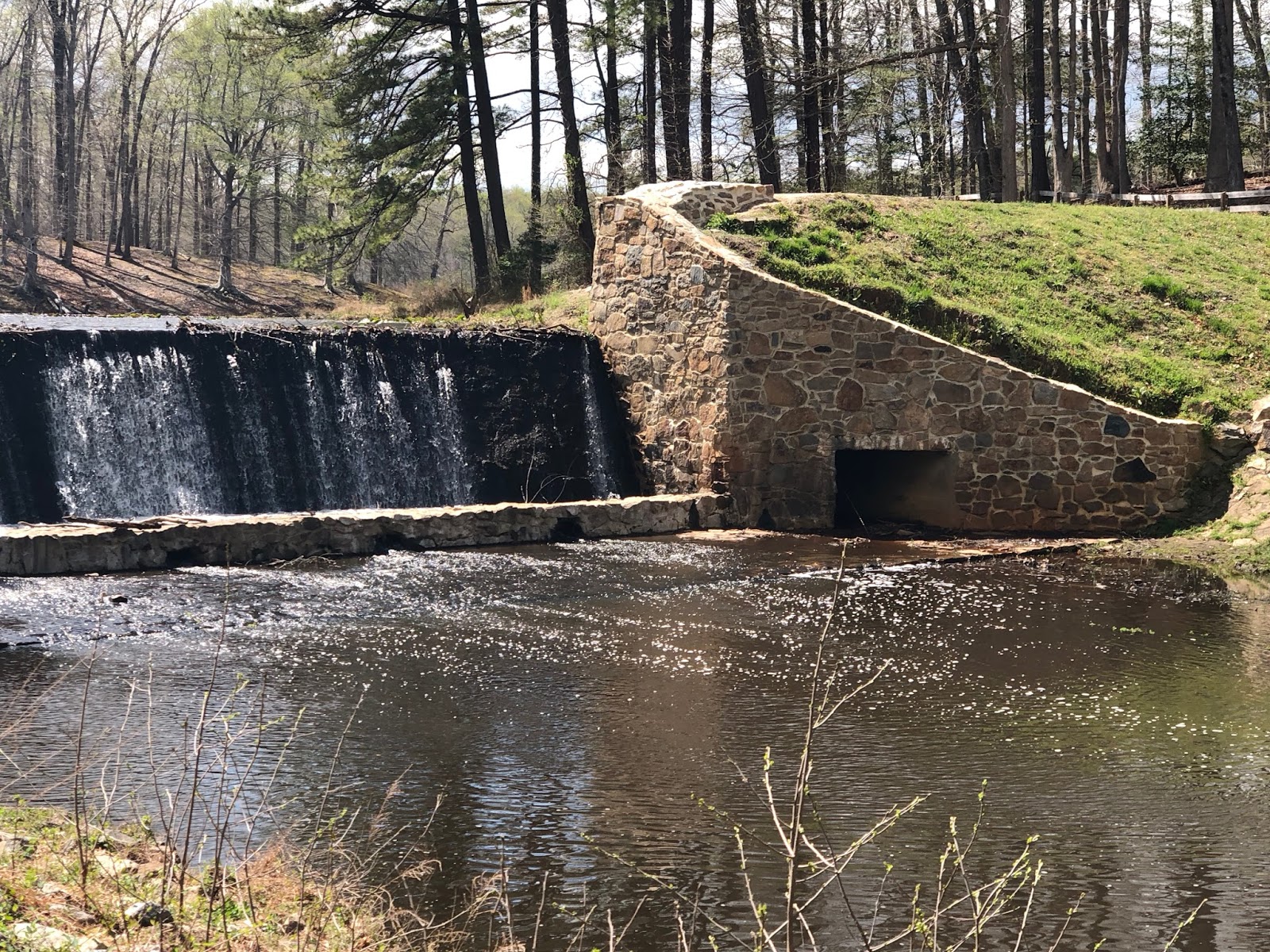
By making camp for a few days at Pocahontas State Park, we are almost there.  Plus, the park's location midway between Petersburg and Richmond, Virginia, gives us an opportunity to follow the final events of the Civil War.  More about that in forthcoming posts.  Today I'd like to share a little of the beauty we discovered at this park.


The wide roads leading to this campground were a bit of a relief.  Before I made our reservations last fall, I checked our truckers' atlas to make sure the road leading to the park was navigable by our big rig, the Dawntreader.  That research was inconclusive.  On the one hand, the route was not highlighted by yellow in the atlas, a sure sign that taking our big bus in that direction was not a good idea.  Yet, when I made our reservations on Reserve America, there were plenty of big-rig-friendly campsites in the park.  Clearly, previous rigs had navigated the questionable road into the campground safely so we decided we could, too.


And are we glad we did!  This park was perfect.  Big pull-through campsites with water and electric hook-ups, a dump station easily accessible and plenty of hiking trails to explore.


Our favorite was the  2.5-mile trail around the pretty-as-a-picture Beaver Lake.


We were almost sorry to leave, but Washington awaits and I'm looking forward to spending time with our family.

Tuesday, April 24, 2018

Twists of Fate

You decide:  Would we have won the Revolutionary War without these twists of fate?

The American victories at Kings Mountain and Cowpens paved the way to the end of the Revolutionary War at Yorktown.  Thomas Jefferson called these battles "the turn of the tide of success."

But for some fateful happenstances, these battles could have easily gone the other way.

So could have our departure from Greenville, SC, when Tim could not swing our RV, the Dawntreader, fully around the U-turn we needed to make, if we were going to visit NPS's National Military Battlefields at Kings Mountain and Cowpens.


With oncoming traffic headed our way, Tim turned into their path until he reached a driveway where we could take refuge.  Yikes!  There we unhooked our Jeep in preparation for backing out onto the highway once again, a maneuver he successfully made.  Whew!  I think this twist of fate, the first time we've ever had to unhook the car unexpectedly, subtracted 10 years from my life.  But I digress.  Back to my question about the Revolutionary War.

The Battle of Kings Mountain, October 7th, 1780

The obelisk that commemorates the American victory at Kings Mountain

Forewarned by two Patriot deserters that a large body of militia were marching upon him, British Maj. Patrick Ferguson sent a plea requesting reinforcements to Lord Charles Cornwallis and Lt. Col. Banastre Tarleton holed up in nearby Charlotte, NC.  But both Cornwallis and Tarleton were ill, or at least that was their response.  Yet, Ferguson was a Scot and as such was not a favorite of either man.  Had he been, perhaps his commanding officers would have better supported him and the battle would have turned out differently.


Instead, on October 7, 1780, the Overmountain Men of Col. Isaac Shelby and Col. John Sevier surrounded and swarmed up Kings Mountain where Ferguson and his company were camped.

"When we encounter the enemy, don't wait for a word of command.  Let each of you be your own officer, and do the very best you can...If in the woods, shelter yourselves and give them Indian play; advance from tree to tree...killing and disabling all you can..." ~ Col. Isaac Shelby, Patriot leader

This 1.5 walking trail leads visitors around the battlefield at Kings Mountain.

Everyone knew Col. Sevier's rugged frontiersmen for their long-rifle marksmanship--and their touchy eagerness for a brawl.  But no experienced military man of that day expected men armed only with hunting weapons to be able to face and defeat real soldiers, trained to use the bayonet.  It had never happened--until Kings Mountain.


Three times frontiersmen from Tennessee charged up the mountainside.  Once, then twice they were chased back down by Carolina Loyalists wielding 17-inch-long bayonets.  Yet somehow Sevier's patriots found the courage to stop running, turn around and go back up against that fearsome cold steel one last time.

The marker where Ferguson fell.
This time Ferguson was killed and his forces overran.  The battle was won!


The Battle of Cowpens, January 17, 1781


Upstate Carolinians drove their cattle down the Blue Ridge Mountains to the cow pens near Chesney, NC where they fattened them up before herding them to market in Charleston, SC.  This open forest proved well-suited for the American rebels led by General Daniel Morgan to make a stand against the forces of Lt. Col. Banastre Tarleton at the Battle of Cowpens on January 17, 1781.


Morgan's strategy was to position his rebel sharpshooters at the skirmish line to wait until Tarleton's army moved within shooting distance.  Their orders were to aim at the British officers, fire one or two good shots and then fall back to the militia.  As the British came within range, the sharpshooters discharged a deadly fire, dropping two-thirds of the officers, before melting back to the second line of the patriots' defense.

"At first it was pop, pop, pop (the sound of the rifles), and then the whole volley.  It seemed like one sheet of flame from right to left." ~ Thomas Young, American Militiaman, Fair Forest Regiment, 17 years old


A misunderstood order from Lt. John Eager Howard had the center and left flank of Continental soldiers in retreat only to be urged by General Daniel Morgan to "form, form my brave fellows.  Old Morgan was never beaten." When they did so, their new position, perfectly timed, brought them into position to surround the British forces.

Monument at Cowpens National Battlefield

This classic military move, a double envelopment by the Americans, the only successful one of the Revolutionary War, brought the battle to a decisive end.  For Americans, Cowpens was a surprising victory and a psychological shift in the minds of the Continental soldiers.  The British surrendered at Yorktown later that year.

So there you have it!  A dysfunctional relationship at Kings Mountain stayed British reinforcements and a misunderstood order led to an unorthodox double envelopment at Cowpens.  Moreover, Tim and I concluded our day's trip safely after all, twists of fate in our favor all the way around.

Saturday, April 21, 2018

Asheville's Grove Park Inn


E. W. Grove envisioned the building of a resort in the restful atmosphere of the Blue Ridge Mountains.  He pictured "a big home...with all the old-fashioned qualities of genuineness with no Sham,"  Perhaps that last qualifier was his reaction to the Biltmore, the over-the-top lavish home of his Asheville contemporaries, the Vanderbilts.

This image is from one of the resort's postcards.

Searching for a cure to chronic bronchitis, Grove, a pharmaceutical magnate from Tennessee, arrived in Asheville, North Carolina in 1896, just a year after the Vanderbilts completed their grandiose home.

When we first visited Asheville several years ago, Tim and I toured the Biltmore.  This time we were drawn to the top of Sunset Mountain where Grove's dream became a reality once the legendary Inn opened its doors in 1913.  Grove's concept of the resort was influenced by his visit to the Old Faithful Inn in Yellowstone National Park.  Grove's son-in-law, Fred Seely who also became the inn's first manager, oversaw its construction.  With instructions that every visible stone should reveal its most time-worn face, Italian stonemasons and hundreds of local laborers used boulders taken from the mountain to build the inn.


Passing through its portals, you enter into the Great Hall where it's hard to say what first impresses you:  the view of the Blue Ridge Mountains from the west-facing windows or--


the two massive fireplaces at each end of the Great Hall.


The last are famous for the original 1913 Otis elevators cleverly hidden within their chimneys, put there to conceal the noise of the machinery.  One of these elevators is still in use.  I enjoyed reading quotations from notable authors and philosophers like Ralph Waldo Emerson engraved on the lobby's stone walls.


Over the past 100 plus years, ten U. S. Presidents and countless celebrities have made their way to the Inn.


Now with the $25 million renovation completed after Omni Hotels & Resorts purchased the property in 2013, even more guests may stay in the two wings of rooms added to the original structure.


Guests can enjoy such amenties as the championship tennis complex, the 18-hole golf course and the subterranean spa built below the ground to keep the hotel's views of the mountains unobstructed.


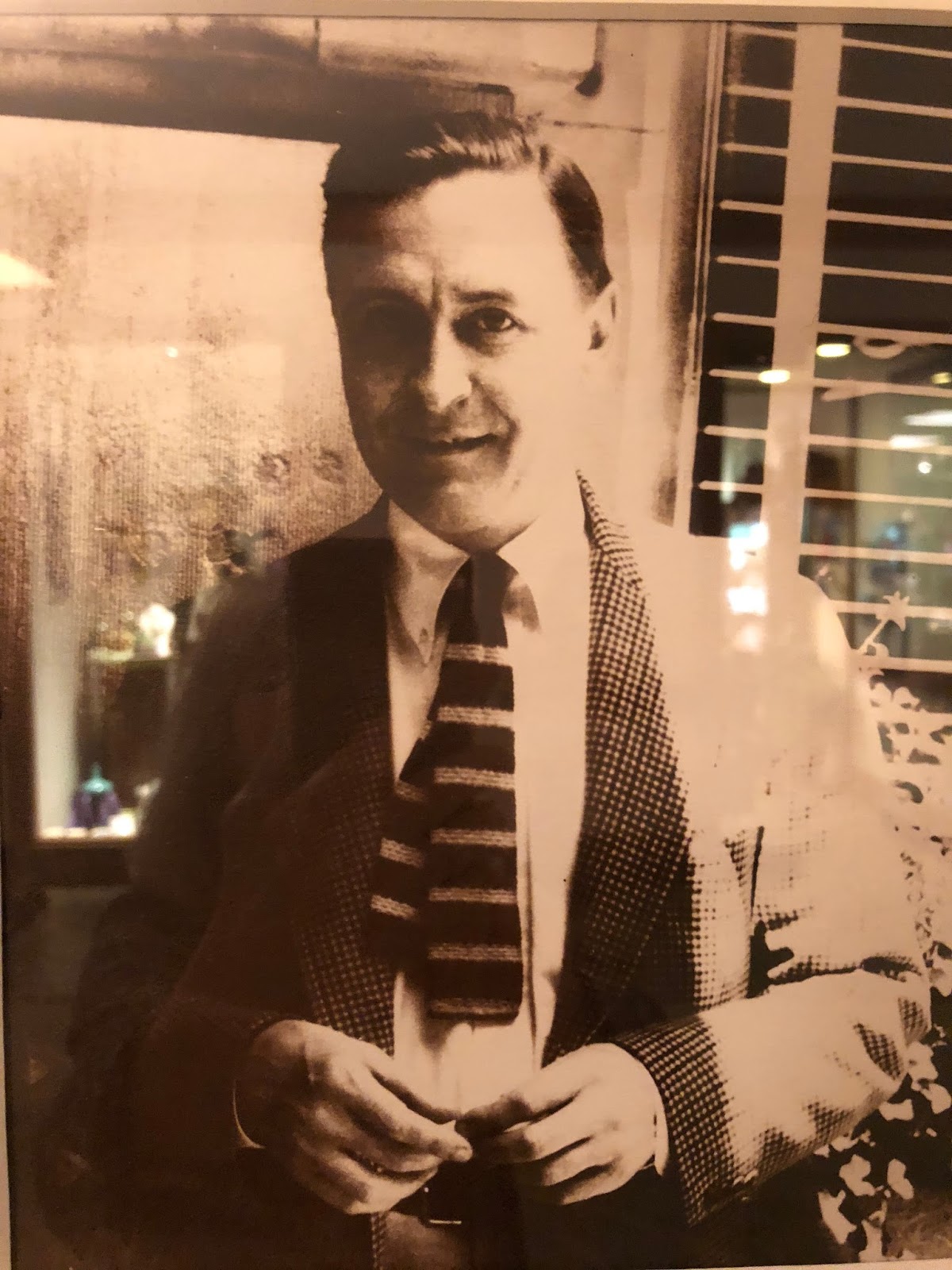
Author F. Scott Fitzgerald might take the prize for the most extended stay.  Fitzgerald's wife Zelda became ill and was admitted to Asheville's Highland Hospital.


Fitzgerald resided in Rooms 441 and 443 for a whole summer of 1936 to be close to her.


Now Tim and I can say we were guests at the Inn, too.


Tuesday, April 17, 2018

Greenville's Green Spaces


One of the benefits of our full-time RV lifestyle is the opportunity to visit friends around the country.


Tim and I recently spent four days in Greenville, South Carolina, visiting Tim's college roommate, Brent and his wife Lori.  You'd think that in that time I'd take a decent photo of them, but all I have is this snapshot of the backs of Tim and Brent taken at Furman University where Brent is a professor.  At least this photo shows a little of Furman's campus, a lovely green space made even more beautiful by the azaleas and pansies in bloom.


We fell in love with their city which is situated in the foothills of the Blue Ridge Mountains and especially two of its public parks.


Richard Pearis, a wealthy settler from Virginia, arrived in the area around 1754 to trade with the Cherokee Indians.


Over time the E in his surmane was dropped and now that name graces many entities in the city including nearby Paris Mountain State Park, a vantage point overlooking the city with a lake for canoeists/kayakers, picnic pavilions and numerous hiking/mountain biking trails.


Pearis built a grist and saw mill on the waterfalls of the Reedy River that later attracted textile mills.  At one time, 18 textile mills were operating within three mills of downtown Greenville, earning the city the sobriquet, The Textile Capitol of the World.


Today the jewel of Greenville's downtown is Falls Park on the Reedy, a 32-acre park and garden built around the waterfalls.


If you want an unobstructed view of the falls, climb up to the Liberty Bridge, a 355-foot suspension bridge that is supported by cables on only one side.


There's also the 20-mile Swamp Rabbit Trail which runs through the park.


The day we were there dozens of schoolchildren were picnicking on the greens, presumably after a visit to an event at the Peace Center, a performing arts venue adjacent to the park.


Once a textile mill town, Greenville, South Carolina has moved into the 21st century as a economic powerhouse.


Major corporations such as Michelin, General Electric and BMW have a presence there bringing more jobs for its growing population.  In fact, U. S. News has ranked Greenville 31st on its List of Best Places to Live and 13th on its List of Best Places to Retire.


Tim and I have added it to our own list of possible places to live after our life on the road ends.  We'd love to see the beauty of these spaces as the seasons change.