Showing posts with label VA. Show all posts

Thursday, May 3, 2018

On To Richmond!


St. Paul's Episcopal Church

"On to Richmond" was the battlecry of the Union troops once Petersburg fell.  After our time at Petersburg National Battlefield, Tim and I, too, headed to Richmond, the erstwhile capitol of the Confederacy.

Instead of touring the Civil War battlefields spread around the city, a project that would take several days, we joined a walking tour of the city, but that experience was not one that I'd recommend.  Yet I guess you get what you pay for and since the tour was free with a donation, I have no reason to complain.  At least it was an orientation to Richmond's downtown--


most notably the Capitol of Virginia,


the Confederate White House,


and the home of John Marshall, the 4th Chief Justice of the Supreme Court--even if the tour guide's spiel was less than compelling.

What was spellbinding were our visits to two National Park Service properties, first to Tredegar Iron Works and later to the home of Maggie L. Walker.


At Tredegar Iron Works, we learned why Richmond was worth fighting for.  Tredegar Iron Works on the banks of the James River was the Confederacy's most important foundry, churning out more than half the munitions that fueled the Confederate States Army.  In addition, it made the iron plating for the CSS Virginia, the South's first steam-powered ironclad warship.  Today the Tredegar houses two museums, one supported by the National Park Service and the other the American Civil War Museum.  Due to time constraints, Tim and I chose to visit the one maintained by National Park Service.  After all, I had to get the stamp in my NPS Passport.  We found the visitors center a fascinating look at why Richmond with its manufacturing and transportation infrastructure was such a prize in the Civil War.
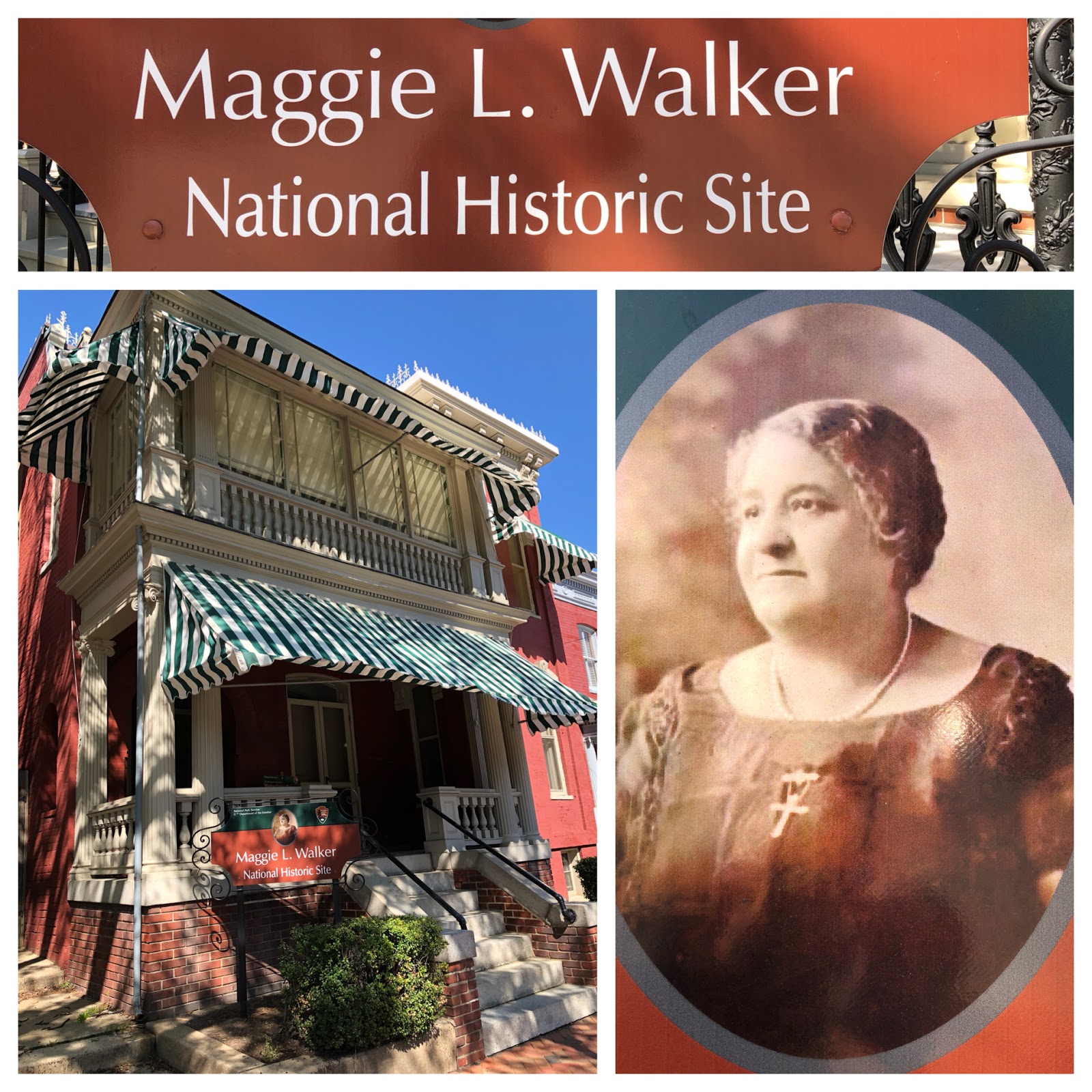

Later the same day, we stopped at a very different National Park property, the home of Maggie L. Walker.  Neither Tim nor I had ever heard of Mrs. Walker before and we were astonished by the incredible impact she had on the black neighborhood in Richmond's historic Jackson Ward.  In 1901 she boldly presented her community with an idea for economic empowerment:  "We need a savings bank, chartered, officered, and run by the men and women of the Order...Let us have a bank that will take the nickels and turn them into dollars."  In 1903 St. Luke Penny Savings Bank opened its doors--the first chartered bank in the United States founded by a black woman.

Of course, what caught Tim attention, former law enforcement officer that he is, was the suspicious death of Mrs. Walker's husband who was shot and killed by her son.  Allegedly, the son thought an intruder--not his father--was trying to break into the house.  But that's a little difficult to believe, given that the incident occurred in broad daylight and the fact that Mr. Walker's philandering ways were an embarrassment to the family.  The true story is buried by now but it does make one wonder what really happened.

Left: the hotel lobby
Right: the dome skylight

Friends told us that we ought to partake in a true Southern afternoon tea at the historic Jefferson Hotel.  Regretfully, when we arrived there, we discovered that the tea is only offered Fridays through Sundays--not on a Thursday, the day we were there.  So that's another reason, along with Richmond's battlefields, for us to return to this beautiful city at some future date.


With thoughts of what we'd missed at the hotel's Palm Court, we decided to pay a visit to Maymount, the grand Gilded Age estate that the wealthy owners James and Sallie Dooley willed to the city of Richmond.


There I could imagine Sallie Dooley presiding over her own afternoon tea with her invited guests of Richmond's elite.


I also found it interesting that the childless Dooleys never had to discourage children from crawling into their fanciful Swan bed with them.  Nor did they wrestle with the question of how parents with differing faiths should raise their progeny.


As it was, every Sunday James would have the carriage brought around to deliver Mrs. Dooley to the Episcopal worship service before he continued on to mass at the Catholic church.


Finally, and perhaps fittingly since it was our final stop on our Richmond itinerary, we made a pilgrimage to Hollywood Cemetery.  The cemetery situated on a bluff that overlooks the James River is the final resting place of two U. S. Presidents, James Madison and John Tyler, as well as the Confederate President Jefferson Davis.  Twenty-two Confederate generals including George Pickett and J.E.B. Stuart are also buried there.  We didn't visit them all, preferring to focus on the three presidents.


I thought the gravesite of Jefferson Davis would be the most impressive but on the day we visited, it was surrounded by construction tape as workers repaired the circular drive around it.


Instead, we found Madison's grave nicknamed "The Birdcage" the most impressive with its ornate Gothic Revival style.  It makes my plans to be cremated upon my death with my ashes spread as fertilizer over the east 80-acres of my family's farm seem very stark.  Ah, well!  Hopefully my day is far away!  On to Washington and Philadelphia where we have plans to spend the coming weeks visiting our children.


Tuesday, May 1, 2018

Petersburg Is the Key


"The key to taking Richmond is Petersburg" believed Civil War Union General Ulysses S. Grant.  Consequently, when his more direct forays against the capitol of the Confederacy failed, Grant swung his soldiers east and then south to lightly-defended Petersburg in a masterful move meant to sever the supply line of the rebel army.  It was arguably the one time Grant outmaneuvered the canny Confederate General Robert E. Lee.

The Eppes Plantation at City Point

On our way to Washington, Tim and I devoted a day to seeing how Grant did this.  Having lived in Virginia for more than fifteen years, we've become Civil War buffs.  Something about seeing the sites where major battles played out has given the war an immediacy that has captured our interests.  However, in all the time we lived here, we never made it to Petersburg, that is until now.  So beware!  The rest of this post is a history lesson of what impressed us the most about the siege.


With its proximity to the confluence of the James and the Appomattox rivers, Petersburg was a transportation hub that funneled what war materiels the South still possessed to Lee's ill-equipped rebel soldiers dug in at Richmond.  By the time of the Siege of Petersburg from June 1864 to April 1865, the freight of all but one railroad from the Deep South bound for the Confederate capitol passed through Petersburg.


When I was a child, one of our family vacations was a trip to Durango, Colorado, where my railroad-mad dad made reservations for us to ride the Durango & Silverton Narrow Gauge Railroad.  That ride  sparked my own interest in railroads and made me pay attention to the importance of the railroads at Petersburg.

To sever those rail lines, Grant laid siege to the city and made use of the dormant City Point section of the South Side rail line to build his own railroad to supply his troops.  This ability to build railroads as needed was another way more industrialized North surpassed the South. The railroads of the Confederacy, in keeping with its strict stance on states' rights, were not centrally controlled like those in the North.  To prevent their purchase by rivals, Southern railroad companies would lay track using different gauges, a business practice that proved detrimental to the Confederate war effort.

Plantation of Dr. Richard Eppes where Gen. Grant established his headquarters.

I found it interesting in our visit to Grant's headquarters at City Point that he chose to live in what looked like a shack instead of appropriating the plantation home of Dr. Richard Eppes for his personal quarters after the Eppes family fled to what they supposed was the safety of Petersburg.

Grant's Headquarters on the grounds of the Eppes' Plantation

So Grant built a short line from the wharfs he quickly constructed at City Point, the base for one of the greatest logistical operations of the Civil War.  There more than 100 ships a day dropped supplies of food, ammunition and supplies which were then ferried by rail to the Union Army entrenched on the east side of Petersburg.


Had the Union commanders pressed their advantage upon their arrival at Petersburg, the siege might not have been necessary, but alas they did not.  At 7 p.m. on June 15, 1864, the boom of Union cannons to the east foreshadowed an attack on the Dimmock Line.  Minutes later, the soldiers of the Union 18th Corps broke through the undermanned Confederates and swarmed over Battery 5, a fortified earthworks emplacement for heavy guns.


In the two hours that followed, the Federals captured 1.5 miles of Petersburg's defenses.  Though few Confederates stood between the Federals and the streets of Petersburg, Union Maj. Get. William F. Smith stopped his advance to await reinforcements.  Had he continued his momentum, nine months of tedious, deadly siege could have been avoided.


"We could blow that damn fort out of existence if we could run a mine shaft under it." ~ A private of the 48th Pennsylvania, June 23, 1864.


Spurred by the offhand suggestion of a former coal miner, Lt. Col. Henry Pleasants put his 48th Pennsylvania to digging.  Their objective was to tunnel under the Confederate line and blow up the battery at Elliott's Salient.

Such a plan stirred Tim's memory of his stint in the Army when he was assigned to the Corps of Engineers, the division that performs a variety of construction or demolition tasks under combat conditions.  Naturally, Tim was fascinated to learn that Pleasants' troops secretly proceeded with their plan literally right underneath the noses of the Confederates.


Beginning on June 25, 1864, and continuing for the next month, these Pennsylvania coal miners burrowed a shaft 511 feet into the hillside.  Then they packed four tons of powder into the magazines under the Confederate battery.  At 3:16 a.m. on July 30, Lt. Col. Pleasants lit the fuse and scrambled out of the tunnel.  After a 30 minute wait for the explosion to detonate, Pleasants concluded that the fuse had gone out.  With dawn approaching and at risk of losing the surprise attack, two volunteers, Lt. Jacob Douty and Sgt. Harry Reese, crawled into the tunnel to try lighting the fuse again.  This time it worked.  Two hundred and seventy-eight Confederates died in the explosion that created a crater measuring 170 feet long, 60 feet wide and 30 feet deep.  Two 1,700-pound cannons were hurled completely out of the works.


But instead of pushing through, the first waves of Union attackers simply stood at the Crater, gawking at the incredible scene they'd created and thus allowed the Confederates to regroup.

And so it went, first one side and then the other surged back and forth, but it was just a question of time.  With the arrival of spring, the beleaguered Confederates and the city fell.  Seventy thousand Americans were casualties at Petersburg.  Infection and disease accounted for the greatest number of deaths.

A window at the Eppes Plantation at City Point
By preserving the Petersburg National Battlefield, the National Park Service gave us a window to look back at this important event.  Two weeks later General Robert E. Lee surrendered at Appomattox Court House and the war ended.


Thursday, April 26, 2018

Yet Another One


Once again Tim and I have found a lovely state park.  We're headed north to Washington, D.C., for a visit with our children and a week of routine doctor appointments.


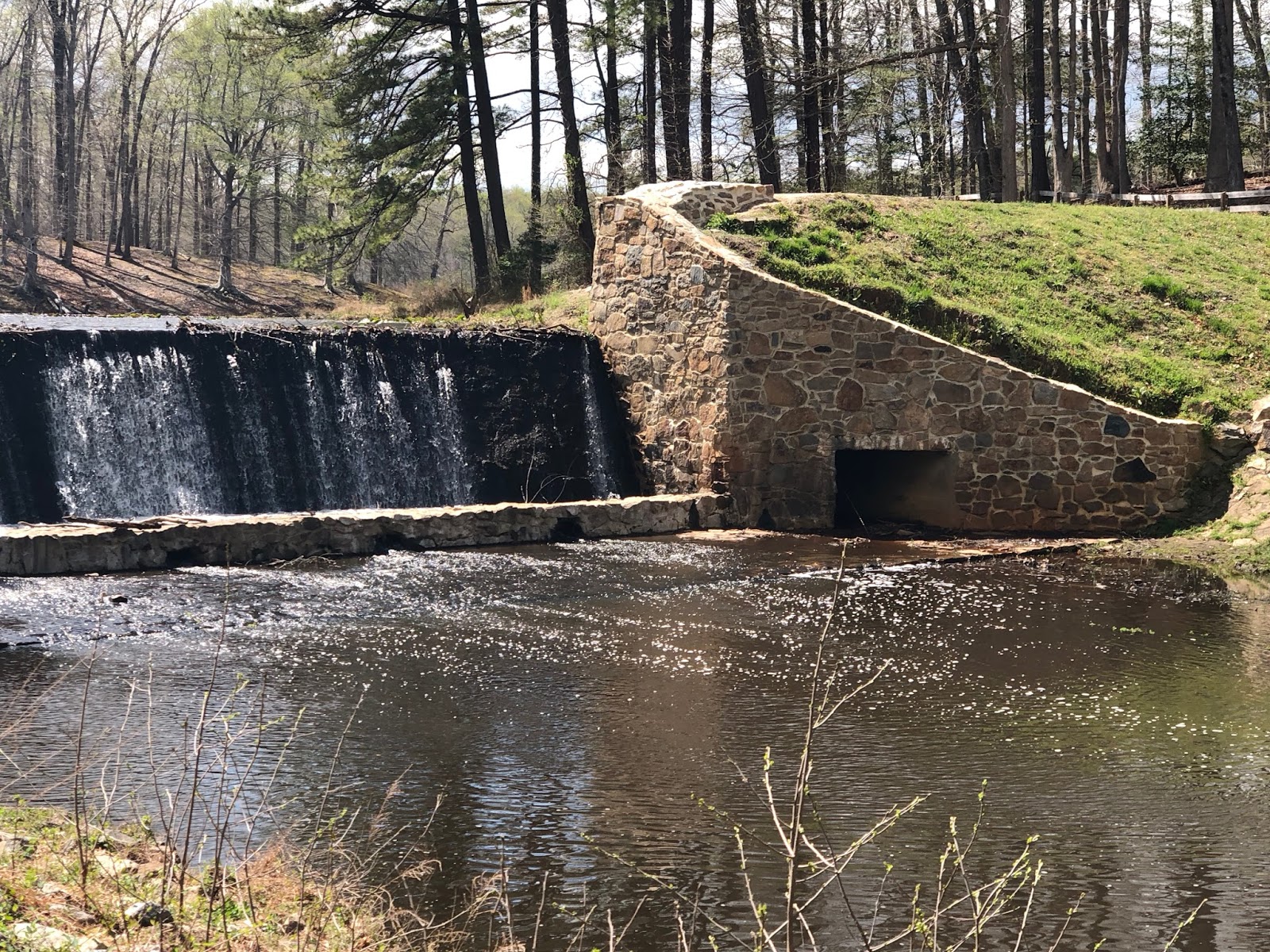
By making camp for a few days at Pocahontas State Park, we are almost there.  Plus, the park's location midway between Petersburg and Richmond, Virginia, gives us an opportunity to follow the final events of the Civil War.  More about that in forthcoming posts.  Today I'd like to share a little of the beauty we discovered at this park.


The wide roads leading to this campground were a bit of a relief.  Before I made our reservations last fall, I checked our truckers' atlas to make sure the road leading to the park was navigable by our big rig, the Dawntreader.  That research was inconclusive.  On the one hand, the route was not highlighted by yellow in the atlas, a sure sign that taking our big bus in that direction was not a good idea.  Yet, when I made our reservations on Reserve America, there were plenty of big-rig-friendly campsites in the park.  Clearly, previous rigs had navigated the questionable road into the campground safely so we decided we could, too.


And are we glad we did!  This park was perfect.  Big pull-through campsites with water and electric hook-ups, a dump station easily accessible and plenty of hiking trails to explore.


Our favorite was the  2.5-mile trail around the pretty-as-a-picture Beaver Lake.


We were almost sorry to leave, but Washington awaits and I'm looking forward to spending time with our family.

Sunday, April 30, 2017

Backroads To Beaches

Leaving Charleston via the Arthur Ravenel Bridge

Instead of hopping on Interstate 26 and then Interstate 95 from Charleston, SC, Tim and I took the backroads to return to Washington, D.C.  It's been a month since my cochlear implant surgery.  Now that the swelling has decreased, it's time to turn on the implant and see if it works.


But first, the beach!  By taking the backroads, we added Myrtle Beach, Nags Head and Virginia Beach to our itinerary.  Three beaches in three different states--South Carolina, North Carolina and Virginia!  If that doesn't make us beach bums, I don't know what will.

Myrtle Beach is the most popular destination along the Grand Strand, an arc of beaches that stretches 60 miles along the South Carolina coast, and a new experience for us.


Unbelievably, we scored a campsite at the end of a row in Myrtle Beach Travel Park, giving us an amazing view of the ocean from inside our RV, the Dawntreader.  

At lower left, Tim gazes at the moon.

Perfect for viewing the sunrise and later soaking up the sun!  We were reluctant to leave, but more beaches beckoned.

Jennette's Pier in Nags Head

So we figuratively pulled up anchor on the Dawntreader and sailed north to Nags Head.  Not only did we wish to experience the beach there, but we also wanted to pay homage to the Wright brothers who proved that flight was possible at Kitty Hawk.

The Wright Brothers' Memorial
Hailing from Kansas, I know what windy days are like, but the gusts of the Outer Banks could certainly match or exceed them.  The wind, the isolation and the sand made it easy to see why Wilbur and Orville picked this place to perfect their planes.  The winds provided lift, the isolation meant privacy from newspaper reporters and the sand softened their landings. 

From upper left: Replicas of the makeshift buildings used by the Wrights,
the park ranger, Tim & I at Memorial Rock,  the marker of the final flight's distance
In his talk, the park ranger at the National Park Service Wright Brothers Memorial brought the enormity of what these two brothers who never graduated from high school achieved.  These two co-owners of a Dayton, Ohio bicycle shop used what they observed of birds in flight and what they knew of balance from their familiarity with bicycles to solve a question that man has wondered about since the beginning of time.  Can man fly?  The Wrights turned that impossibility into absolutely possible.


Rain moved in on Sunday and the temperatures dropped so after attending church, we visited nearby Fort Raleigh, thus ticking off another National Park Service property from the list.  


Fort Raleigh is named for Sir Walter Raleigh who in 1584 was granted a charter by Queen Elizabeth to explore and establish an English settlement in the New World.  Although he never stepped foot on North America, he sent others to found Roanoke Colony, a colony that became known the Lost Colony when all trace of the settlement and its people disappeared.

Lost is also what happened to us when we made our way to Virginia Beach.  The GPS sent us through a maze of backroads that had us trapped before a bridge whose weight limit was 13 tons.  Yikes!  The Dawntreader weighs twice that.  But with cars lined up behind us, there was no alternative except to move forward.  Thank goodness, the bridge held but this is not an experience I wish to repeat.

Pam, Cindy, Tim and  Randy

Despite the chilly rainy days, we had a warm time with friends in Virginia Beach and Williamsburg.


Randy and Pam gave a a tour of the Navy ships in port at Norfolk; 


Then, they took us to a favorite waterfront restaurant for supper.  

Yas, Cindy, Tim and Ralph

Ralph and Yas, longtime friends from Washington, D.C. cooked dinner for us, giving us the chance to share life's journeys with one another.


Would we take the backroads again?  Absolutely!